

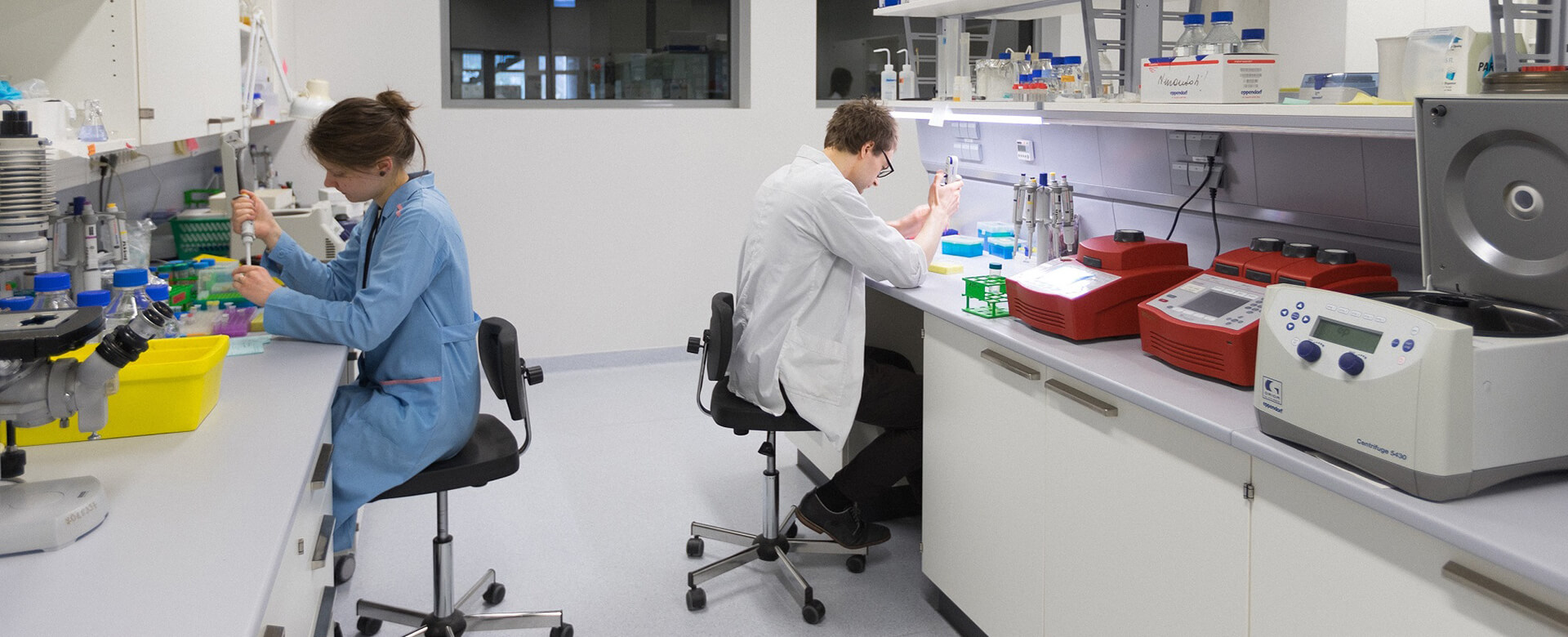
Doctoral (PhD) studies are third-level studies, and doctoral (PhD) students are postgraduate students and researchers. The purpose of doctoral studies is to train researchers capable of conducting independent research and experimental development, as well as solving research problems.
Doctoral studies at the Life Sciences Center of Vilnius University are oriented towards the quality of studies, flexible scheduling of the study process, and the establishment of a suitable academic environment. Doctoral students also enhance their knowledge through workshops, international events, scholarly projects, and educational work.
We are always looking for PhD students at our Center. If you would like to discuss possible research topics and opportunities, please get in touch with the Head of the laboratory and the department of your interest.
Organization of Doctoral Studies
Study Plan
- The doctoral student, together with their supervisor, prepares a study plan of postgraduate studies within two months from the start of doctoral studies according to the Regulations for Doctoral Studies at Vilnius University. The plan includes the study subjects to be covered and the timing of examinations (in quarters of the calendar year), the planned research programme and its stages, publication of results, and internships. The Committee must approve doctoral student work plans.
- The scope of doctoral studies amounts to at least 30 credits. Postgraduate studies must include at least three courses, and participants must acquire at least three credits through general skills development activities.
- You can choose courses from the list of subjects in any field of science offered for doctoral studies.
- The work plan is recommended to be designed in such a way that 5 credits of the 30 credits required would be acquired for the participation in general skills development activities (i.e., project application preparation, academic writing, academic ethics, intellectual property, entrepreneurship, communication skills, etc.).
- Credits for the development of general skills are included in the total amount of credits to be collected. Therefore, they must be listed in the study plan table. These listed activities do not need to be specifically named; it is sufficient to write “General competence skills development” and indicate the total amount of credits planned to be acquired. The teacher does not need to be specified either (it is possible to enter “will be determined”, “under consideration”, etc.). Credits for general competence skills development should be planned to be collected during the first three years of studies.
- Doctoral students who are studying for a PhD in the field of biochemistry and have not studied the programme of biochemistry before (during Bachelor’s or Master’s studies) must include a structural or functional biochemistry subject in their studies plan.
- All the works listed in the plan have to be carried out no later than the end of the study period. The scope of research results dissemination should be equal to that necessary for the defense of the dissertation.
- The original study plan signed by the doctoral student and his/her supervisor must be sent to the Doctoral School administrator in PDF format by the specified date. In addition to the work plan, all doctoral students must also present the consent forms of the supervisor and the consultant, as well as the list of publications.
- At the meeting dedicated to the approval of study plans, doctoral students usually give a short presentation on the background in their education, the study plan (the exams chosen, the research planned, and the problem being solved, aims, and objectives), and answer questions. The supervisor's participation in this meeting is highly desirable.
- The approved plans must be signed by the Chairman of the Committee and brought to the VU Department for Doctoral and Postdoctoral Studies.
Changes of Plan
- If a doctoral student does not take the exams during the study years according to their study plan, they must submit to the Committee a request to postpone the exam date, stating the reason for the delay.
- To change the subjects studied in the work plan, the doctoral student must submit a request for subject change, indicating the reason why, and a study plan after modifications to the Committee. Changes to the study plan may be approved only on the condition that the minimum number of credits required by the VU Regulations will be completed.
- A consultant may be assigned to the doctoral student at any stage of the studies, if necessary. For that, a request to the Doctoral Committee must be submitted together with the agreement of the desired consultant and a list of his publications. Any active researcher may be appointed as a doctoral consultant.
Progress Report
- Progress report of doctoral studies is reviewed in accordance with the doctoral student’s study plan by the Committee at the end of each study year.
- After each year of studies, the doctoral student submits a written progress report to the Committee according to the approved progress report form. This report, signed by a doctoral student and their supervisor, must be sent in PDF format to the LSC Doctoral School administrator by the end of September. Fourth year students must send their progress reports together with thesis draft till 15th of September.
- Doctoral students who are reporting for the last year of their studies must remember that they must pass all the examinations set out in the plan during their doctoral studies; otherwise, the study plan will be deemed to have not been completed. Doctoral candidates who have completed their final year of study must submit a manuscript of their dissertation with their report to the committee.
- The doctoral student has to give the presentation of the report to the Committee in the presence of the supervisor. If the supervisor is unable to attend such a meeting, he/she must provide the Committee with written feedback on the doctoral student’s work during the reporting period.
- Hearings of progress reports also include consideration of requests submitted by doctoral students (changing of work plans, postponement of examinations, credit granting, etc.).
Examinations
- The coordinator of the chosen course has to be contacted for taking the examination because they select the examination board, coordinate the date and time.
- The order regarding the examination board, date, and time has to be issued before taking the examination by the VU division in which the examination is taken. The Doctoral School administrator prepares orders of examinations taken at the LSC.
- All the information about the examinations taken at the LSC (i.e., the subject of the studies, the composition of the examination board, place, date, time, and form of the examination) has to be submitted to the administrator of the Doctoral School at least three days before the examination. If the examination is conducted as a seminar, the presentation title must also be reported.
- A copy of the order for taking the examination should be saved, especially if the order is prepared not at the LSC. All orders issued at the LSC can be found in the VU documentation system AVILYS.
- A record of each examination taken has to be filed in the doctoral programme examinations report, where the assessment received is written and signed by all the members of the board. A copy of the signed protocol must be sent to the doctoral studies administrator after each examination. Postgraduate students enrolled from 2022 onwards do not need to fill in an examination protocol paper form. The examination results are entered directly into the DVS AVILYS.
- After passing all the examinations, the doctoral programme examination report has to be brought to the VU Department for Doctoral and Postdoctoral Studies (Central building, Room 108). This remains for those who were enrolled before 2022. Before that, please
Scan your doctoral programme examination report and send it to the
Doctoral School.
General Competence Skills Development
- The Doctoral Committee must approve credits collected for the development of general competencies. Therefore, a doctoral student must submit a request for endorsing credits to the Doctoral Committee, listing all undertaken activities. It has to be supplemented with a table describing these general competence skills, the activities developed, and copies of the certificates or other documents confirming participation in the activities mentioned.
- The credits for transferable skills are calculated according to the table for calculating the credits.
- It is recommended that a request for an estimate of the number of credits and/or approval of general competency development credits be submitted to the Committee along with annual progress reports.
Academic Trips
- The Order by the Rector must be issued before any academic trip. To do this, you need to submit a filled-in and signed request for an educational trip. For the Rector’s Order to be drawn up, the request for the academic trip must be accompanied by a document confirming the availability of such a trip. It must contain information that the internship is arranged and that the event is held within the given time span (e.g., event programme, event information on the website, invitation from the organizers, registration documents, etc.).
- The request must include, if necessary, daily allowance and/or accommodation rental costs. It has to be written as indicated in the instructions given in brackets. The amounts per country can be checked in the law "Dėl dienpinigių ir kitų komandiruočių išlaidų apmokėjimo".
- The finances of the trip must be used during the days of the trip specified in the order (and the application). Arrival is possible no earlier than the day before the scheduled event, and departure is no later than the day after.
- The financial resources of mobility funds are coordinated, and the request has to be signed by Dr. Daiva Baltriukienė, Director of the Doctoral School.
- If you pay the conference fee yourself, the payment (as well as other travel-related expenses) must be made after the issue of the order from your bank account. Within five working days after the trip, you have to provide an account statement showing payment execution, and the Report on students' travel expenses (in Lithuanian) with financial documents of the actual costs incurred during the trip. LSC doctoral student field trip documents are handled by the administrator, Ilma Jonaitytė, tel. (0 5) 268 7008, .
- Fuel costs for expeditions around Lithuania for doctoral studies may be reimbursed from doctoral mobility funds. To do this, an order for the trip must be drawn up specifying the route, the car, and the car registration number. The costs of an additional return to Vilnius would not be refunded (accommodation costs may be reimbursed).
- If a planned trip for which an order has already been issued is cancelled or undergoes some changes, you must fill out a form to request a change to the order and submit it to the administrator of the Doctoral School.
Using Doctoral Funds
- Doctoral students financed by the state budget receive part of the funds for reagents, which are distributed through the Doctoral School according to the description approved by the Doctoral School Council.
- These finances may be used for doctoral studies through the Doctoral School by postgraduate students in their 1 to 3 year of studies funded by the state budget. Money cannot be spent by postgraduate students during the calendar year of admission (their funds will be transferred only next year), by EU-funded doctoral students (their studies are administered separately), or by postgraduate students during the last year (money is reserved for the defence of their dissertation).
- All purchasing must be made in accordance with the requirements of public procurement, through the LSC purchase requests system by filling out the request. Consultations are provided by a specialist in public procurement, Rasa Būdienė (; Room C513, tel.223 4425).
- The purchase of long-term equipment using doctoral funds must be planned according to the order describing the usage of these funds.
- The doctoral student and their supervisor must sign the invoice after purchasing according to the public procurement procedure. After affixing the accounting stamp (available at the Doctoral School, Room C504), the invoice should be signed by the materially responsible person. After collecting all the signatures, the invoice (together with the order contract, if necessary) must be delivered to Rasa Būdienė (Room C513). Payment invoices will be accepted there until the 1st of December.
- Finances for doctoral students whose studies are funded by the EU are administered separately by the LSC department to which the doctoral student is assigned. The administrator of the corresponding institute can consult about their spending.
Academic Leave
- Academic leave is granted for childcare or illness after presenting a child's birth certificate or a copy of the document from healthcare workers and applying for academic leave. During studies, a doctoral student may take a one-year academic leave for personal reasons upon providing only a completed request for educational leave. The request must be submitted at least 5 days before the leave is due, and the doctoral student may not take leave during the month for which the scholarship is received.
- The application for academic leave is filled in using a form approved by the VU. After filling in, this form must be signed by a doctoral student, their supervisor, and the person responsible for postgraduate students (the Chairperson of the Committee or the Director of the Doctoral School).
- Upon academic leave, the study period is extended accordingly. During academic leave, the doctoral student cannot have academic trips (in such a case, they have to return from leave).
- The filled-in request for return from academic leave form must be submitted to return to doctoral studies after academic leave. A doctoral student who has not returned after academic leave without a valid reason or academic trip for 15 days is expelled from postgraduate studies.
- A person who was on academic leave on the recommendation of a doctor, a medical advisory commission, or due to pregnancy and childbirth, or parental leave, and submits the request for the termination of doctoral studies before the expiry of the academic leave period, is exempted from paying the tuition fee.
Dissertation Defence
- For the organisation of the dissertation hearing and the preparation of the protocol, please get in touch with the PhD School Administrator.
- The dissertation is being prepared in accordance with the dissertation preparation guidelines and the dissertation template (Sorry, for now just in Lithuanian).
- The dissertation must be discussed in the LSC in the presence of the scientific supervisor and the consultant, and the protocol of the hearing must be prepared. After debates, it is decided whether the dissertation can be submitted for further defence.
- The Chairperson of the Committee, upon receiving the dissertation defence request together with the manuscript of the dissertation, will organise a meeting of the Committee within a maximum of two weeks (except for July and August), at which reviewers will be appointed. The scientific supervisor may recommend possible reviewers.
- The reviewers should submit their conclusions within one month. The PhD candidate must reply in writing to the reviewers to answer their questions.
- The dissertation should be presented by the PhD candidate at the meeting of the Committee, where, if the dissertation fulfills the requirements, the Committee should decide on the dissertation defence board, the date, the place, and the language of the defence, and submit it to the Rector of the University for approval. The scientific supervisor may recommend to the Committee the members of the defence board. The members of the defence board must have no conflict of interest with the PhD student or his/her supervisor, and preferably at least one member should be from a foreign research and study institution.
- After receiving the order, the PhD student prepares all the documents required for the defence (which are listed and their forms are available on the VU website) and takes them to the VU Doctoral and Postdoctoral Department at least 1.5 months before the scheduled defence. The dissertation is prepared and submitted for printing.
- The printed dissertation must be shared with the members of the Defence Board and the University Library (except for dissertations to be defended in closed session).
- The defence of the dissertation should be organised and audio-recorded by the staff of the Doctoral School.
- The dissertation defence documents and the audio recording of the meeting shall be returned to the VU Doctoral and Postdoctoral Department no later than one week after the dissertation defence.
- Within two weeks after the dissertation defence (except for dissertations defended in a closed session), the defended dissertation must be taken to the Martynas Mažvydas National Library of Lithuania and uploaded to the Lithuanian Academic Electronic Library (eLAB).
Organization of Dissertation Defence Externally
- If the doctoral student is not able to defend their dissertation during the studies period and within a year after the end of their studies, the dissertation is defended externally.
- After completing the application for permission to defend the dissertation on an external basis, all the necessary documents have to be prepared. The documents must be brought to the VU Department for Doctoral and Postdoctoral Studies (Central building, Room 108). The person responsible for doctoral studies directs the registered application, together with the provided documents, to the appropriate Doctoral Committee.
- Two reviewers shall be appointed at the Committee meeting. Their reviews should be submitted to the Committee. If reviewers conclude that the dissertation can be defended, the doctoral student must present it at the Committee meeting.
- If the Committee decides that the dissertation can be defended, it appoints the consultant, provides for or approves examinations, the composition of the Dissertation Defence Board, date, time, and language of defence during the meeting.
- After that, all the necessary documents (listed at the VU website) are prepared and have to be brought to the VU Department for Doctoral and Postdoctoral Studies (Central building, Room 108). Further defence procedures proceed in the usual way.
Document Forms
Documents:
Doctoral programme examinations report
Requests:
Application for academic leave
Request for return from academic leave
Request for the termination of doctoral studies
For Committee:
Request for the subject change
Request for the postponement of the examination
Table of activities improving general skills
Description of Study Course Units
Biology
Bioethics
Cell biology
Eukaryotic microorganism physiology
Genetically modified organisms
Human and animal physiology
Immunology (for Biology programme)
Immunotechnology (for Biology programme)
Laboratory animal science
Molecular and cellular biology of cancer
Molecular taxonomy of prokaryotes
Molecular virology
Molecular systematics
Protein structural bioinformatics
Biophysics
Biological psychology
Human and animal physiology
Molecular mechanisms of signal transduction
Neurobiology of sensation and perception
Ecology and Environmental Sciences
Algal ecology: fundamental and applied aspects
Application of biotechnology in ecology
Applied ecology
Ecological physiology of animals
Environmental risk assessment of chemicals
Geographic Information systems in environmental science
Population dynamics
Chemistry Engineering (Biotechnology)
Fundamentals and methods of genetic engineering