

Short Description: Bruker impact II VIP QTOF is a high-resolution time-of-flight mass spectrometer designed for accurate mass determination, identification, and analysis of various compounds in complex matrices. The mass spectrometer is compatible with liquid and gas chromatography, as well as a DART ionization system.
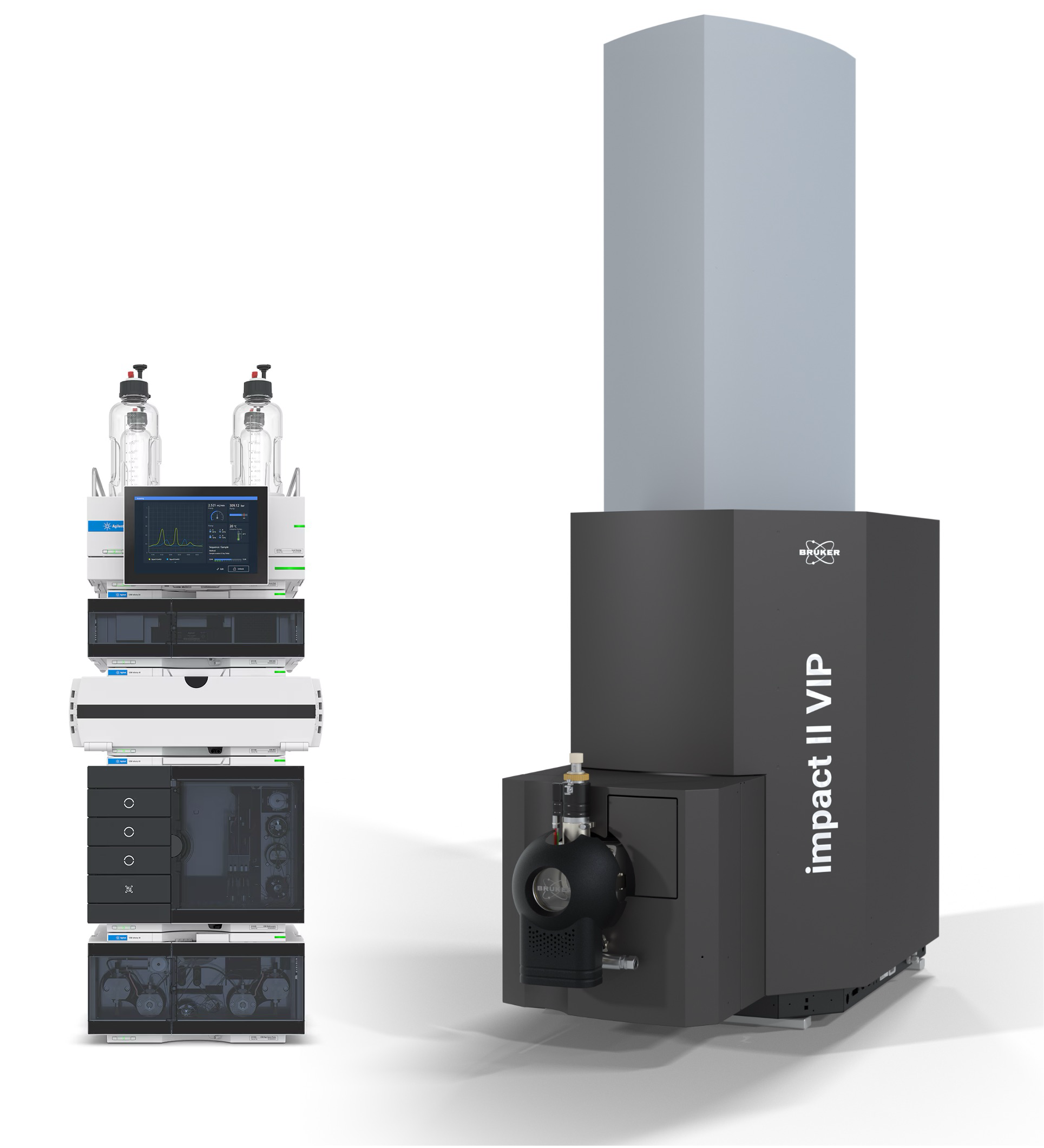 Produser: Bruker
Equipment Information:
Functions:
- Performs high-resolution accurate-mass MS and MS/MS measurements.
- Determines ion mass-to-charge ratios, isotopic patterns, and fragmentation spectra.
- Performs liquid and gas chromatography mass spectrometry analyses.
- Performs direct DART-MS analysis of samples without chromatographic separation.
Capabilities:
- The system is compatible with the Agilent 1290 Infinity III UHPLC system, enabling the combination of chromatographic separation with spectrophotometric and mass spectrometric detection.
- The Bruker 8500 gas chromatograph and GC-APCI ionization source enable the analysis of volatile compounds suitable for gas chromatography.
- The DART ionization system enables direct sample analysis without chromatographic separation.
- Interchangeable VIP-HESI, GC-APCI, and DART ionization sources allow the system to be adapted to samples with different properties and to a range of analytical tasks.
Purpose:
- Designed for the qualitative and quantitative analysis, accurate-mass determination, and identity confirmation of various organic compounds.
- Used in studies requiring high-resolution MS and MS/MS data, accurate isotopic pattern determination, and reliable compound identification.
- Suitable for the analysis of known and unknown compounds in chromatographically separated or directly introduced samples.
Applications:
- Accurate-mass determination and compound identity confirmation based on HRMS and MS/MS data.
- Targeted screening of known compounds and identification of unknown compounds in complex matrices.
- Monitoring of chemical reactions, including the detection of intermediates, final products, and by-products.
- Metabolomics, chemical profiling, and other untargeted analyses.
Operating Principle:
Sample components are first separated using a liquid or gas chromatography system or introduced directly using DART. The molecules are ionized by ESI or APCI, and the resulting ions are directed into the quadrupole. During MS analysis, the ions are transferred to the time-of-flight mass analyzer, where their mass-to-charge ratios are determined based on their flight times. During MS/MS analysis, the quadrupole selects specific precursor ions, which are fragmented in the collision cell. The resulting product ions are transferred to the time-of-flight analyzer, where their mass-to-charge ratios are determined according to their flight times.
Technical Specifications:
Mass range: 20–40,000 m/z.
Quadrupole isolation mass range: 20–3,000 m/z.
Resolving power: 60,000 FWHM at m/z 1222.
Mass accuracy: ≤1 ppm in both MS and MS/MS modes.
Acquisition rate: up to 60 spectra/s in both MS and MS/MS modes.
Dynamic range: 10⁵.
Software:
- Compass Hystar
- otofControl
- MetaboScape
- TASQ
VU ID: 8155808
Location: BVI 232
Core Facility: Continuous Flow Synthesis
Equipment is operated by Personnel only: Yes
It is allowed to work with the equipment independently after familiarization with the work process on site: No
Only those with the appropriate certificate/certificate are allowed to work with the equipment: Yes
There is an opportunity to participate in equipment usage training: No