

Short Description: Rotary vacuum evaporators designed for solvent distillation, removal, and sample concentration using evaporation flasks ranging from 50 mL to 5 L. Four different configurations allow users to select suitable evaporation conditions and achieve efficient solvent vapor condensation.
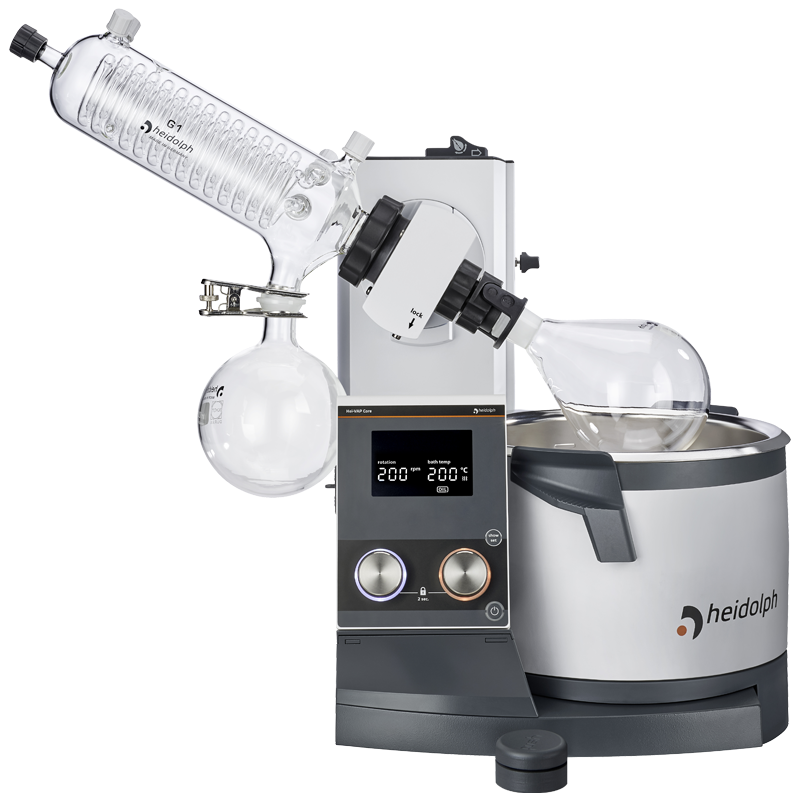 Produser: Heidolph
Equipment Information
Functions: Rotary vacuum evaporators designed for solvent distillation, removal, and sample concentration using evaporation flasks ranging from 50 mL to 5 L. Four different configurations allow users to select suitable evaporation conditions and achieve efficient solvent vapor condensation.
Capabilities: The equipment accommodates samples of various volumes (25 mL-2.5 L) and allows adjustment of evaporation flask rotation speed and heating bath temperature. Depending on the configuration, vacuum can be controlled manually or automatically to maintain a preset pressure. Some systems are equipped with recirculating chillers that provide controlled solvent vapor condensation while reducing water consumption.
Operating principle: The sample contained in the evaporation flask is rotated in a heated water or oil bath. Reducing the pressure lowers the solvent's boiling point, allowing evaporation at lower temperatures. Flask rotation creates a thin liquid film, increasing the evaporation surface area and improving heat transfer. The resulting solvent vapors are condensed in a cooled condenser, and the recovered liquid is collected in a separate receiving flask.
Applications:
- Concentration of organic synthesis reaction mixtures and solvent removal.
- Solvent distillation, separation, and recovery.
- Crystallization by solvent evaporation.
- Vacuum drying of powders and other solid materials using suitable accessories.
- Concentration of chromatography fractions.
- Concentration of plant and other natural product extracts.Sample preparation for chemical, biochemical, and instrumental analysis.
Technical Specifications:
- Evaporation flask capacity and rotation speed: Compatible flask volumes: 50 mL–5 L; rotation speed: 10–280 rpm.
- Heating system: 4.5 L heating bath; temperature range: 20–100 °C (water) or 20–210 °C (oil); temperature control accuracy: ±1 °C; heating power: 1,300 W.
- Vacuum system: Manual or automatic regulation of the preset pressure, depending on the configuration; equipped with Hei-VAC Valve Tec or Hei-VAC Vario Station vacuum systems.
- Condensation and cooling system: Diagonal (G1) or vertical (G3) condenser; condensation surface area: 1,400 cm²; selected configurations include Hei-CHILL recirculating chillers.
- Control and flask lifting: Digital control of rotation speed and heating bath temperature; 3.5-inch LCD display; manual or motorized flask lift with a travel range of 155 mm.
Equipment Configurations Available in the Laboratory:
- Hei-VAP Basic – A basic configuration with a vertical G3 condenser, manual flask lift, and manual vacuum control. Designed for routine solvent removal and concentration of reaction mixtures.
- Hei-VAP University Academic-Chill – A configuration with a diagonal G1 condenser, manual flask lift and vacuum control, and a Hei-CHILL recirculating chiller. Designed for standard solvent evaporation, academic research, and teaching applications.
- Hei-VAP Core Allround Chill – A configuration featuring automatic vacuum control, a vertical G3 condenser, manual flask lift, and a Hei-CHILL recirculating chiller. Suitable for distillation of various solvents and sample concentration when stable evaporation conditions are required.
- Hei-VAP Advanced Evaporation – A configuration with a motorized flask lift, a vertical G3 condenser, and a Hei-VAC Vario Station vacuum system that automatically maintains the preset pressure by adjusting the pump speed. Designed for more demanding distillation processes requiring precise and stable vacuum control.
VU ID: 8155752, Hei-VAP University Academic-Chill
Location: BVI 227
Core Facility: Continuous Flow Synthesis
Equipment is operated by Personnel only: No
It is allowed to work with the equipment independently after familiarization with the work process on site: Yes
Only those with the appropriate certificate/certificate are allowed to work with the equipment: Yes
There is an opportunity to participate in equipment usage training: Yes
Contact Scientist: Jonas Žurauskas
Contact email address:
Information for the User:
- An introductory safety briefing by the responsible person is mandatory before using the equipment. Only trained and authorized personnel are permitted to operate it.
- Adequate local exhaust ventilation must be provided when working with volatile, flammable, or toxic solvents.
- Appropriate personal protective equipment (safety glasses, protective gloves, and a laboratory coat) must be worn.
- Before operation, check the condition of the glassware, the tightness of all connections, and the proper functioning of the cooling system.
- The evaporation flask must not be filled beyond half its capacity. Vacuum pressure should be adjusted gradually to prevent sudden boiling, foaming, and sample carryover into the condenser.
- Use heating bath fluids recommended by the manufacturer: deionized water for water baths and suitable silicone oil for oil baths. If the overtemperature protection is triggered, identify the cause before resuming operation.
- After use, allow the heating bath to cool, clean the glassware, and dispose of collected solvents in accordance with the laboratory's chemical waste management procedures.
- Operation-Manual-Rotary Evaporator-Hei-VAP-Core
Additional Comments:
All systems are compatible with standard Heidolph glassware sets (G1, G3, G3 XL, G5, G6), with or without protective coating.