

Contacts: 4th floor C wing.
Life Sciences Center, Saulėtekio al. 7, LT-10257, Vilnius
About
The formation of the plasma membrane is considered a crucial event in evolution, and life as we know it would not be possible without it. Actual plasma membranes contain a complex, heterogeneous distribution of lipids and membrane proteins that interact to create critical biological functions. To investigate this complex membrane environment, significant progress has been made to model native membranes.
Our research group focuses on the development of nature-inspired models, in particular, surface-tethered phospholipid membranes (tBLM) and membrane-protein complexes exhibiting catalytic activities. The group addresses problems in basic life sciences and their applications in biomedicine. In particular, including sensor development for various endogenous and exogenous pathogens and ultrasensitive detection of microbial toxins (α-hemolysin (αHL), Vaginolysin (VLY), Pneumolysin (PLY), etc.).
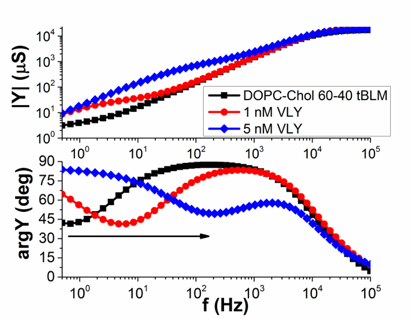
We offer a broad spectrum of technological solutions to reconstitute proteins into the tethered bilayer for structural and functional studies. Bioelectrochemical and Biospectroscopic techniques, along with relevant expertise, can be accessed by external users through the standard open-access procedures implemented at Vilnius University. We seek both academic and industrial partnerships to develop further molecular devices based on tethered bilayer technologies and to advance fundamental knowledge of protein function in biological membranes. In particular, we seek to establish partnerships with theoretical groups with expertise in modelling the structures of biomolecules in membranes and in predicting the dynamic properties of ion carriers in confined nanocompartments. Also, we aim to spread our technological knowledge into the areas of biochemistry and molecular biology, where the phospholipid milieu is required for the functional reconstitution of membrane proteins for structural and functional studies. Joint initiatives for EU and other international funding for research and technology development are also sought after.
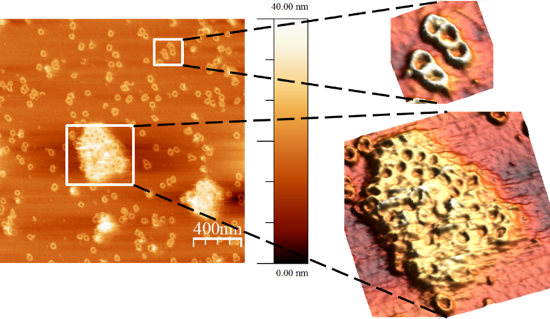 Our resources contain proprietary technology and compounds for the production of the self-assembled molecular anchors and tethered phospholipid bilayers. Broad spectrum of electrochemical and spectroscopy instrumentation for molecular level characterization of the structure and function of phospholipid bilayers, membrane-protein interaction, detection of membrane-damaging toxins, and surface visualization by fluorescence and atomic force microscopies. Proprietary algorithms and software for the analysis of the electrochemical impedance response of tethered bilayers.
Main Grants
- Research Council of Lithuania grant "Advanced Technology Development Program" project, B-38, AMILOIDE. (2008-2010). Project partners: LSMU Institute of Biomedical Science, LSMU Neurological Clinic, Institute of Biotechnology, Institute of Chemistry, and Institute of Physics. (Project Leader Dr. G. Valinčius).
- Research Council of Lithuania grant MIP project, MIP-11395, IMFABITE (2011-2012). Immobilized phospholipid bilayers for protein reconstitution. (Project Leader Dr. G. Valinčius).
- Research council of Lithuania grant National research programme "Chronic Non-Infectious Diseases" project, LIG-12048, MALPALMA (2012-2014) (Project Leader: Dr. R. Morkūnienė).
- MINIFOB funded by European Social Fund Agency, “Miniaturized phospholipid biosensors” (2013-2015), (Principal investigator: Dr. G. Valinčius).
- Biosentox (2017-2019) “Biosensors for toxin detection” funded by VU and Lithuanian business support agency (Principal investigator – G. Valinčius).
Personnel
Head of Department
Dr. Rima Budvytytė
senior researcher
+370 5 2234394
Research staff
| Habil. Dr. Gediminas Niaura research professor |
Dr. Giulio Preta senior researcher +370 52234402 |
Dr. Benjamin Francis Cooper senior researcher +370 52234402 |
| Dr. Marija Jankunec senior researcher +370 52234402 |
Dr. Tadas Ragaliauskas researcher +370 52234401 |
Dr. Božena Pavliukevičienė researcher +370 52234401 |
|
Dr. Tomas Sabirovas |
Dr. Rimgailė Tamulytė researcher |
Dr. Martynas Talaikis researcher |
PhD students
| Modestas Mažerimas | Evelina Jankaitytė | Ozlem Cinar Zeynep |
| Salwa Islam | ||
Technical staff
| Dr. Arūnas Bulovas biochemist |
Danutė Kurečkienė technician |