

Congratulations to our group member, Ingrida Zelionkaitė, who on July 2, 2025, successfully defended her doctoral dissertation titled "Exploring the Relationships between Hormonal Contraceptives and Emotional Functioning: a Psychophysiological Approach".
Scientific supervisor: Prof. Dr. Ramunė Grikšienė (Vilnius University, Natural Sciences, Biophysics).
Doctoral Defense Committee: Chair – Assoc. Prof. Dr. Robertas Guzulaitis (Vilnius University, Natural Sciences, Biophysics), Dr. Kastytis Dapšys (Republican Vilnius Psychiatric Hospital, Natural Sciences, Biophysics), Prof. Dr. Markus Hausmann (Durham University, United Kingdom, Natural Sciences, Biophysics), Dr. Eglė Mazgelytė (Vilnius University, Health Sciences, Medicine),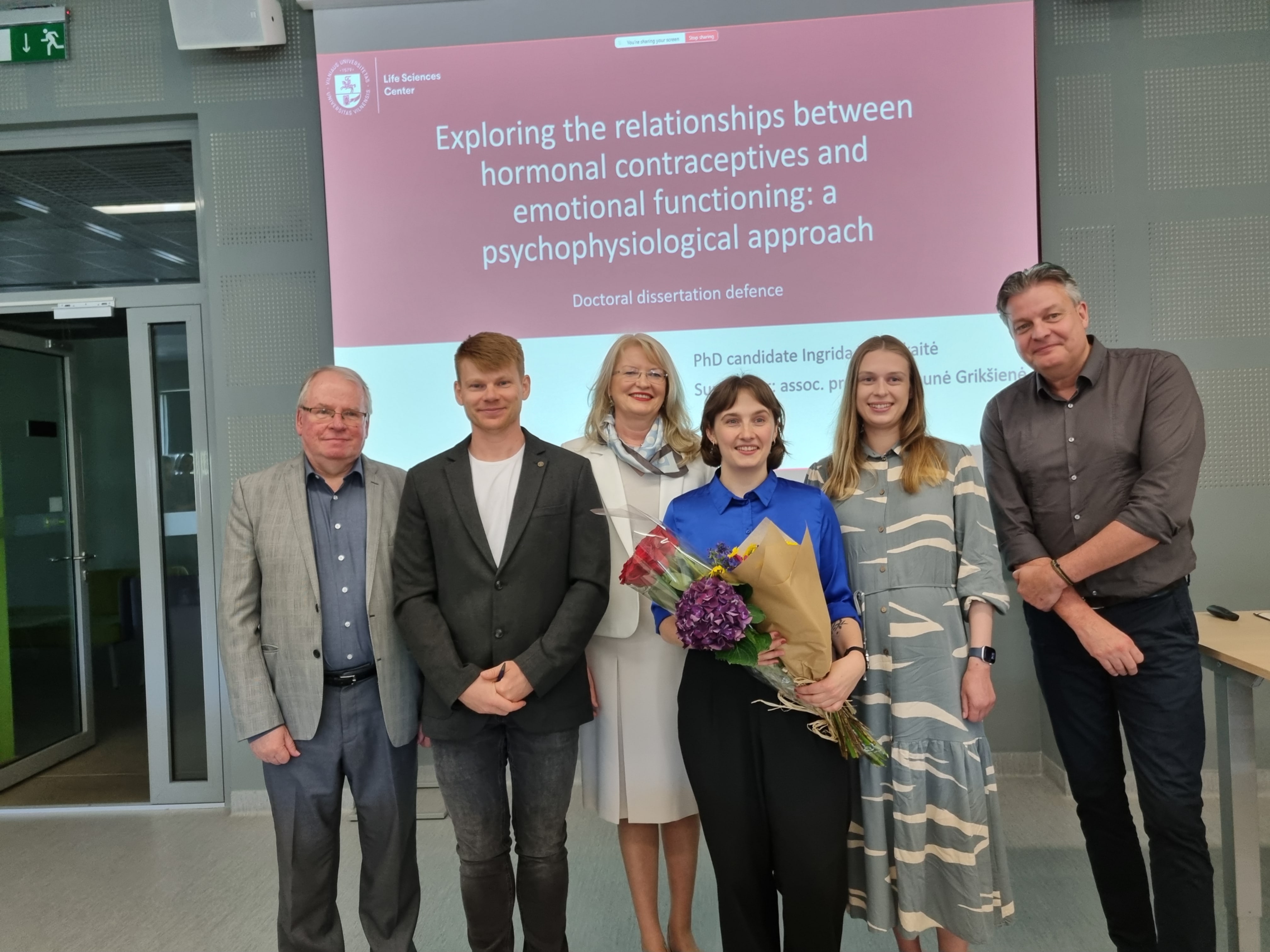 Assoc. Prof. Dr. Lina Zabulienė (Vilnius University, Health Sciences, Medicine).
Anotation
In recent years, the effects of hormonal contraception (HC) have received increasing scientific attention, with a growing focus on not only its physiological impact but also its potential implications for mental health. Worsening mental health, which may be linked to alterations in emotional functioning, is among the most frequently reported reasons for discontinuing the HC use.
This dissertation explored the association between HC use and emotional processing. The study included naturally cycling (NC) women in either the follicular or luteal phase, as well as women using oral contraceptives (OCs) or a hormonal intrauterine device (IUD). Data were collected using psychological questionnaires, self-report ratings, electroencephalography (EEG), and eye-tracking.
The findings revealed no associations between HC use and self-reported emotional or psychological parameters (such as alexithymia or emotion regulation habits). The evaluation of and reactivity to emotional images did not differ between NC and OC women, suggesting similar emotional perception and reactivity across these groups. However, EEG analyses showed that IUD-users exhibited greater attentional and cognitive control engagement during a cognitive emotion regulation task compared to NC and OC women. Eye-tracking data further revealed that OC-users spent less time looking at human faces in neutral and erotic images compared to NC women.
In summary, while general emotional functioning does not differ among women with different hormonal statuses, specific components such as attention and cognitive control may be modulated.
Together with the defense committee member Prof. Markus Hausmann from Durham University, UK, we took part in a tour of the Vilnius University Library and Central Campus.