

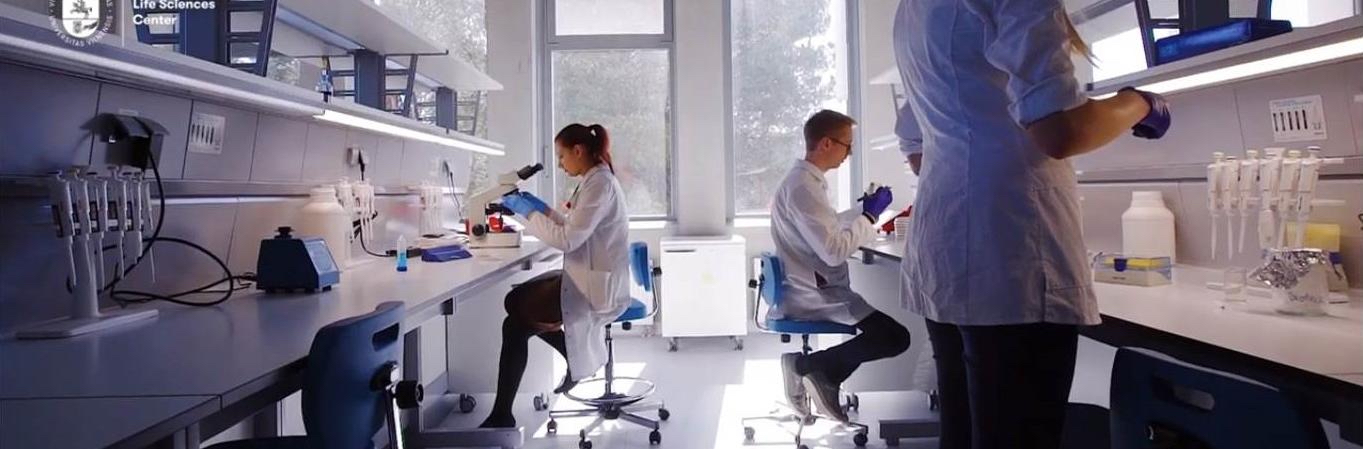
Science is a journey. Discover your career at VU LSC!
PROGRAMME DESCRIPTION
|
Programme type |
Master's |
|
Field of study |
Genetics |
|
Study area |
Life Sciences |
|
Degree |
Master of Life Sciences |
|
Duration |
2 years |
|
Workload |
120 ECTS credits, 770 contact hours, 2200 self-study hours |
|
Language of instruction |
English |
|
Location |
Life Sciences Center |
|
Starting date |
September 1st |
|
Tuition fee EU*/Non-EU students |
€5 538 / €6 500 per year |
| *EU citizens are entitled to apply for state-funded places | |
- The objective
To develop experience of the experimental work in genetics, which can be realised by original experimental work in various fields of genetics: molecular, plant, human genetics, or genetics of microorganisms, gene engineering, cytogenetics, and genotoxicology. The programme provides modern knowledge and practical skills in genetics necessary for an independent scientific and professional career in rapidly developing areas of genetic technologies, biomedicine, and biotechnologies.
- Career opportunities
A graduate is able to work in the field of biotechnological and biomedical industry, at research institutions of biomedical profile, as well as at educational institutions.
- Access to further studies
Analytical knowledge could be strengthened in doctoral studies in biology (genetics), molecular biology, or biochemistry.
KEY LEARNING OUTCOMES
A holder of a Master's degree in Genetics possesses a strong working knowledge of molecular, human, and plant genetics, cytogenetics, genotoxicology, and gene informatics, and is competent to conduct original investigations in the fields of theoretical and applied genetics, molecular biology, and genotoxicology. They have also acquired IT, teamwork, and critical and analytical thinking skills, are able to extend their knowledge without guidance, and are ready to take personal responsibility for their professional development.
VU LSC students of MSc Genetics can participate in the Coimbra Group Cancer Biology Project. The purpose of the project is to enable students to extend their knowledge and focus their studies and research in the field of Cancer Biology.
COURSE INFORMATION
The programme has the following structure:
|
Course Type |
1st Semester (30 ECTS credits) |
2nd Semester (30 ECTS credits) |
3rd Semester (30 ECTS credits) |
4th Semester (30 ECTS credits) |
|
Compulsory Courses |
Structure and Function of Eukaryotic Chromosomes (5) Genome Evolution (5) Oncogenetics (5) |
Genotoxicology (5) Big Data Analysis in Genomics (5) Term Research Project (10) |
Term Research Project (15) |
Master Thesis (30) |
|
Elective Courses |
Bioinformatics for Evolutionary Biology (5) Introduction for Data Analysis with R (5) Laboratory Animal Science (5) Advanced Therapeutics Medicinal Products & Regenerative Medicine (5)
Python for Data Science (5) Paleogenomics (5) Synthetic Biology (5) |
Advanced Biostatistics (5) Behaviour Genetics (5) Applied Plant Genetics and Genomics (5) Recombinogenesis and DNA Repair (5) Molecular and Genomic Medicine (5) Molecular Mechanisms of Aging and Rejuvenation Technologies (5) Advanced Therapeutics Medicinal Products & Regenerative Medicine (5) Cell Technologies (5) Microbiota research in health and disease (5)
|
All the same as in the 1st Semester |
EXAMINATION AND ASSESSMENT REGULATIONS
The main form of assessment is an examination. Every course unit is completed with either a written or a written-oral examination or a pass/fail evaluation. Students' knowledge and overall performance during the examination are assessed using a grading scale from 1 (very poor) to 10 (excellent).
APPLICATION AND SELECTION REQUIREMENTS
- Bachelor's degree or its equivalent in Life Sciences
- The following subjects or their close equivalents should be studied during Bachelor's studies (comprising no less than 30 ECTS credits in total): Molecular Biology, Bioinformatics, Cell Biology, Genetics, and a Bachelor's Thesis (Project). For each of these subjects, the grades must be at least 60% of the maximum possible grade.
- The average of the learning results during the Bachelor's degree must not be lower than 70% of the maximum possible grade.
- Applicants must submit a motivational letter for the study programme and at least one recommendation from his/her former supervisor or professor.
- Motivational interview.
-
N. B. for non-EU/EFTA applicants: the gap since you completed your Bachelor's degree should not exceed five years.