

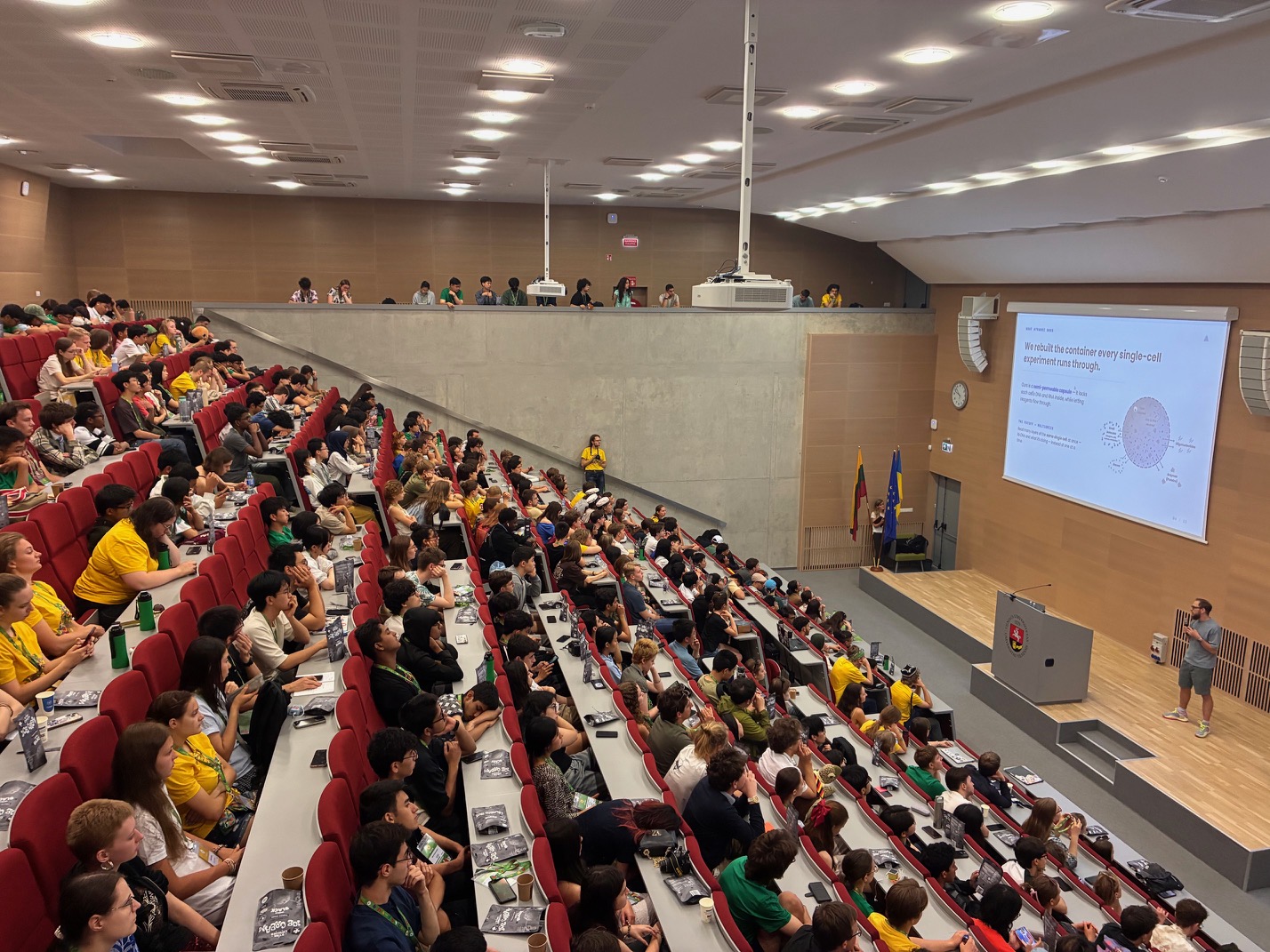
Participants of the International Biology Olympiad (IBO 2026) visited the Life Sciences Center of Vilnius University (VU LSC) on 17 July, where they took part in a special event, "What's Next?"
After an intensive week of competition, the world's most talented young biologists were invited to look beyond the Olympiad and explore life sciences from a broader perspective – not only as an academic discipline, but also as one of the key drivers of future economic growth, technological innovation, and societal progress.
During the event, scientists, biotechnology entrepreneurs, innovation experts, and young researchers shared their professional journeys – from their first laboratory experiments to international research collaborations and successful biotech startups. The central message of the event was clear: biology is no longer confined to the laboratory. Today's breakthroughs emerge where biology intersects with artificial intelligence, data science, engineering, and entrepreneurship to create solutions with tangible impact on society.
From curiosity to global innovation
The first part of the programme, "Inspiring Talks," showcased different paths shaping the future of life sciences.
Oskaras Belousovas, Head of the Vilnius-Lithuania iGEM team, introduced participants to iGEM, one of the world's largest synthetic biology competitions, demonstrating how student-led projects can evolve into internationally recognised biotechnology companies. Drawing on global success stories, he highlighted startups such as Ginkgo Bioworks, Colorifix, and Lithuania's own biomatter, illustrating how bold ideas can grow into companies developing AI-designed enzymes, sustainable manufacturing technologies, and other innovative biotechnology solutions for global markets.
Entrepreneurship and design thinking expert Lina Kižinienė delivered a talk titled "Creativity is Not a Talent," emphasising that creativity is not an innate gift but a skill that can be developed through curiosity, experimentation, and continuous learning. According to her, innovation rarely begins with a single brilliant idea – it grows from asking questions, embracing new perspectives, and consistently seeking better solutions.
Austė Šilkaitytė, Youth Entrepreneurship Education Specialist at Junior Achievement Lithuania, encouraged participants to think of entrepreneurship not simply as starting a company, but as solving real-world problems. She highlighted that biology can open diverse career paths – from research and bioinformatics to data science, innovation, science communication, policymaking, and biotech entrepreneurship.
Donatas Staniulis, Executive Director of the Vilnius-Utrecht Advanced Disease Modeling Center, stressed the importance of interdisciplinary collaboration in modern science. Meanwhile, Juozas Nainys, CEO of Atrandi Biosciences, shared how a scientific career can lead to building a globally recognised biotechnology company. He demonstrated that world-class life science innovations can be developed in Lithuania and successfully adopted by leading research institutions worldwide. According to him, artificial intelligence will dramatically accelerate our understanding of complex biological systems and enable the development of next-generation medical technologies.
The future of biology requires more than scientific knowledge
The second part of the event featured the panel discussion "Future of Bio Startups", where speakers explored the skills that the next generation of biologists will need.
The panelists agreed that biology alone will no longer be enough. Future scientists will need to understand artificial intelligence, analyse large datasets, collaborate across disciplines, and communicate their ideas effectively. The greatest breakthroughs occur when biologists work together with software developers, engineers, clinicians, and entrepreneurs.
Speakers repeatedly emphasised that the greatest value is created at the intersection of disciplines. Biology combined with AI accelerates scientific discovery; together with engineering it enables the design of novel biological systems; through data science it advances personalised medicine; and together with entrepreneurship it transforms scientific discoveries into products and solutions that benefit society.
The discussion also focused on the future of personalised medicine. According to the speakers, AI will help researchers better understand human biology, interpret increasingly complex datasets, and develop treatments tailored to individual patients.
Another important message was that scientific careers are rarely linear. Participants were encouraged not to fear changing directions, exploring different fields, or learning from failure. Curiosity, resilience, and the willingness to keep experimenting were identified as some of the most important qualities of today's scientists and innovators.
Inspiration for future biologists
The event concluded with an engaging discussion between speakers and Olympiad participants. Young biologists asked about career opportunities in biotechnology, the role of artificial intelligence in research, and how early-career scientists can contribute to solving global challenges.
The speakers encouraged students to remain curious, embrace difficult questions, and remember that the greatest discoveries begin with the desire to understand what has not yet been discovered.
At the Vilnius University Life Sciences Center, participants heard not only inspiring personal stories but also a clear vision of what it means to be a biologist in the 21st century. Tomorrow's biologist may become a researcher, AI specialist, bioinformatician, entrepreneur, startup founder, science communicator, or innovation leader. Above all, they will need the curiosity to ask bold questions and the ability to collaborate across disciplines to solve real-world problems.
That was precisely the question the "What's Next?" event set out to answer. It showed that the future awaiting IBO participants extends far beyond academic research – towards creating innovations, building companies, and developing technologies capable of transforming healthcare, industry, and society.