

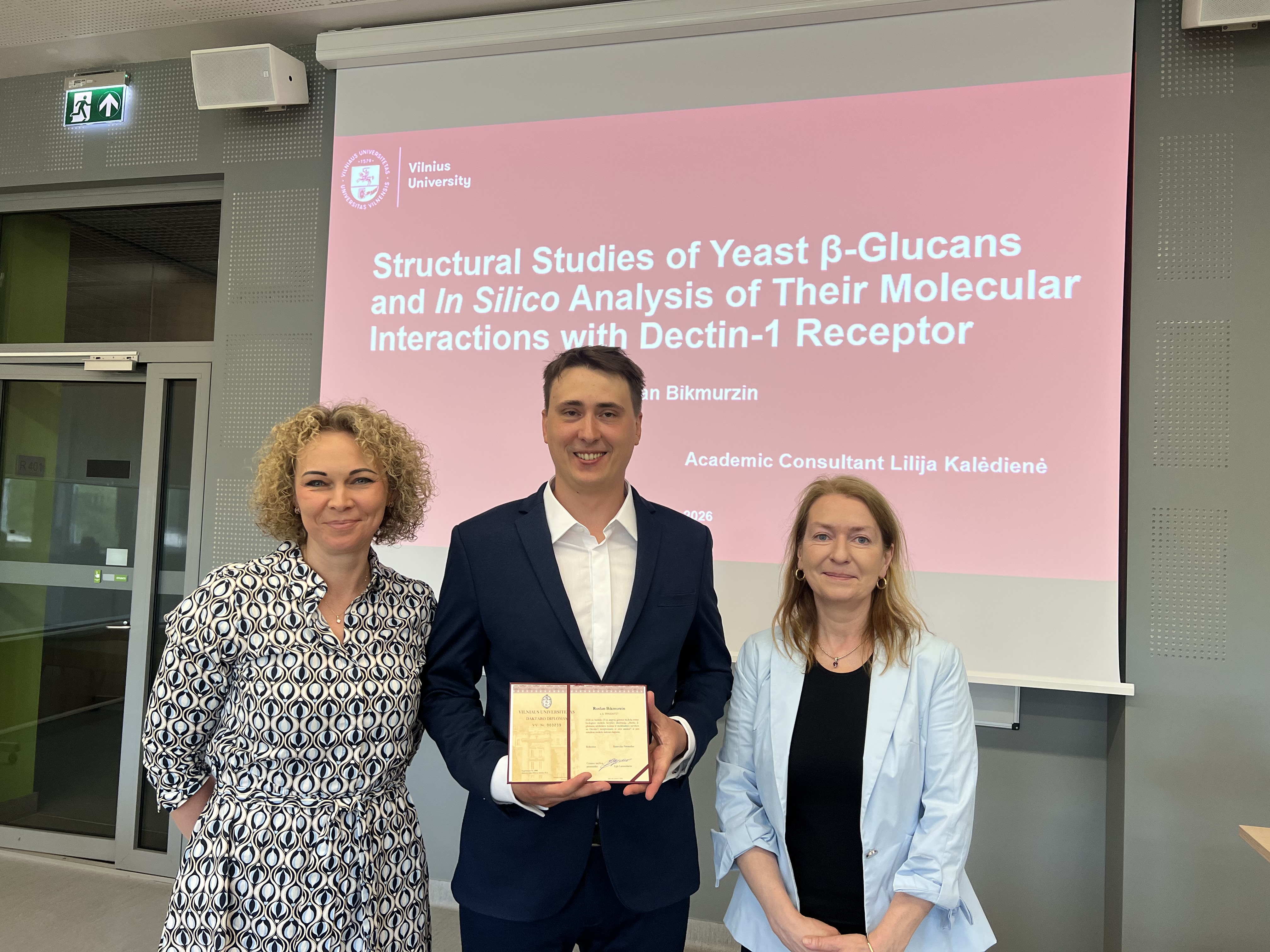
Ruslan Bikmurzin has defended his thesis entitled "Structural Studies of Yeast β-Glucans and In Silico Analysis of Their Molecular Interactions with Dectin-1 Receptor" for the degree of Doctor of Science in Biology.
Scientific consultant: Prof. Dr. Lilija Kalėdienė (State Scientific Research Institute Nature Research Center, Natural Sciences, Biology).
Composition of the Dissertation Defense Board: Chairperson - Prof. Dr. Eglė Lastauskienė (Vilnius University, Natural Sciences, Biology); Dr. Visvaldas Kairys (Vilnius University, Natural Sciences, Biology), Dr. Martynas Talaikis (Vilnius University, Natural Sciences, Biochemistry), Dr. Vaclav Vetvička (University of Louisville, USA, Natural Sciences, Biology), Dr. Auksė Zinkevičienė (Innovative Medicine Centre, Natural Sciences, Biology).
Biologically active molecules such as β-glucans have attracted increasing attention due to their ability to modulate immune system activity. β-glucans act as pathogen-associated molecular patterns (PAMPs) that are recognized by pattern recognition receptors (PRRs) of the innate immune system, such as Dectin-1. β-glucans isolated from different sources are classified as biological response modifiers (BRMs) because they can stimulate various immune system processes, including phagocytosis and cytokine synthesis. Due to these properties, β-glucans are being investigated as potential immunotherapeutic agents, functional food components, and vaccine adjuvants. However, detailed data on the relationship between their structural diversity and immune receptor activation are still lacking. Because the spatial structure, branching, and conformation of β-glucans can elicit different biological responses, it is necessary to study their structure–function relationships in detail. β-glucans' properties depend on the biological origin and the isolation method. Different β-glucan fractions can differ in their molecular weight, structure, branching, solubility, and immunological activity. β-glucans from Saccharomyces cerevisiae yeasts are among the most studied due to their well-known chemical structure and safety profile. In contrast, β-glucans from the genus Candida are medically and immunologically important.
This dissertation focused on the structural analysis of β-glucan fractions extracted from yeasts using different methods and analyzed using spectroscopic methods: ATR-FTIR and 13C solid-state nuclear magnetic resonance (ssNMR). In addition, the ability of β-glucans to interact with the dimeric form of Dectin-1 receptor was assessed using in silico methods: molecular docking and molecular dynamics (MD) simulations. These methods not only reduce the use of experimental animals but also provide detailed insights into molecular interaction mechanisms.