

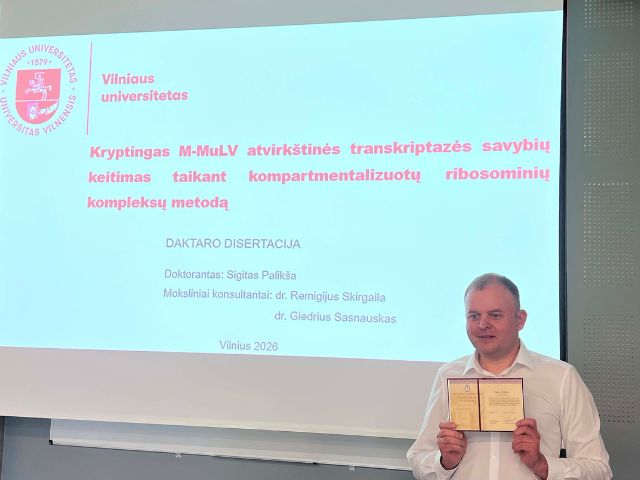
Sigitas Palikša has defended his thesis entitled "Directed evolution of the M-MuLV reverse transcriptase using the compartmentalized ribosome display" for the degree of Doctor of Science in Biochemistry.
Scientific consultants: Dr. Giedrius Sasnauskas (Vilnius University, Natural Sciences, Biochemistry), Dr. Remigijus Skirgaila (UAB Thermo Fisher Scientific Baltics, Natural Sciences, Biochemistry).
Composition of the Dissertation Defense Board: Chairperson - Dr. Mindaugas Zaremba (Vilnius University, Natural Sciences, Biochemistry); Dr. Rūta Gerasimaitė (Max Planck Institute, Germany, Natural Sciences, Biochemistry); Prof. Dr. Rolandas Meškys (Vilnius University, Natural Sciences, Biochemistry); Prof. Dr. Saulius Serva (Vilnius University, Natural Sciences, Biochemistry); Dr. Giedrius Vilkaitis (Vilnius University, Natural Sciences, Biochemistry).
In vitro evolution is one of the most effective approaches for modifying protein properties. In the research described in this dissertation, a novel method for compartmentalized ribosomal complexes was applied, combining ribosome display technology with compartmentalization techniques. Using this method, the target protein can freely interact with the substrate during the experiment, while the genotype–phenotype link is maintained by a physical barrier. The compartmentalised ribosomal complexes method was applied for the directed evolution of M-MuLV Reverse Transcriptase properties.
During the selection of thermostable reverse transcriptase mutants, new mutations increasing protein resistance to high temperatures were identified. By combining the most beneficial point mutations, multiple mutants were constructed that exhibited strong substrate interaction, high processivity, and the ability to synthesise cDNA at substantially higher temperatures compared to the wild-type protein. In another experiment, mutants capable of efficient cDNA synthesis at low concentrations of deoxynucleoside triphosphates were selected. Most mutations accumulated in the protein active site, while the ability to function efficiently at low substrate concentrations resulted from increased affinity for the dNTP substrate.
The results of the conducted evolution experiments demonstrate the method's potential for selecting proteins with desired properties and reveal similarities to the principles of natural evolution.