

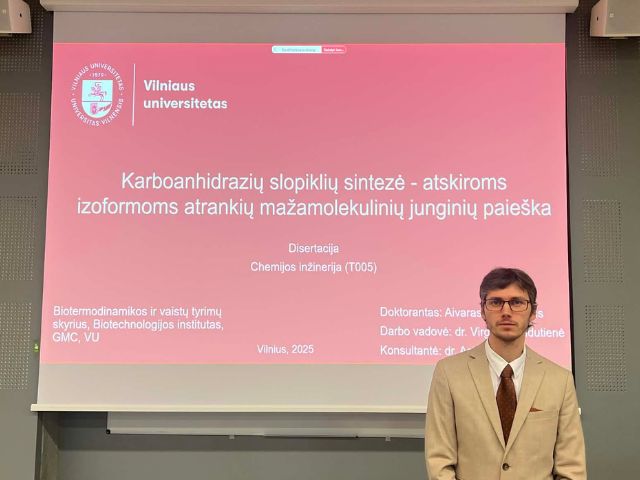
Aivaras Vaškevičius defended his thesis entitled "Development, Characterization and Application of New Monoclonal Antibodies Against Indoor Allergens for Diagnostic Purposes" for the degree of Doctor of Science in Chemical Engineering.
Scientific supervisor: Dr. Virginija Dudutienė (Vilnius University, Technology Sciences, Chemistry Engineering).
Composition of the Dissertation Defense Board: Chairperson - Prof. Dr. Eglė Arbačiauskienė (Kaunas University of Technology, Nature Sciences, Chemistry); Assoc. Prof. Dr. Rima Budvytytė (Vilnius University, Natural Sciences, Biochemistry), Dr. Gražvydas Lukinavičius (Max Planck Institute, Germany, Technology Sciences, Chemistry Engineering), Assoc. Prof. Dr. Denis Sokol (Vilnius University, Technology Sciences, Chemistry Engineering), Assoc. Prof. Dr. Ieva Žutautė (Vilnius University, Technology Sciences, Chemistry Engineering).
In this work, the synthesized covalent inhibitors were designed to target the inhibition of carbonic anhydrase IX/XII isoforms. To the best of our knowledge, these are the first covalent inhibitors developed for the selective inhibition of carbonic anhydrase IX/XII isoforms. In contrast to traditional covalent inhibitors, the compounds produced in our laboratory possess a masked “warhead” that can form a covalent bond only after being activated by the carbonic anhydrases themselves. Moreover, due to the carbamate/carboxylic acid fragments released during activation, these compounds could potentially be applied not only as carbonic anhydrase inhibitors but also as carriers for cytotoxic agents to cancerous tissues.
Another important finding was the ability of the compound 2-((2,3,5,6-tetrafluoro-4-sulfamoylphenyl)sulfonyl)ethyl acetate to react with primary amines to form 5,7,8-trifluoro-4-substituted-3,4-dihydro-2H-benzo[b][1,4]thiazin-6-sulfonamide 1,1-dioxides. According to literature data, similar compounds are obtained from 1-substituted-4-((2-chloroethyl)sulfonyl)-2,3,5,6-tetrafluorobenzene and primary amines.
The work carried out contributes to the development and advancement of new strategies for inhibiting carbonic anhydrase.