

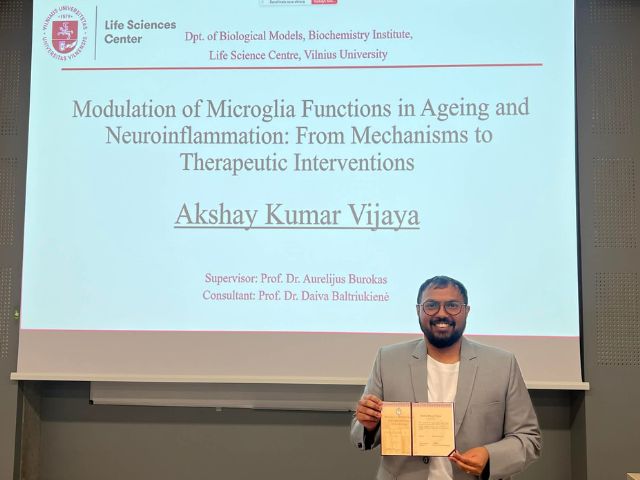
Akshay Kumar Vijaya has defended his thesis entitled "Modulation of Microglia Functions in Ageing and Neuroinflammation: From Mechanisms to Therapeutic Interventions" for the degree of Doctor of Science in Biochemistry.
Scientific supervisor: Prof. Dr. Aurelijus Burokas (Vilnius University, Natural Sciences, Biochemistry).
Scientific consultant: Prof. Dr. Daiva Baltriukienė (Vilnius University, Natural Sciences, Biochemistry).
Composition of the Dissertation Defense Board: Chairperson - Dr. Veronika Viktorija Borutinskaitė (Vilnius University, Natural Sciences, Biochemistry); Assoc. Prof. Dr. Robertas Guzulaitis (Vilnius University, Natural Sciences, Biophysics), Dr. Ainhoa Plaza-Zabala (University of the Basque Country, Spain, Natural Sciences, Biochemistry), Prof. Dr. Danielius Serapinas (Lithuanian University of Health Sciences, Medical and Health Sciences, Medicine), Dr. Laura Cutando (Autonomous University of Barcelona, Spain, Natural Sciences, Biochemistry).
Aging fundamentally alters microglial cell activity by promoting chronic neuroinflammation, metabolic changes, and reduced functional capacity, all of which contribute to the development of neurodegenerative diseases. This dissertation examines the interaction between aging, diet, the gut microbiota, and the endocannabinoid system in influencing microglial cell functions and evaluates therapeutic interventions that target these processes.
First, using APP/PS1 mice as a model for Alzheimer’s disease, it was found that long-term supplementation with the next-generation probiotic Akkermansia muciniphila reduced anxiety-like behavior, improved cognitive performance, and decreased hippocampal microglial cell density. To precisely analyze aging-associated microglial states, an optimized protocol for isolating microglia from the brains of aging mice was developed, ensuring high purity and the preservation of the in vivo resting phenotype.
In aging mice, long-term exposure to a high-fat diet induced anxiety, memory impairments, and dysbiosis. In microglial cells, it reduced phagocytosis, increased reactive oxygen species production, and accelerated cellular senescence. Prebiotic supplementation (galactooligosaccharides and fructooligosaccharides) mitigated these behavioral, microglial functional, and microbiota alterations by preserving beneficial bacteria and restoring microglial activity.
Finally, it was shown that modulation of the endocannabinoid system regulates microglial functions in an age-dependent manner: CB1 and CB2 receptor agonists differentially affected phagocytosis and oxidative stress in young versus aging cells.
This work provides an integrated assessment of the interplay between aging, the gut microbiota, and the endocannabinoid system in the context of microglial function and regulation. Filling these knowledge gaps is crucial for developing new, personalized therapeutic strategies that aim to reduce age-related neuroinflammation and neurodegenerative processes.