

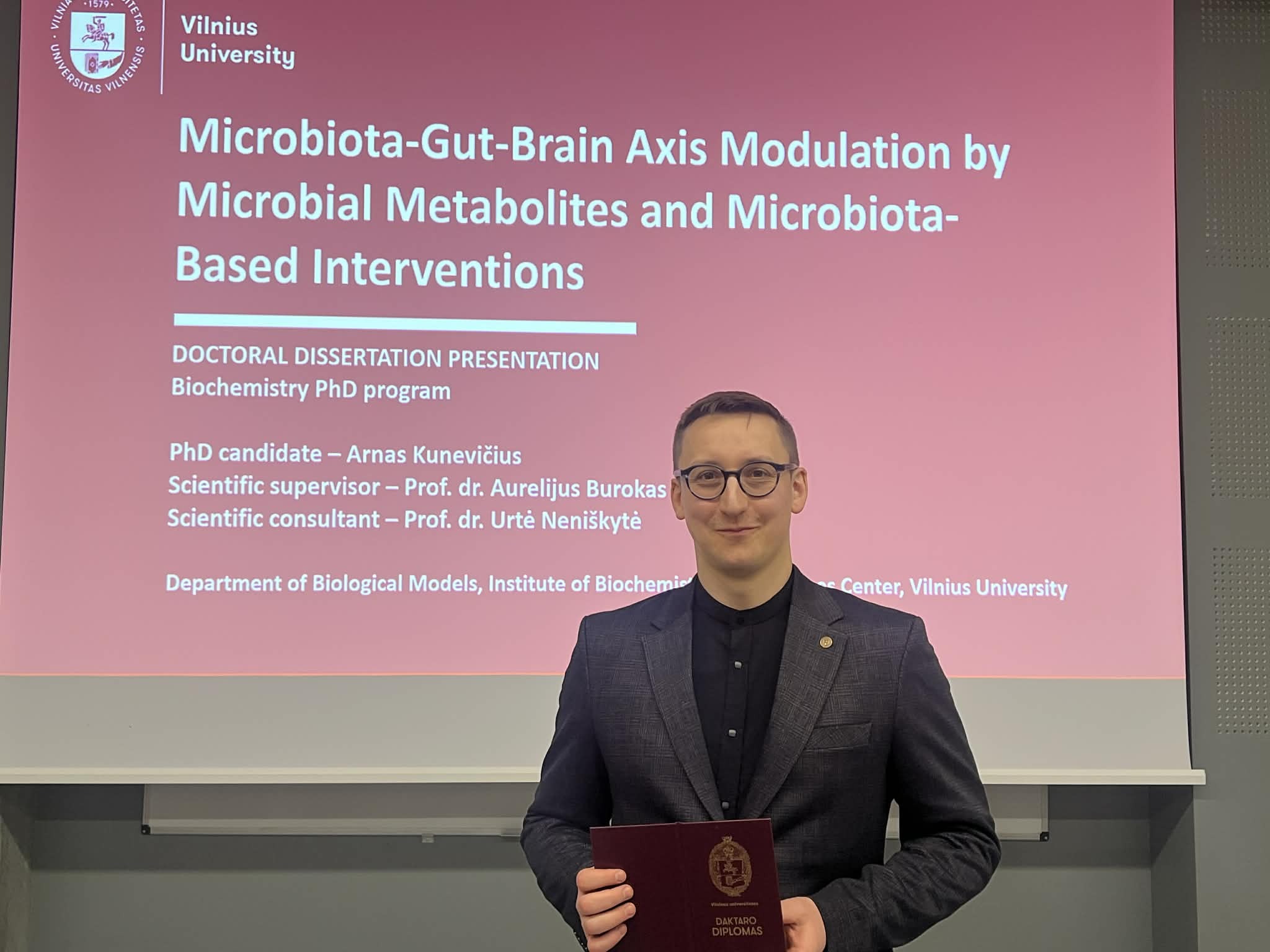
Arnas Kunevičius has defended his thesis entitled "Microbiota-Gut-Brain Axis Modulation by Microbial Metabolites and Microbiota-Based Interventions" for the degree of Doctor of Science in Biochemistry.
Scientific supervisor: Prof. Dr. Aurelijus Burokas (Vilnius University, Natural Sciences, Biochemistry).
Scientific consultant: Prof. Dr. Urtė Neniškytė (Vilnius University, Natural Sciences, Biochemistry).
Composition of the Dissertation Defense Board: Chairperson - Prof. Dr. Julija Armalytė (Vilnius University, Natural Sciences, Biochemistry); Prof. Dr. Renata Gudiukaitė (Vilnius University, Natural Sciences, Biology), Assoc. Prof. Dr. Robertas Guzulaitis (Vilnius University, Natural Sciences, Biophysics), Prof. Dr. Jan Manuel Rodriguez Parkitna (Maj Institute of Pharmacology, Polish Academy of Sciences, Poland, Natural Sciences, Biochemistry), Dr. Jonita Stankevičiūtė (Vilnius University, Natural Sciences, Biochemistry).
This dissertation investigated the role of the gut microbiota in CNS disorders. We found that children in Lithuania with autism spectrum disorder (ASD) exhibit reduced microbiota diversity, noticeable alterations in metabolic profiles, and a decreased number of beneficial bacterial species. Fecal microbiota transfer experiments showed that ASD-associated microbiota can induce long-lasting changes in microbiota composition, the metabolome, and behavior in healthy adult mice. In addition, prenatal exposure led to sex-specific alterations in the offspring’s gut and plasma metabolomes, behavior, and hippocampal gene expression. Both fecal transfer models revealed significant changes in amino acid metabolites, particularly those related to tryptophan. Therefore, we further examined indole metabolism and identified metabolites capable of crossing the blood–brain barrier and entering the brain. To highlight the potential of microbiota-based interventions, we demonstrated that Akkermansia muciniphila and galactooligosaccharides improved gut function, increased microbiota diversity, and reduced cognitive and behavioral impairments in a mouse model of Alzheimer’s disease. In summary, our data provide evidence that the gut microbiota and its metabolites regulate the host’s metabolic profile, brain physiology, and behavior, and that microbiota-targeted interventions may represent a promising strategy for treating CNS disorders.