

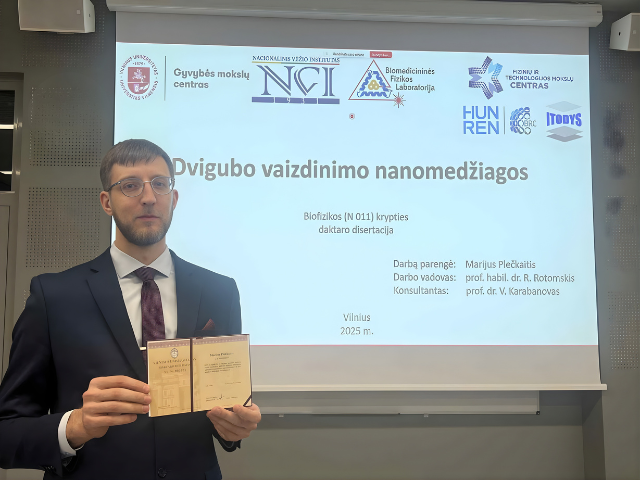
Marijus Plečkaitis has defended his thesis entitled "Nanomaterials for Bimodal Imaging" for the degree of Doctor of Science in Biophysics.
Scientific supervisor: Prof Habil Dr Ričardas Rotomskis (Vilnius University, Natural Sciences, Biophysics – N 011).
Scientific consultant: Prof Dr Vitalijus Karabanovas (National Cancer Institute, Natural Sciences, Biophysics – N 011).
Composition of the Dissertation Defense Board: Chairperson - Prof Dr Aidas Alaburda (Vilnius University, Natural Sciences, Biophysics – N 011); Dr Renata Karpicz (Vilnius University, Natural Sciences, Physics – N 002); Prof Dr Vilma Kisnierienė (Vilnius University, Natural Sciences, Biophysics – N 011); Assoc Prof Dr Lina Mikoliūnaitė (Vilnius University, Natural Sciences, Chemistry – N 003); Assoc Prof Dr Mindaugas Tamošiūnas (University of Latvia, Latvia, Natural Sciences, Biophysics – N 011).
Early diagnosis and intervention of cancerous lesions are key factors that increase patient survival. Since individual imaging methods used in clinical practice are often not effective enough for early cancer detection, researchers are developing various dual- or multimodal imaging contrast agents that can combine different imaging techniques, thus compensating for the limitations of one method with the advantages of another. Accordingly, the aim of this dissertation was to evaluate the potential of different dual-imaging nanomaterials for cancer diagnostics. The experiments investigated magnetic iron oxide nanoparticles decorated with gold nanoclusters (MN-AuNCs), as well as upconverting nanoparticles doped with rare-earth metals and coated with maghemite nanocrystals. These materials were biocompatible in vitro with cells, and although they did not exhibit specificity toward cancer cells alone, they combined optical and magnetic resonance imaging modalities. Moreover, MN-AuNCs generated reactive oxygen species under light exposure, capable of inducing cancer cell death, thus making them promising theranostic nanomaterials due to their combined dual-imaging and therapeutic properties. The third type of nanomaterials studied—molecular TPPS4 aggregates—self-assembled in an acidic environment into a unique sea urchin-like structure featuring a tubular central core and long branching filaments. The TPPS4 aggregates exhibited fluorescence as well as second and third harmonic generation properties, therefore they can also be classified as dual-imaging nanomaterials.