

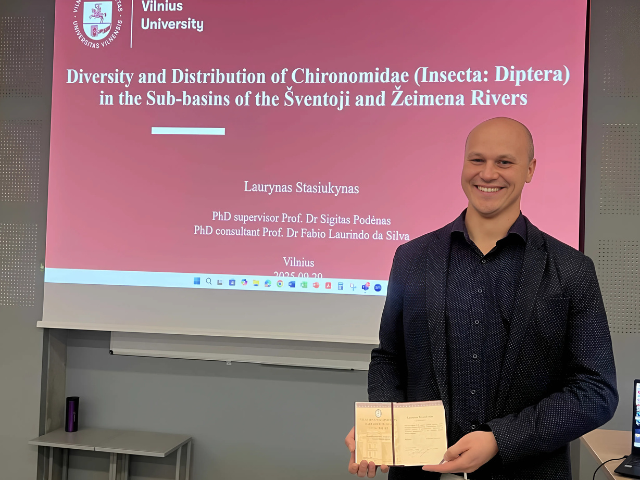
Laurynas Stasiukynas has defended his thesis entitled "Diversity and distribution of Chironomidae (Insecta: Diptera) in the Šventoji and Žeimena rivers sub-basins" for the degree of Doctor of Zoology.
Scientific supervisor: Prof. dr. Sigitas Podėnas (Vilnius University, Natural Sciences, Zoology – N 014).
Scientific consultant: Prof. dr. Fabio Laurindo da Silva (University of São Paulo, Institute of Biosciences, Natural Sciences, Zoology, N 014).
Composition of the Dissertation Defense Board: Chairperson - Dr. Rasa Bernotienė (State Scientific Research Institute Nature Research Centre, Natural Sciences, Zoology, N 014); Dr. Justas Dainys (State Scientific Research Institute Nature Research Centre, Natural Sciences, Ecology and Environment, N 012); Dr. Zigmantas Gudžinskas (State Scientific Research Institute Nature Research Centre, Natural Sciences, Ecology and Environment, N 012); Dr. Valeria Lencioni (Museo delle Scienze, Trento, Italy, Natural Sciences, Zoology, N 014); Dr. Virginijus Sruoga (Vilnius University, Natural Sciences, Zoology, N 014).
Lithuania is characterized by a dense river network, which plays a crucial role in maintaining and protecting biodiversity. The hydrological, physical, and chemical properties of rivers—such as water temperature, pH, substrate type, dissolved oxygen concentration, electrical conductivity, and salinity—directly influence the composition and functioning of organism communities in river ecosystems.
However, the diversity of aquatic macroinvertebrates—particularly non-biting midges (Diptera: Chironomidae)—and the relationships between their communities and environmental factors in Lithuania have so far been little studied.
Non-biting midges are one of the most important and widely distributed insect groups in aquatic ecosystems, characterized by high species diversity, population abundance, and ecological plasticity. They play a significant role in shaping macroinvertebrate community structures, decomposing organic matter, and serving as valuable bioindicators for assessing the condition of aquatic habitats.
This dissertation presents, for the first time in Lithuania, a systematic analysis of Chironomidae diversity and distribution in six rivers of Eastern Lithuania (Dubinga, Kiauna, Luknelė, Plaštaka, Skerdyksna, and Šešuola), evaluating the influence of ecological, physical, chemical, and hydrological factors—including river impoundment—on their communities.
The results of this study provide a deeper understanding of Chironomidae community structures, enrich the faunistic data of the country, and open possibilities for a broader application of this insect group in assessing river ecological status and the impact of human activities on aquatic ecosystems.