

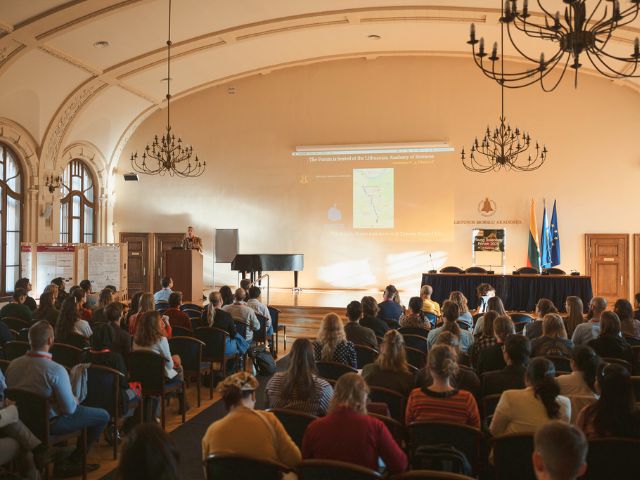
On September 24–26, Vilnius is hosting the EMBO Young Scientists Forum, bringing together researchers to discuss topics with real-world impact: the discovery of new viruses, genome editing technologies, and molecular mechanisms that help us understand and treat human diseases.
The forum is gathering more than 100 young scientists from 20 European countries. It is organized by an international team of researchers, including Dr. Gytis Dudas, Dr. Patrick Pausch, Dr. Algirdas Toleikis, and Dr. Stephen Knox Jones Jr., who emphasize that the forum is a unique opportunity to showcase cutting-edge research in Lithuania and to build new partnerships.
Research shaping the future
Today’s technologies allow what once took years to be done faster and more precisely. Yet, as Dr. Gytis Dudas reminds, the key question always remains – what do these data mean for people? His lab is studying orthomyxoviruses, distant relatives of influenza, and is exploring which of them may infect vertebrates.
“We have found that the Sinu virus, discovered in mosquito populations in South America, is likely able to infect a wide range of vertebrate organisms. Meanwhile, our favorite, the Wuhan mosquito virus 6, although it seemed dangerous at first, does not infect vertebrates,” Dr. Dudas explains.
Dr. Patrick Pausch specializes in genome editing. He points out that CRISPR and other tools are already being applied in medicine and agriculture – from therapies for inherited diseases to genetically improved crops resistant to drought and pathogens.
Returning from the UK, Dr. Algirdas Toleikis is pioneering a new research direction in Lithuania – studying DNA motors, proteins responsible for mechanical work inside cells. Their malfunction is linked to cancer and other diseases.
Dr. Stephen Knox Jones Jr. highlights the responsibility that comes with gene editing: “The technology can be precise, but the most important question is understanding what exactly should be changed. In nature, diversity is a strength.”
Why Vilnius and why EMBO
The forum organizers agree – organizations such as EMBO and EMBL (European Molecular Biology Laboratory) are an investment in Europe’s future.
All four scientists connect their careers with Lithuania and international networks. Dr. Pausch emphasizes that CRISPR research in Lithuania is world-class, and collaboration strengthens Europe’s competitiveness. Dr. Dudas values the opportunity to combine computational analyses with laboratory experiments and reminds that even seemingly unnecessary studies often lead to unexpected breakthroughs – from yeast used in beer to mechanisms that helped create CRISPR.
Dr. Toleikis sees Lithuania as a place to expand a new research direction – the study of DNA motors. Meanwhile, Dr. Stephen Knox Jones Jr., who has relocated permanently from Texas, notes that scientists in Lithuania feel valued, unlike in the U.S. where science can become a target of political debate. He adds that EMBO helps researchers benefit from each other’s strengths more effectively and at lower cost.
While science is often imagined as work in the lab, the researchers stress the importance of in-person connections. “The most important collaborations start not in formal meetings, but over coffee after a talk,” Dr. Pausch says. “Shared dinners and discussions of successes or failures often grow into unexpected ideas,” Dr. Dudas adds.
The forum is not only about presentations. It is about friendships and new ideas that may grow into tomorrow’s therapies, technologies, or even strategies to prevent future pandemics.
About the forum
The EMBO Young Scientists Forum brings together the next generation of researchers from across Europe. The program includes talks by internationally recognized scientists and ERC grant holders, as well as presentations by young researchers showcasing their work. Scientific sessions, discussions, practical workshops, networking, and social activities create a unique environment where conversations and idea exchanges serve as a launchpad for future breakthroughs in health and biotechnology.