

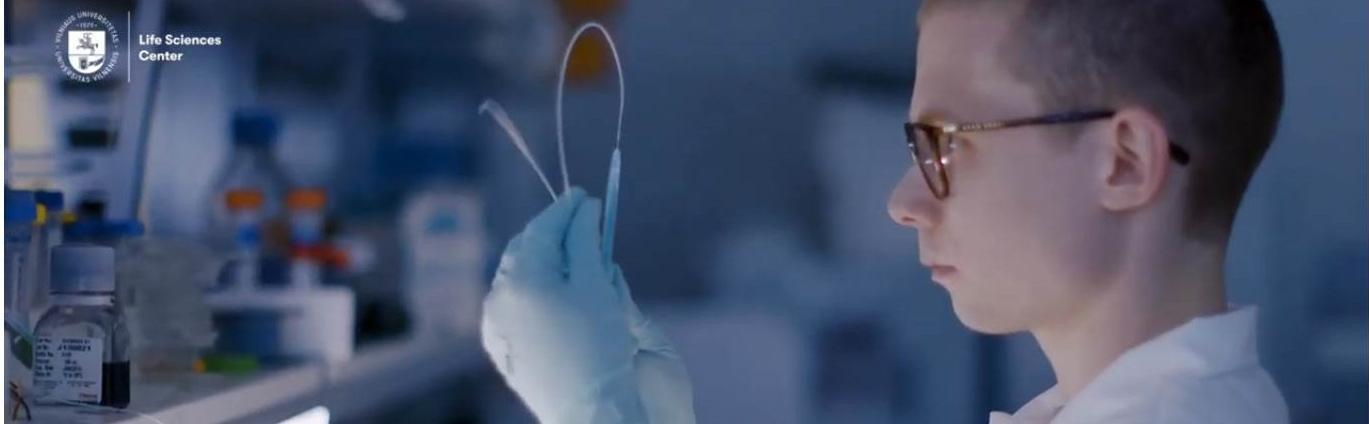
Science is a journey. Discover your career at VU LSC!
PROGRAMME DESCRIPTION
|
Programme type |
Master's |
|
Field of study |
Biotechnology |
|
Study area |
Technological Sciences |
|
Degree |
Master of Technological Sciences |
|
Duration |
2 years |
|
Workload |
120 ECTS credits, 220 contact hours, 1780 self-study hours |
|
Language of instruction |
English |
|
Location |
Life Sciences Center |
|
Starting date |
September 1st |
- The objective
To train professionals who would like to experience what studying a doctorate might be, whilst at the same time allowing them to earn a highly valuable master's level qualification for their career in industry.
The uniqueness of the program lies in its study approach, which is based on individual interdisciplinary specialization tailored to students’ interests through projects in laboratories and individual contact hours (mentoring).
Graduates of this program will be able to plan and conduct a research project, understand and construct a methodology, analyze and present results to the scientific community and society, effectively cooperate with scientists, engineers, and managers, and contribute to interdisciplinary teams in solving complex tasks.
- Career opportunities
A graduate is highly skilled for work in the biotechnological industry and trading companies.
- Access to further studies
The programme is designed for students progressing to PhD studies.
KEY LEARNING OUTCOMES
A holder of a Master's degree in Molecular Biotechnology has good working knowledge in biotechnological processes and is competent to carry out independent and original investigations in the field of Theoretical and Applied Biotechnology. They also have acquired IT, teamwork, critical and analytical thinking skills, are able to extend their knowledge without guidance, and are ready to take personal responsibility for their professional development.
COURSE INFORMATION
The study programme has the following structure:
|
Course Type |
1st Semester (30 ECTS credits) |
2nd Semester (30 ECTS credits) |
3rd Semester (30 ECTS credits) |
4th Semester (30 ECTS credits) |
|
Compulsory Courses |
Preparation and Management of Biotechnological Projects (5) Bioethics and Biosafety (5) Elective unit I (5) Elective unit II (5) Elective unit III (5) Project I (5) |
Development of Biotechnology Business (5) Elective unit I (5) Elective unit II (5) Elective unit III (5) Project II (10) |
Project III (30) |
Final Thesis (Project IV) (30) |
|
Elective Courses* (based on fixed contact hours) |
Advanced Light Microscopy (5) Analytical Biochemistry (5) Biocatalysis (5) Biomolecular Simulations (5) Biomolecules: Structures and Functions(5) Biosensors (5) Thermodynamics of Protein Interactions with Ligands (5) Cell Biology (5) Eukaryotic Cell Proteomics and Cell Regulation (5) Fundamentals of Clinical Trials (5) Genome Engineering Using CRISPR-Cas Systems (5) Human Biology (5) Immunotechnology (5) Lipid Technology and Its Application (5) Microbial Bioactive Compounds (5) Molecular Diagnostics (5) Molecular Medical Microbiology (5) Non-globular Proteins (5) Protein Expression Systems (5) Protein Structural Bioinformatics (5) Spectroscopy (5) Stem Cell Technologies (5) Tissue Engineering Technologies (5) Biomaterials: Design, Development and Biomedical Applications (5) Biofilm: a Microbial Lifestyle (5) Methods in Molecular Biology (5) Nanotechnology: Science and Applications (5) |
|
*Requirements of minimal/maximal number of registered students may be applied.
EXAMINATION AND ASSESSMENT REGULATIONS
The main form of assessment is an examination. Every course unit is completed with either a written or a written-oral examination or a pass/fail evaluation. Students' knowledge and overall performance during the examination are assessed using a grading scale from 1 (very poor) to 10 (excellent).
AN EXCLUSIVE MASTER'S PROGRAMME IN MOLECULAR BIOTECHNOLOGY AT VU LSC
Project-based learning, motivation, and freedom of choice in education are the key components in a modern education system. You can find these and more unique features in the new Master’s in Molecular Biotechnology programme at Vilnius University Life Sciences Center (VU LSC).
The aim of this two-year programme is to train professionals who would like to experience what studying a doctorate might be, while also allowing them to gain a highly valuable Master’s qualification in the field of biotechnology, both in industry and academia. A distinctive feature of the programme is the opportunity to study based on an individual interdisciplinary specialization, according to the student’s interests, through projects in laboratories and individual contact hours (mentoring).
Students are free to choose from an extensive range of courses and design their educational portfolio. This Master’s programme offers mentoring by the team of internationally recognized researchers, an opportunity to pursue a Master’s project in modern, well-equipped research laboratories at the VU LSC or industry partner research laboratories, to develop transferable skills, such as statistics, big data analysis, project management, LEAN, and other methodologies used by industry, and progress to PhD studies.
Graduates of a Master's degree in Molecular Biotechnology will develop not only strong technical skills in Biotechnology, but also advance their critical thinking, problem-solving, and decision-making skills. Students will be able to understand and construct methodologies, draw clear and thoughtful conclusions, communicate results to the scientific community and society, effectively collaborate with scientists, engineers, and managers, and contribute to interdisciplinary teams in solving complex tasks. They will understand how to make ethical and societal considerations in life science-related issues, which are essential for leading projects in academia and industry.
ENTRY REQUIREMENTS
- Bachelor's degree or its equivalent in Life Sciences, Physical Sciences, Technological Sciences, and Engineering Sciences (Bioengineering).
- The education of the applicant, based on previous academic studies and degrees, must state the degree project or work experience in research or research-related areas.
- The education of the applicant should include at least 30 ECTS credits in the fields of Biology, Molecular Biology, Chemistry, Biochemistry, etc. The grade point average in these subjects must be at least 60% of the maximum possible.
- The average of the learning results during the Bachelor's degree must not be lower than 70% of the maximum possible grade.
- N. B. for non-EU/EFTA applicants: the gap since your completed Bachelor's degree should not exceed five years.
- Applicants must submit:
i) a motivational letter for the study programme;
ii) one scientific recommendation.
APPLICATION AND SELECTION REQUIREMENTS