

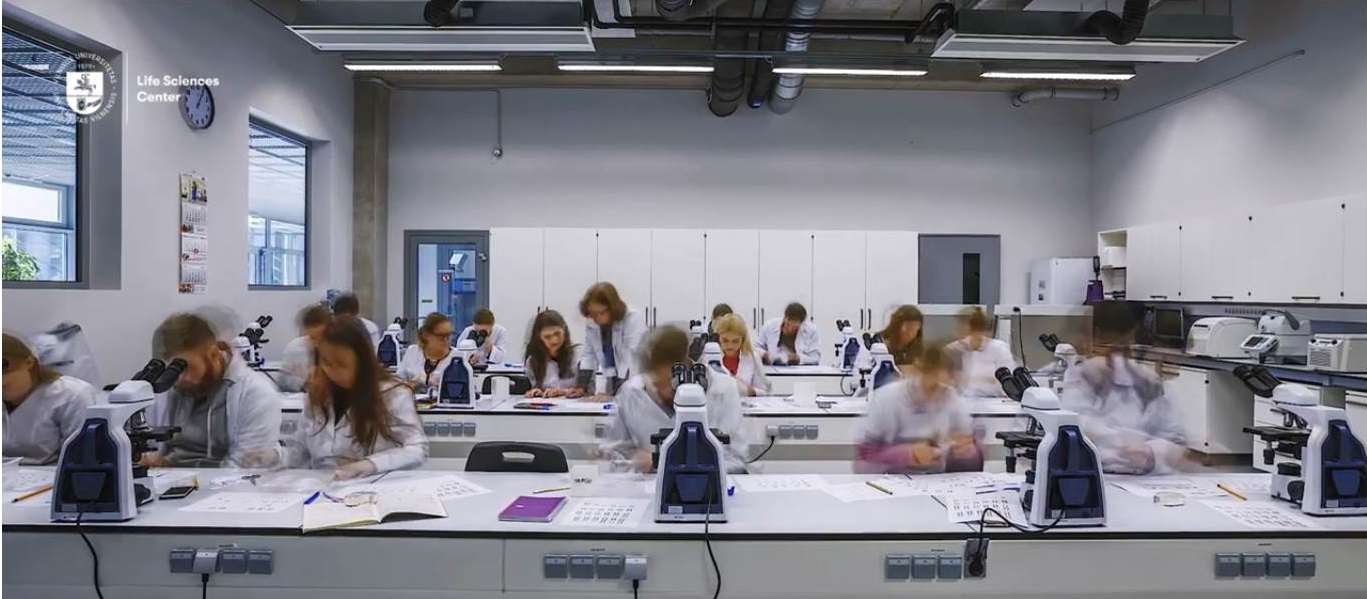
Science is a journey. Discover your career at VU LSC!
PROGRAMME DESCRIPTION
|
Programme type |
Master's |
|
Field of study |
Biochemistry |
|
Study area |
Life Sciences |
|
Degree |
Master of Life Sciences |
|
Duration |
2 years |
|
Workload |
120 ECTS credits |
|
Language of instruction |
English |
|
Location |
Life Sciences Center |
|
Starting date |
September 1st |
|
Tuition fee EU*/non-EU students |
€5 538 / €6 500 per year |
| *Citizens of the European Union are eligible to apply for state-funded places | |
- The objective
To deepen and broaden knowledge in biochemistry and related sciences, as well as to understand the achievements and perspectives of biochemistry. The programme provides the research skills necessary to stand and apply modern methods and technologies required for the creative development and implementation of scientific ideas.
- Career opportunities
A graduate is able to work in biochemical and chemical laboratories, as well as in industry and trading companies.
- Access to further studies
Analytical knowledge could be strengthened in doctoral studies in biochemistry and related fields.
KEY LEARNING OUTCOMES
A holder of a Master’s degree in Biochemistry has knowledge in biochemistry necessary for independent scientific research, uses modern methods and technologies of experimental biochemistry and related sciences in vivo, in vitro and in silico, has an ability to integrate the knowledge of different sciences, apply methods and technologies of biochemistry and related sciences in research and practical work, select appropriate methods of research and interpret reasonably the results obtained through those methods, work in the interdisciplinary areas and use the knowledge of different scientific fields in solving problems of the research, perform research and practical work requiring analytical and innovative thinking, plan and conduct research in the field of biochemistry and related fields. The programme enables individuals to take responsibility for their decisions, critically evaluate the latest developments in biochemistry and related sciences, and update and enhance their knowledge and skills.
COURSE INFORMATION
The programme has the following structure:
|
Course Type |
1st Semester (30 ECTS credits) |
2nd Semester (30 ECTS credits) |
3rd Semester (30 ECTS credits) |
4th Semester (30 ECTS credits) |
|
Compulsory Courses |
Term Research Project (10) Mechanisms of Organic Reactions (5) |
Term Research Project (10) |
Term Research Project (15) |
Master Thesis (30) |
|
Elective Courses |
Bioinformatics for Evolutionary Biology (5) Epigenomics (5) Genetics of Microorganisms (5) Advanced Therapeutics Medicinal Products & Regenerative Medicine (5) Python for Data Science (5) |
Mechanisms of Nucleic Acids and Protein Interactions (5) Biological Membranes (5)* Molecular Virology (5)* Bioethics (5) Advances in Biostatistics (5) Advanced Therapeutics Medicinal Products & Regenerative Medicine (5) Methods of Single-Molecule Research and Cell Biophysics (5) Microbiota research in health and disease (5) |
Bioinformatics for Evolutionary Biology (5) Epigenomics (5) Genetics of Microorganisms (5) Advanced Therapeutics Medicinal Products & Regenerative Medicine (5) Python for Data Science (5) |
*international students are taught individually
EXAMINATION AND ASSESSMENT REGULATIONS
The main form of evaluation is an examination. However, course units may also be evaluated on a pass/fail basis. Every course unit is concluded with either a written or a written-oral examination or a pass/fail evaluation. Students' knowledge and general performance during the exam are evaluated using a grading scale from 1 (very poor) to 10 (excellent), or by pass/fail evaluation when pass/fail assessment is foreseen as the final evaluation of the course unit.
ENTRY REQUIREMENTS
- Applicants for the Biochemistry Master's programme should have a Bachelor's or equivalent degree in one of these fields: Biochemistry, Molecular Biology, Biotechnology, Bioengineering.
- Applicants must have carried out experimental research work for a Bachelor’s thesis in Biochemistry or related sciences.
- Applicants must have studied all of the following courses during their bachelor's degree studies: analytical chemistry, physical chemistry, organic chemistry, bioorganic chemistry, and biochemistry.
- The average of the learning results during the Bachelor's degree must not be lower than 70% of the maximum possible grade.
- N. B. for non-EU/EFTA applicants: the gap since your completed Bachelor's degree should not exceed five years.
APPLICATION AND SELECTION REQUIREMENTS
- All the applicants must take an entrance examination in Biochemistry.