

Short Description: Compact three-in-one instrument combining a potentiostat (for constant voltage or constant current electrosynthesis), a cyclic voltammetry (CV) analyzer and a magnetic stirrer. Designed for preparative organic electrochemistry at laboratory scale – from electrochemical characterization by CV to electrosynthesis in small (2.5–10 mL) glass vials. Vol
 Produser: IKA-Werke GmbH & Co. KG (Vokietija)
Equipment Information:
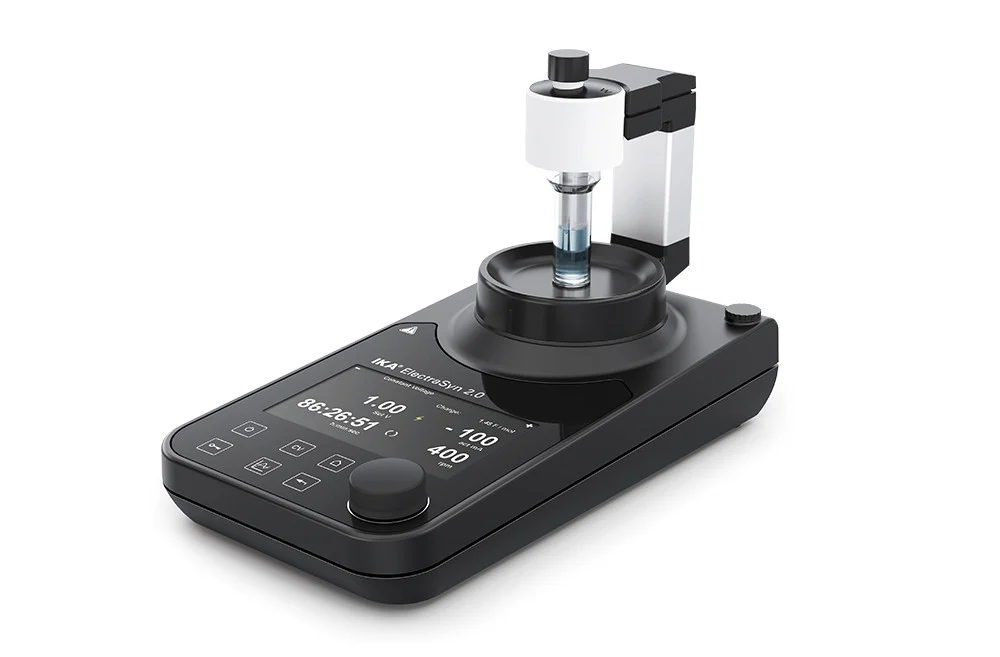
The ElectraSyn 2.0 is a standardized electrochemical synthesis platform developed by IKA in collaboration with Prof. Phil S. Baran (Scripps Research Institute).
It integrates three traditionally separate lab devices:
(1) a potentiostat – constant-voltage or constant-current mode with user-defined duration and parameters;
(2) an analytical instrument – cyclic voltammetry (CV) for characterizing electrochemical properties;
(3) a magnetic stirrer – for reaction homogenization.
Operating principle: standardized electrode pairs (graphite, glassy carbon, Pt, Ni, Zn, Mg, stainless steel, Ni foam) are inserted into a glass vial with an optional Ag/AgCl reference electrode; the keyed lid automatically identifies the electrode type. The internal stirrer agitates the reaction while the set voltage/current is applied between the working and counter electrodes; data are shown on the TFT display and transferred via USB or the ElectraSyn mobile app (Wi-Fi available via the optional e-Hive module).
Main functions:
- CV (up to ±10 V sweep range),
- constant-voltage electrolysis,
- constant-current electrolysis,
- Smart Assist mode for new users (helps choose initial V/I),
- repeated cycles,
- time limits,
- charge (Q) limits.
Compatible accessories:
- 6-reaction Carousel (parallel screening),
- e-Hive (up to 24 reactions),
- Pro-Divide / Pro-Seal (divided cell with ion-exchange membrane),
- GOGO module (universal extension),
- ElectraSyn flow (continuous-flow electrosynthesis).
Applications:
- C–H activation,
- oxidation and reduction without chemical oxidants/reductants,
- radical coupling,
- anodic allylic oxidation,
- Kolbe electrolysis,
- electrochemical nitration,
- replacement of expensive or hazardous reagents with "clean" electrochemical methods,
- catalyst screening,
- electrochemical kinetics via CV,
- green-chemistry and sustainable-process development,
- optimization of pharmaceutical-relevant syntheses.
Technical Specifications:
- Type: three-in-one – potentiostat, CV analyzer, magnetic stirrer
- Voltage output (electrodes): 30 / 10 V
- Current output: 100 mA
- Modes: constant voltage, constant current, cyclic voltammetry (CV)
- Motor rating: 9 W
- Speed range: 50 – 1500 rpm (accuracy ±10 rpm)
- Max. stirring quantity (H₂O): 0.1 L
- Stir bar length: 8 – 16 mm
- Reaction vial sizes: 2.5, 5, 10, 20 mL (with matching holders)
- Compatible electrodes: graphite, glassy carbon, Pt, Ni, Ni foam, Zn, Mg, stainless steel; Ag/AgCl reference
- Display: TFT (chemical- and scratch-resistant hardened glass)
- Operation: rotary knob + capacitive touch
- Interfaces: USB; Wi-Fi via e-Hive accessory; ElectraSyn app (iOS / Android)
- Protection: IP 40
- Ambient temperature: +5 … +50 °C
- Permissible relative humidity: 80 %
- Dimensions (W × H × D): 130 × 150 × 250 mm
- Weight: 1.4 kg
- Power: 100–240 V AC, 50/60 Hz; nominal input 48 V DC; 39.84 W (5 W standby); input current up to 1500 mA
Software: iBA Analysis Software
VU ID: 8...
Location: BVI
Core Facility: Continuous Flow Synthesis
Equipment is operated by Personnel only: Yes
It is allowed to work with the equipment independently after familiarization with the work process on site: Yes
Only those with the appropriate certificate/certificate are allowed to work with the equipment: Yes
There is an opportunity to participate in equipment usage training: Yes
Contact Scientist (Leading Scientist): Jonas Žurauskas
Contact email address:
Information for the User:
- A briefing by the responsible person is mandatory before use. Electrochemical reactions can release gases (H₂, O₂, Cl₂, etc.) – the device must be placed in a fume hood or under adequate extraction ventilation, especially when using flammable solvents or electrolytes. Use only standard IKA-compatible electrodes and vials; non-standard electrode geometries may cause short-circuits or inaccurate results. Before starting, verify that the electrodes are of proper length (immersed in the solution but not touching the bottom of the vial), that the inter-electrode gap is within recommended range (~3 mm) and that the lid is tight. After use, rinse electrodes with a suitable solvent, dry them and protect from mechanical damage (especially glassy carbon and Ag/AgCl reference). The lid's replaceable vial contact is sensitive to moisture – keep it dry. When using the divided cell (Pro-Divide), select the appropriate ion-exchange membrane for the solvent pH and electrolyte.
- Data Sheet ElectraSyn 2.0 Package
Additional Comments:
The ElectraSyn 2.0 is distinctive in that it standardizes electrochemical organic synthesis – reproducible electrode geometries, vial sizes and settings make it easy to transfer and reproduce published procedures directly. The instrument is extendable with the Carousel (6 reactions), e-Hive (up to 24 reactions), Pro-Divide (divided cell) and ElectraSyn flow (continuous-flow) accessories. The device is suitable both for chemists new to electrochemistry and for experienced electrochemists – the Smart Assist mode and the IKA Knowledge Base method library make entry easier.