

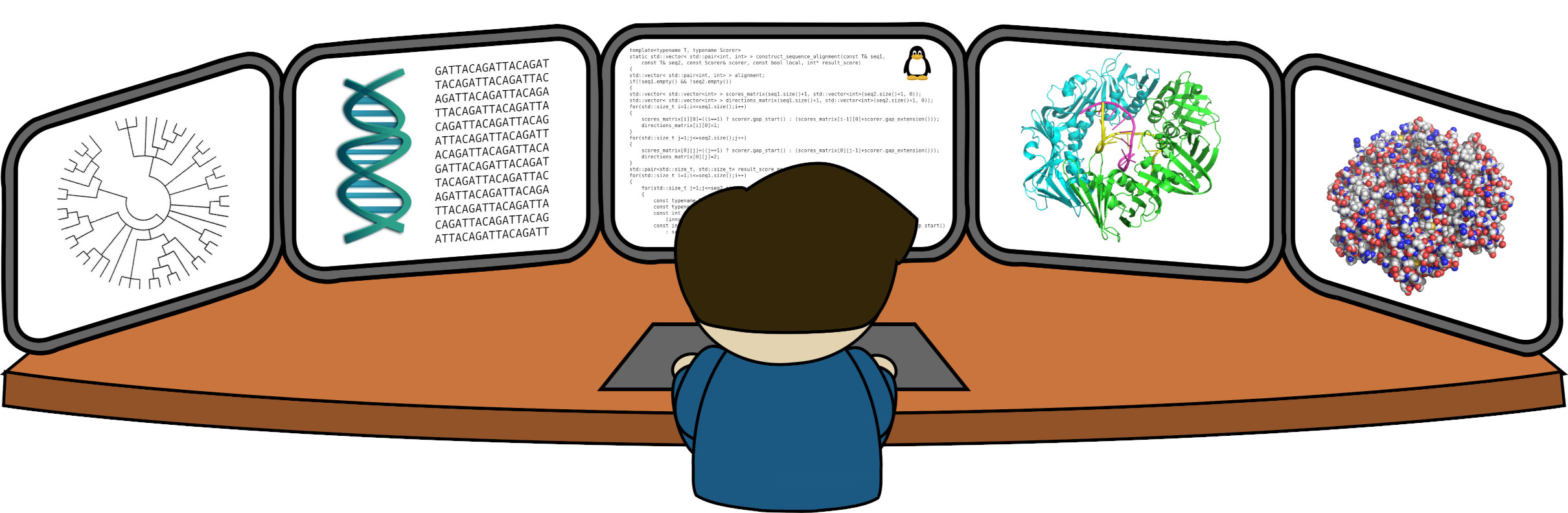
Our research combines the development of computational methods with their application to fundamental biological problems.
1. Computational Methods Development
We develop approaches for identifying distant evolutionary relationships between proteins and for analyzing, comparing, modeling, and evaluating the three-dimensional structures of proteins and macromolecular complexes. A particular emphasis is placed on biomolecular interactions, including protein–protein, protein–nucleic acid, and protein–ligand interactions. Our aim is to develop accurate, efficient, and scalable methods for analyzing large and rapidly growing sequence and structure datasets and for predicting structural and interaction-related properties. We increasingly incorporate modern machine-learning methods and advances in artificial intelligence to improve the accuracy, scalability, and interpretability of computational analyses. All of our software packages and web servers have open access.
2. Applications to Biological Problems
Our application-oriented research is driven by specific biological questions rather than by any particular computational methodology. We use the most appropriate available approaches, whether developed in our laboratory or elsewhere, and integrate sequence, structure, genomic-context, and other computational analyses as required by the problem. Our main interests include the evolution, structure, and molecular mechanisms of proteins and protein assemblies involved in DNA replication, repair, and mutagenesis, as well as prokaryotic defense systems. Current focus areas include DNA polymerases, CRISPR–Cas systems and related RNA-guided nucleases, signaling proteins associated with antiviral defense, and prokaryotic Argonaute systems, although our research is not limited to these topics. Many of these studies are conducted in close collaboration with the wet labs, so that mechanistic and functional hypotheses derived using computational approaches could be tested experimentally.