

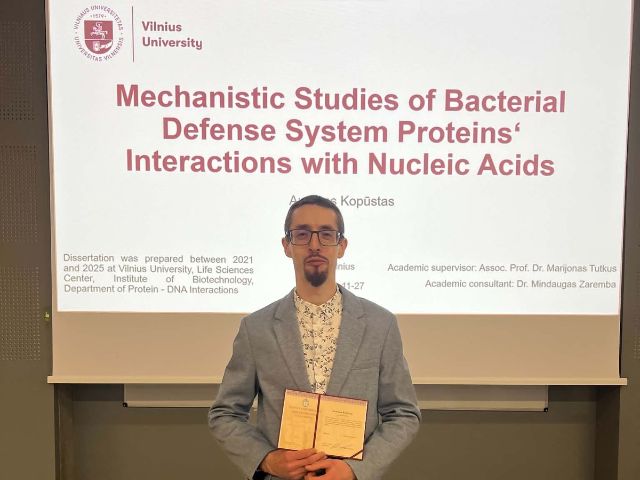
Aurimas Kopūstas defended his dissertation entitled "Mechanistic Studies of Bacterial Defense System Proteins‘ Interactions with Nucleic Acids" and was awarded a Doctor of Science in Biochemistry.
The dissertation was prepared between 2021 and 2025 at the Institute of Biotechnology of the Vilnius University Life Sciences Center. The research was supported by the Research Council of Lithuania, which funded the doctoral student’s two-week research visit to KU Leuven in Leuven, Belgium, during the spring semester of 2023.
Scientific supervisors: Dr. Marijonas Tutkus (Vilnius University, Natural Sciences, Physics; 1 October 2024–30 September 2025); Dr. Mindaugas Zaremba (Vilnius University, Natural Sciences, Biochemistry; 1 October 2021–30 September 2024).
Scientific consultants: Dr. Mindaugas Zaremba (Vilnius University, Natural Sciences, Biochemistry; 1 October 2024–30 September 2025); Dr. Marijonas Tutkus (Vilnius University, Natural Sciences, Physics; 1 October 2021–30 September 2024).
Composition of the Dissertation Defense Board: Chairperson – Assoc. Prof. Dr. Rima Budvytytė (Vilnius University, Natural Sciences, Biochemistry); Dr. Rūta Gerasimaitė (Max Planck Institute, Germany, Natural Sciences, Biochemistry); Prof. Dr. Johannes Hohlbein (Brandenburg University of Technology, Germany, Natural Sciences, Biophysics); Prof. Dr. Saulius Serva (Vilnius University, Natural Sciences, Biochemistry); Dr. Justas Svirelis (Aligned Bio, Sweden, Natural Sciences, Biochemistry).
Various mobile genetic elements, such as bacteriophages and plasmids, can pose a threat to the integrity of bacterial cells. To protect themselves from these potentially harmful foreign nucleic acids, bacteria have evolved a wide range of defence strategies. The key effector proteins of various bacterial defence systems have rapidly become versatile molecular tools in fields such as biotechnology and biomedicine, highlighting the practical value of detailed studies of the extensive bacterial defence arsenal.
Alongside traditional structural and ensemble biochemical methods widely used to study protein–nucleic acid interactions, single-molecule approaches provide unique insights into these interactions with high spatial and temporal resolution. In this dissertation, single-molecule fluorescence microscopy was used to investigate in vitro the molecular mechanisms of protein–nucleic acid interactions in three distinct bacterial innate and adaptive immune systems.
The mechanism of interaction between the restriction endonuclease BfiI and DNA was determined using single-molecule FRET. A soft DNA curtains platform was used to elucidate the target-search mechanism of the type I-F CRISPR-Cas Cascade complex in the context of the anti-CRISPR protein AcrIF9. Finally, a standard flow-stretching DNA assay was used to reveal the complete mechanism of action of the short prokaryotic Argonaute protein XauSPARDA.