

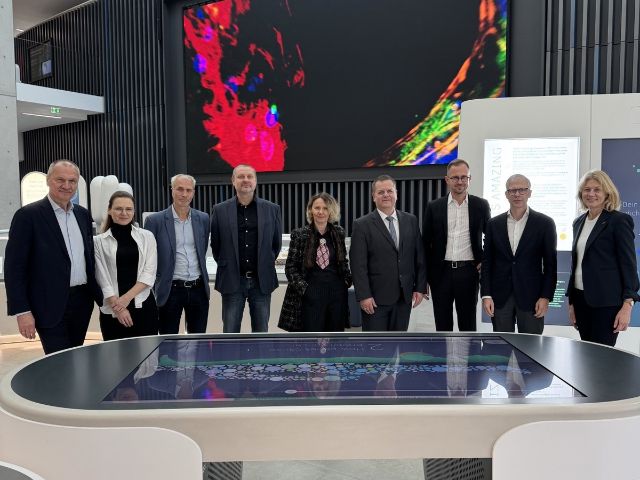
On 13 November, Dr Arvydas Lubys, Director of the Vilnius University Life Sciences Center (VU LSC), visited the European Molecular Biology Laboratory (EMBL) in Heidelberg, Germany, together with representatives of Lithuanian universities and the Office of the President of the Republic of Lithuania. During the visit, the delegation gained insight into EMBL's activities, research infrastructure and the opportunities available to Lithuania's scientific community through the country's membership in the organisation.
The delegation also included Prof. Vytautė Starkuvienė-Erfle, Head of the Lithuanian EMBL Membership Project; Assoc. Prof. Dr Karolis Ažukaitis, Vice-Dean for Research and Innovation at the VU Faculty of Medicine; Prof. Povilas Treigys, Vice-Dean for Information Technology at the VU Faculty of Mathematics and Informatics; and representatives of the Lithuanian University of Health Sciences, Vytautas Magnus University and the Office of the President of the Republic of Lithuania.
Exploring EMBL's Research Infrastructure
During the visit, the Lithuanian delegation learned more about EMBL's activities and key research areas. Discussions covered the principles of open access to scientific data and data management, as well as the opportunities offered by EMBL's research infrastructure.
Part of the visit focused on exploring EMBL's laboratories and technological solutions. The delegation visited the Microbial Automation and Culturomics Core Facility, where they learned about advanced technologies used for microbial cultivation and research. They also toured the Imaging Centre, which provides researchers with access to advanced microscopy equipment. In addition, the visitors explored the activities of EMBL's mobile laboratory and its capabilities for conducting scientific research.
Considerable attention was also given to the organisation and strategic development of scientific activities at EMBL. Discussions explored how the organisation's research programmes are developed and implemented, and how scientific discoveries and technologies are translated into practical applications that drive innovation. The delegation also learned about EMBL's approaches to strategic recruitment, professional development and career progression for researchers.
"Lithuania's membership in EMBL provides opportunities for the entire national scientific community. It is therefore important that representatives of different universities gain first-hand insight into the organisation's activities and infrastructure. EMBL gives researchers access to advanced equipment and technologies that are often difficult for individual countries to obtain due to the substantial investments required. Equally important is the opportunity to learn from EMBL's experience in organising scientific research, strengthen researchers' expertise and develop international collaboration," says Dr Arvydas Lubys, Director of the VU Life Sciences Center.
Cooperation between VU LSC and EMBL
Following Lithuania's accession to EMBL in 2019, Vilnius University was designated as the institution representing the country within the organisation, while the VU Life Sciences Center took on the coordination of membership-related activities. These include disseminating information about opportunities offered by EMBL, organising training courses and visits, encouraging Lithuanian researchers and students to use international research infrastructure, and contributing to the preparation and implementation of membership activity plans and to the submission of reports.
"Lithuania's participation in EMBL over the past five years has received a very positive evaluation. Based on this assessment, we have prepared an activity and financial plan for the next five years of membership, which is currently being reviewed by international experts. The measures outlined in the plan will help develop joint projects between Lithuanian and EMBL researchers, encourage student participation and support the preparation of joint research funding applications," says Prof. Vytautė Starkuvienė-Erfle, Head of the Lithuanian EMBL Membership Project.
At the same time, cooperation with other countries in the region, including Latvia, Estonia and Poland, which are also EMBL member states, is being strengthened.
VU LSC also maintains a separate strategic scientific partnership with EMBL. Following the signing of a partnership agreement in 2020, the Genome Editing Technologies Partnership Institute was established at the Center, with its activities organised in line with the EMBL model. An international team of researchers at the Institute conducts fundamental and applied research, develops CRISPR-Cas and other genome-editing technologies, trains highly qualified specialists, and contributes to innovation.