

Biomatter products are already on the market
The enzymes developed by Biomatter have a wide range of applications and are already used in commercial products. One example is Invitrogen™ SuperScript™ V reverse transcriptase, manufactured by Thermo Fisher Scientific, which converts RNA into DNA. This process is essential in molecular biology laboratories and mRNA research related to vaccine development.
Working with Thermo Fisher Scientific, Biomatter improved the enzyme's resistance to oxidation. This is one of the properties that contribute to the reagent's stability, allowing it to be transported at ambient temperature without special refrigeration. The enzyme can also be stored at room temperature for up to six months.
Plans for expansion
Part of the investment will be used to establish a new 2,000-square-metre enzyme development and testing facility in Vilnius, scheduled to open in 2027.
Biomatter already completes enzyme engineering processes that would traditionally take months or even years in just a few weeks. The new facility is expected to reduce this timeframe even further, potentially to just a few days.
The investment will also support the expansion of the company's sales team and operations in the United States, where approximately half of its customers are based. Biomatter will continue investing in its AI-powered enzyme design platform and the enzyme database that supports it.
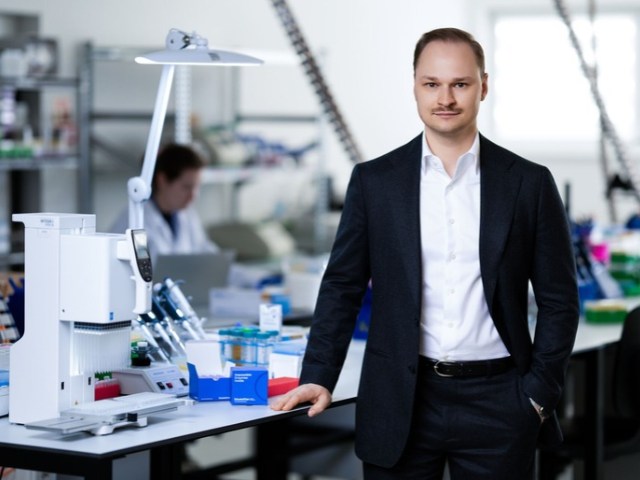
"Our goal is to make ordering a custom-designed enzyme as simple as ordering any reagent from a catalogue – even when an enzyme with the required function does not yet exist," says Laurynas Karpus, CEO and co-founder of Biomatter. "This investment will enable us to develop new enzymes at a greater scale and integrate them into our customers' products more quickly."
Developing specialised enzymes
Traditionally, enzyme engineering begins with an enzyme that already exists in nature. Biomatter's AI models take a different approach, designing unique enzymes based primarily on the chemical reactions customers need them to perform.
This approach draws on years of experimental data collected by the company on enzymes whose structures differ significantly from those found in nature.
In one project, Biomatter developed a specific class of enzyme for mRNA vaccine manufacturing: a methylase that does not require SAM, an expensive molecule essential for the activity of many naturally occurring methylases.
Rather than improving an existing enzyme, the company created an entirely new one capable of catalysing an enzymatic reaction not found in nature. Before being delivered to customers, every enzyme developed by Biomatter, including this methylase, is experimentally validated in the company's laboratory.
"Artificial intelligence is moving from software into the physical world. This transformation is particularly rapid in biology," says Oliver Schoppe, Partner at UVC Partners. "While most companies applying AI in biology are still working to demonstrate that their technologies are effective, Biomatter's enzymes are already being used in commercial products by some of the largest manufacturers in Europe and the United States."
From individual projects to long-term partnerships
Biomatter has developed more than 50 different enzymes for over 25 companies across Europe, the United States and Japan. Its customers operate in the biopharmaceutical, diagnostics, agricultural and industrial biotechnology sectors and include AstraZeneca, BASF, Kirin Holdings, Neogen, Sanofi and Tereos.
What began as individual projects has evolved into strong, long-term partnerships involving the development of a wide range of enzymes.
Each project adds to Biomatter's experimental dataset, enabling the company to design future enzymes even faster and more accurately.
"Enzymes are essential to the food and biotechnology manufacturing industries, which are worth hundreds of billions of dollars. Yet developing them can take months or even years, often forcing companies to settle for enzymes that are poorly suited to their needs," says Harry Briggs, Partner at Astanor.
"Until now, the main limiting factor has been data: AI models could only learn from what already exists in nature. Biomatter has spent years developing enzymes that do not occur naturally and collecting data on how they function. This now enables the company to design entirely new enzymes that evolution has never produced. World-class customers from a wide range of industries continue to choose Biomatter. For us, this is the clearest evidence of the company's potential."
Photo: Biomatter
About Biomatter
Biomatter is a biotechnology company that uses artificial intelligence to design novel enzymes not found in nature, with applications across the pharmaceutical, diagnostics, agricultural and chemical industries.
The company's story began at the Vilnius University Life Sciences Center (VU LSC), where a team of researchers started developing the technology that would later become the foundation of the startup.
Operating since 2018, Biomatter has developed and delivered more than 50 custom-designed enzymes to over 25 companies across various industries.
Biomatter's founders were among the first researchers in the world to publish a study demonstrating that AI models could be used to design novel enzymes that do not exist in nature but exhibit excellent functionality (Nature Machine Intelligence, 2021).
This article was prepared based on information provided by Biomatter.