

THERA-BALT, a project funded by the European Union's Horizon Europe programme under the Teaming for Excellence action, started on 1 November 2026. Its aim is to establish an internationally recognised Competence Centre for Theranostics and Radiopharmaceuticals in Lithuania that will strengthen the capacity of Lithuania and the whole Baltic region to diagnose and treat cancer with targeted radiopharmaceuticals. The total value of the project is about EUR 30 million: EUR 15 million has been granted by the European Union, a further EUR 15 million is planned from national complementary funding in Lithuania.
What is theranostics?
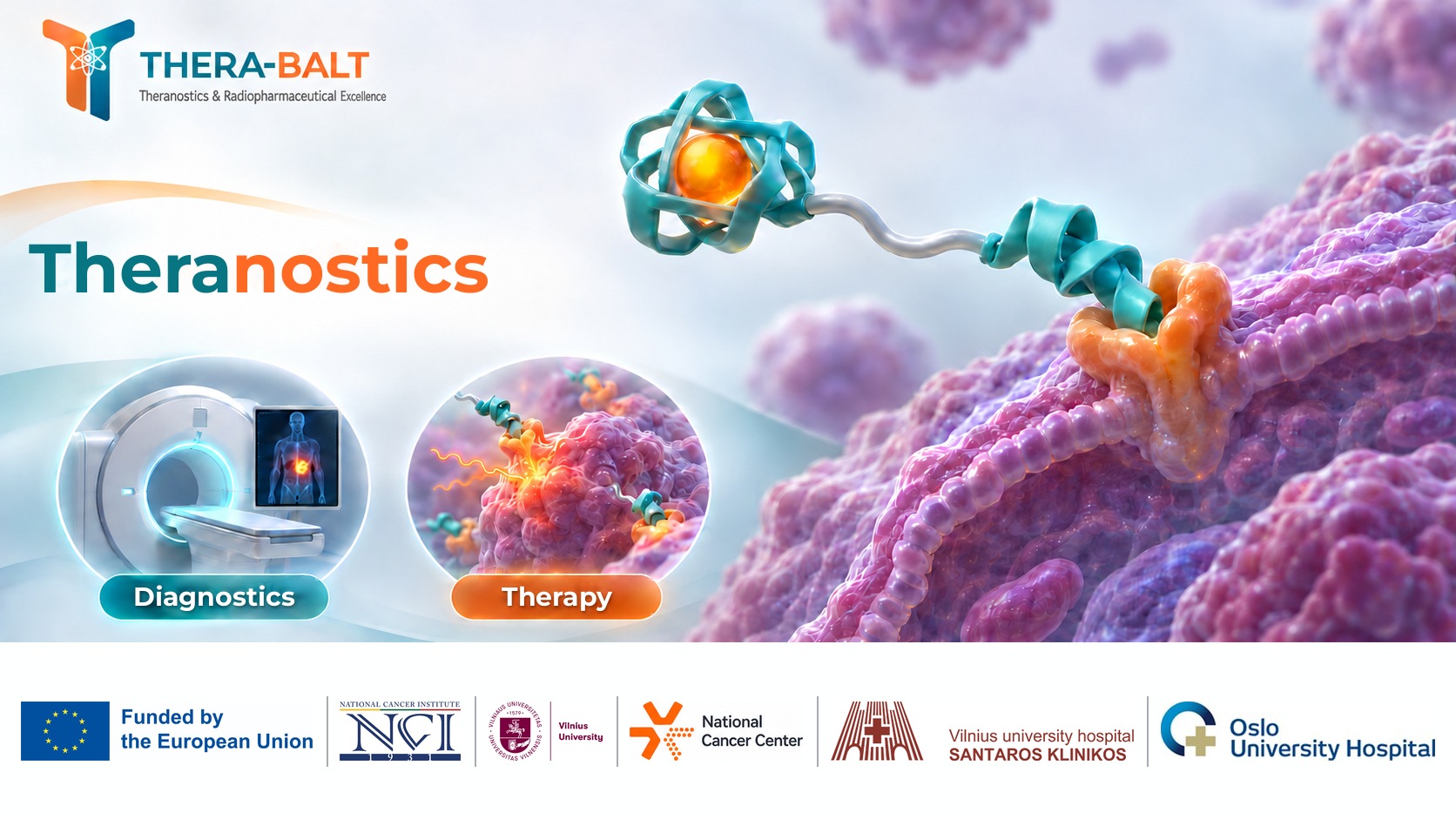
Theranostics is a field of personalised medicine that combines cancer diagnosis and treatment. It is based on specialized radiopharmaceuticals that enable the principle: “I treat what I see, and I see what I treat.”
It uses special molecules that bind to proteins on the surface of tumour cells. This can be compared to a key and a lock: the molecule acts like a key that recognises the lock it fits.
When a diagnostic radioactive isotope is attached to such a “key”, it becomes possible to see where tumour lesions are located in the body and to determine whether they carry a target suitable for treatment. When the molecule is labelled with a therapeutic radioactive isotope instead, the radiation is directed at the cells carrying the same target, and these cells are destroyed.
“Theranostics is no longer just the medicine of the future. Lu-177-labelled radiopharmaceuticals are already used today to treat some patients with advanced prostate cancer or neuroendocrine tumours. However, we still have relatively few such treatment options. With the THERA-BALT project we aim to change this: to bring together scientific and clinical expertise and build the missing infrastructure, so that in Lithuania we can not only use existing medicines, but also develop new ones ourselves, study their efficacy and prepare them for clinical trials. Our ambition is that in the future Lithuania will be not only a country that the newest cancer treatments come to, but also a country where they are born,” says the project leader, Dr Jonas Venius, Head of the Radiation Oncology Centre at the National Cancer Centre.
Partners
The project is coordinated by the National Cancer Institute. The partners are the National Cancer Centre, a branch of Vilnius University Hospital Santaros Klinikos; Vilnius University; and Oslo University Hospital (advanced partner, Norway). The project will run for five years, until 31 October 2031.
What will the centre do?
The Competence Centre will develop its activities in five areas: discovery of molecular targets, radionuclide development and dosimetry, development of new radiopharmaceuticals, preclinical and clinical validation, and multimodal imaging. During the project, modern governance and quality systems will also be introduced; training and mobility programmes will be organised for physicians, researchers, radiopharmacy specialists and medical physicists; talent will be attracted from abroad; and the translation of research results into clinical practice will be strengthened.
The Teaming for Excellence action helps research and innovation institutions become internationally competitive centres of excellence by collaborating with leading European institutions. THERA-BALT aims to make Lithuania and the Baltic region a visible, patient-centred cradle of theranostics expertise within the European Research Area.
The official launch of the project for the partners and the research community will take place in Vilnius on 7 December 2026.
More information about the project is available in the European Commission's CORDIS database: https://cordis.europa.eu/project/id/101250385
The THERA-BALT project (No. 101250385, HORIZON-WIDERA-2025-ACCESS-01) is funded by the European Union. Views and opinions expressed are however those of the author(s) only and do not necessarily reflect those of the European Union or the European Research Executive Agency (REA). Neither the European Union nor the granting authority can be held responsible for them.