

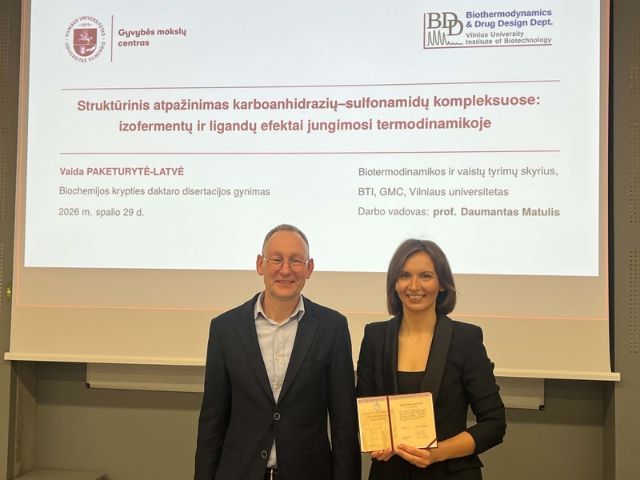
Vaida Paketurytė-Latvė defended her dissertation entitled “Structural Recognition in Carbonic Anhydrase–Sulfonamide Complexes: Isozyme and Ligand Effects on Binding Thermodynamics” and was awarded a Doctor of Science in Biochemistry.
The dissertation was prepared between 2019 and 2025 at Vilnius University.
Scientific supervisor: Prof. Dr. Daumantas Matulis (Vilnius University, Natural Sciences, Biochemistry).
Composition of the Dissertation Defense Board: Chairperson – Dr. Gintautas Tamulaitis (Vilnius University, Natural Sciences, Biochemistry); Prof. Dr. Dalia Barsyte-Lovejoy (University of Toronto, Canada, Natural Sciences, Biochemistry); Dr. Laurynas Dagys (Vilnius University, Natural Sciences, Physics); Dr. Kliment Olechnovič (Vilnius University, Natural Sciences, Biochemistry); Dr. Miglė Tomkuvienė (Vilnius University, Natural Sciences, Biochemistry).
The dissertation investigates the factors governing the molecular recognition between carbonic anhydrases (CAs) and primary sulfonamide inhibitors. By combining fluorescent thermal shift assays, isothermal titration calorimetry and X-ray crystallography, the interactions between 12 catalytically active human CA isozymes and sulfonamides were characterised from both thermodynamic and structural perspectives.
The main findings show that the CA II, CA XII and CA XIII isozymes exhibit similar intrinsic binding affinities across the investigated series of compounds, while displaying substantially different enthalpic and entropic contributions arising from subtle differences in active-site amino acid residues and hydration networks. By accounting for protonation equilibria coupled to binding, intrinsic thermodynamic parameters independent of experimental conditions were determined. It was also demonstrated that changes in the oxidation state of sulfur-containing substituents located ortho to the sulfonamide group alter ligand conformational energy and the formation of intramolecular interactions, which can reduce binding affinity by up to one million-fold. Novel, highly selective inhibitors of the cancer-associated CA IX isozyme were identified.
The dissertation also presents a rigorous analysis of experimental uncertainties using asymmetric profile-likelihood confidence intervals. The findings reveal the complex nature of molecular recognition and provide both a theoretical and practical basis for rational drug design.