

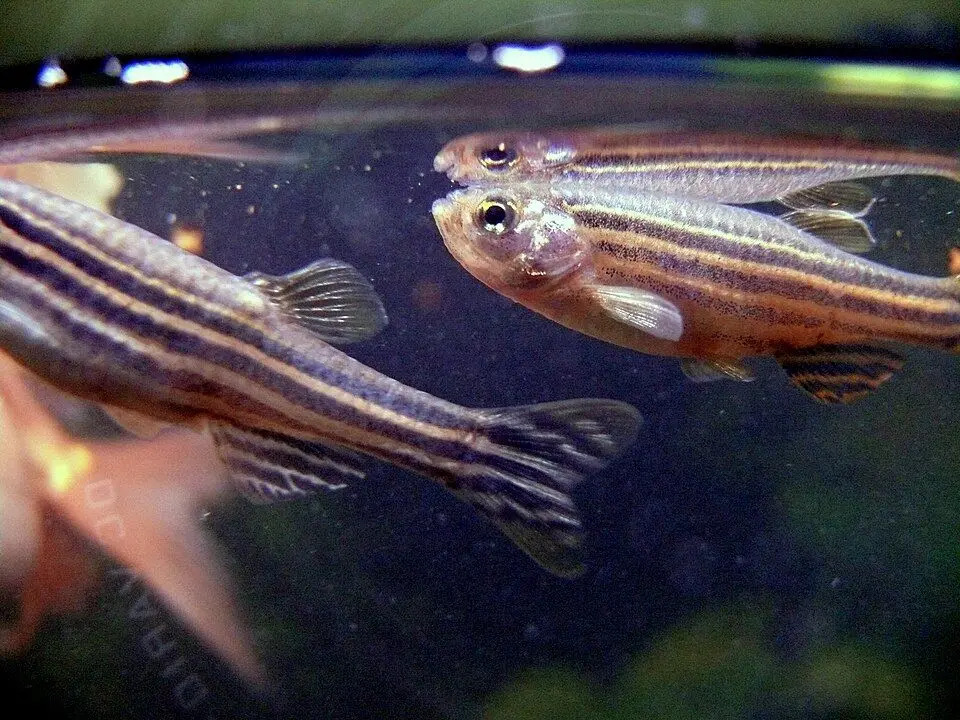
Vilnius University Life Sciences Center (VU LSC) researchers have developed a genetic tool that enables highly efficient control of gene activity at different stages of development in a model organism – the zebrafish. The new tool makes it possible to investigate how the functions of the same genes change as an organism develops and later in life.
The study, carried out by a research team led by Dr Darius Balčiūnas – Edita Bakūnaitė, Emilija Gečaitė, Samanta Žemalytė, Jaroslav Denkovskij and Dr Justas Lazutka – was published in GENETICS, one of the oldest and most influential journals in the field. The publication also received special recognition from the editors and was selected as one of the Featured Articles in the September issue.
The new genetic tool can be applied to a wide range of biological research, from organ regeneration to nervous system function and behaviour. In addition, the zebrafish lines developed during the study became the first genetically modified vertebrate animals created in Lithuania.
Why Is It Important to Control Gene Activity in Research?
According to PhD candidate Edita Bakūnaitė, one of the classic ways to determine what a particular gene does in an organism is to “switch it off” and observe what changes. However, this approach does not always allow researchers to answer the questions they are interested in.
“Some genes are essential during the early stages of development. If we switch such a gene off at the very beginning, the organism may not survive, which means we can no longer investigate what function the same gene performs later, once the organism has developed. For example, genes that are important during heart development may later also play a role in heart regeneration,” explains the researcher.
According to E. Bakūnaitė, this problem can be addressed by switching the gene off not during early development, but later, once the major organ systems have already formed.
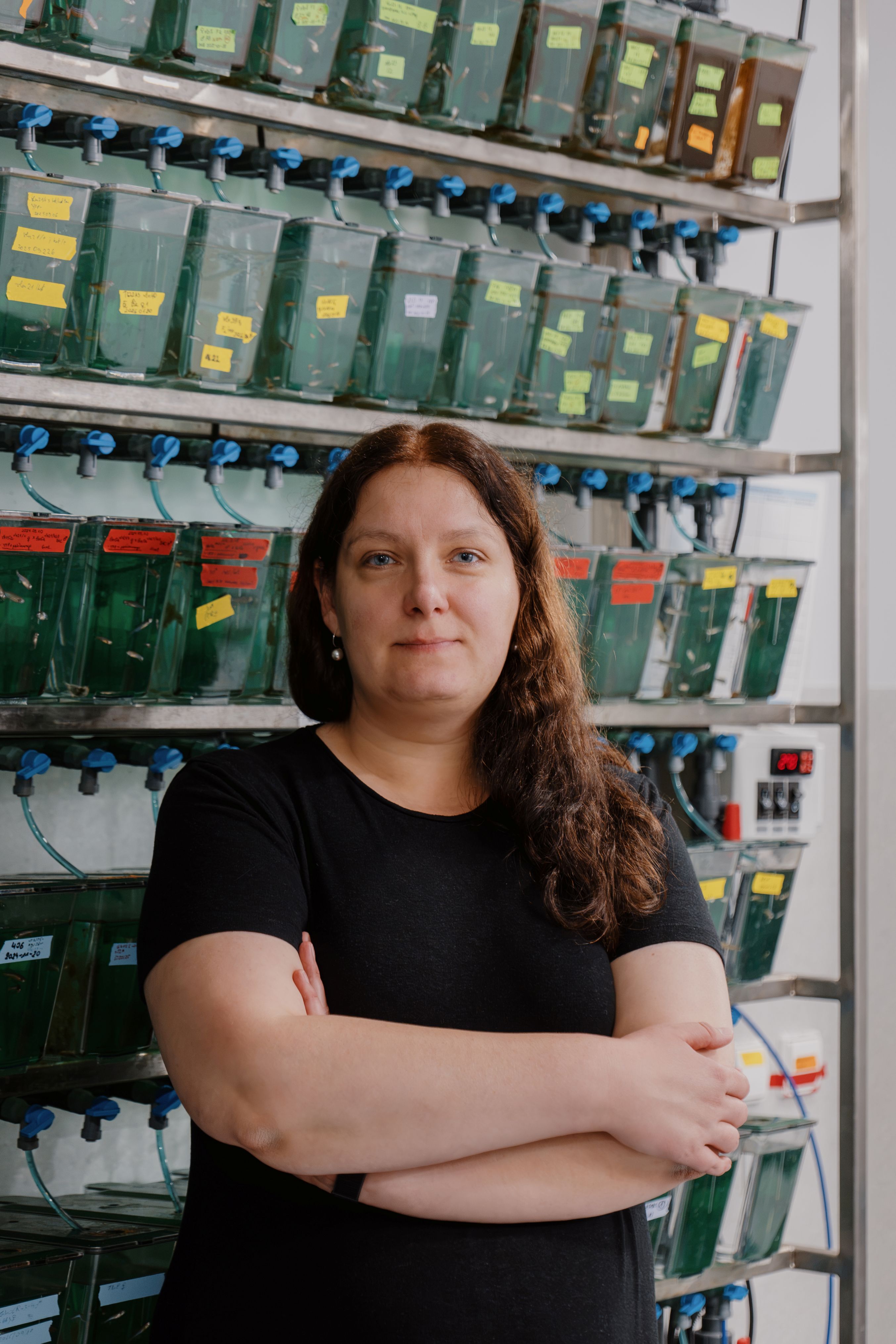 |
| VU LSC PhD candidate Edita Bakūnaitė by the zebrafish aquariums. Photo by VU |
For this purpose, VU LSC researchers developed a zebrafish line in which the gene-regulating system remains highly effective even in adult fish. The researchers also created a new regulatory DNA sequence – the ubbR promoter – which helps ensure that the system functions efficiently at different stages of development.
E. Bakūnaitė explains that promoters previously used had significant limitations: some worked well in embryos but became less active later in development. In contrast, others were not sufficiently effective across different tissues. The results achieved with the new system exceeded even the researchers’ own expectations.
“We hoped to create a more effective system than those used previously, but achieving nearly 100 per cent gene inactivation in adult fish tissues was a very pleasant surprise,” says E. Bakūnaitė.
Zebrafish – a Valuable Research Model
At just a few centimetres long, zebrafish may at first seem very distant from humans. However, according to Dr Justas Lazutka, approximately 70 per cent of zebrafish genes have counterparts in the human genome.
“This genetic similarity allows us to study a wide range of biological processes and disease mechanisms in an organism that is simpler and easier to manipulate experimentally,” he explains.
According to J. Lazutka, zebrafish are also attractive to researchers because of their practical characteristics. They are small, relatively easy to maintain, and can produce large numbers of embryos in a single spawning. This makes them a convenient model for studying a variety of biological processes.
“Another important advantage is that we can directly observe what is happening in a developing organism. Zebrafish embryos are transparent, so under a microscope we can watch organs form and follow other developmental processes,” says the researcher.
One of the most remarkable characteristics of zebrafish, however, is their ability to regenerate damaged or lost tissues and parts of organs.
“Zebrafish can regenerate their fins, spinal cord, optic nerves, and even part of the heart ventricle. This makes them particularly valuable for studying regeneration processes that are much more limited in the human body,” says the VU LSC researcher.
 |
| Dr Justas Lazutka. Photo by VU |
How Could This Research Benefit Humans?
According to Edita Bakūnaitė, tissue and organ regeneration is one area in which the new genetic tool could be particularly useful.
“By switching off individual genes and observing how the regeneration process changes, we can better understand how tissues regenerate in zebrafish. This helps us investigate why, for example, the human heart is left with scar tissue and impaired biological function after a myocardial infarction, while a zebrafish heart can recover after an experimentally induced injury and function as if it had never been damaged within just a couple of months,” says E. Bakūnaitė.
She explains that such studies can help researchers systematically identify genes and biological processes that are important for tissue regeneration, with the resulting knowledge later tested in other biological models.
Another possible application of the new tool is research into the nervous system and behaviour. According to E. Bakūnaitė, the system allows researchers to switch off a gene in an adult fish and observe how this affects its behaviour, responses to stimuli or other bodily functions.
“The possibilities for applying this tool are limited only by our imagination,” E. Bakūnaitė concludes.
The Tool Is Already Being Used by Other Laboratories
One important indication of the reliability of the newly developed method is that it works not only in the VU LSC laboratory.
The zebrafish line developed by the researchers has already been used in a partner laboratory in Taiwan. The ubbR promoter created at VU LSC has also attracted the attention of other research groups. It is being used not only in zebrafish studies but also in research involving related fish in the genus Danionella.
According to E. Bakūnaitė, this is particularly important because scientific methods sometimes work successfully in one laboratory but fail to produce the same results elsewhere.
“The fact that our results have been independently reproduced in other laboratories provides further confirmation that we have developed an important and highly effective tool,” says the researcher.
More Than Five Years of Work
Work on the new system began in early 2021. More than five years passed between the first DNA constructs and the final results and publication.
For the researchers, GENETICS' decision not only to publish the study but also to give it additional editorial recognition was an important acknowledgment of the work behind the project.
“Laboratory work, followed by long hours at the computer describing experiments and their results, can sometimes feel quite solitary, and you occasionally ask yourself: why am I doing this, and who needs it? Learning that our publication had received additional attention from the editors gave meaning to all the work we had put in,” says E. Bakūnaitė.
The rapid adoption of the VU LSC team’s tool in other studies also demonstrated its potential relevance to the wider scientific community. Dr Darius Balčiūnas points out that in the very same week the official publication appeared, the ubbR promoter developed by the team was already used and cited in a study published in Nature.
“The fact that our work was cited in a Nature paper in the very same week our official publication appeared may be something of a speed record,” smiles research group leader Dr D. Balčiūnas.