

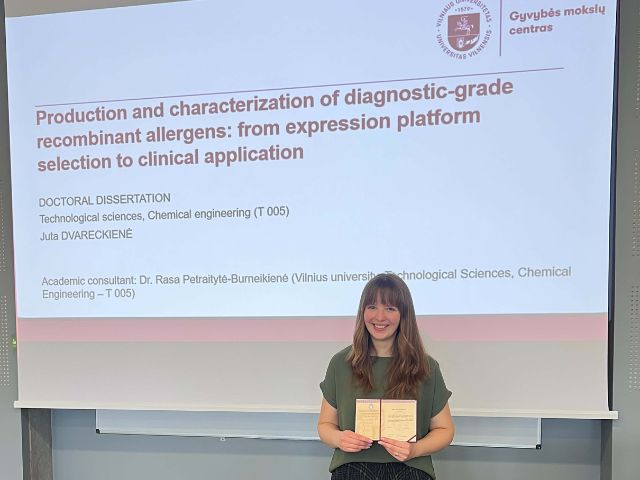
Juta Dvareckienė defended her dissertation entitled “Production and Characterization of Diagnostic-Grade Recombinant Allergens: From Expression Platform Selection to Clinical Application” and was awarded a Doctor of Science in Chemical Engineering.
The dissertation was prepared between 2018 and 2022 at the Institute of Biotechnology of the Vilnius University Life Sciences Center. The research was supported by the European Regional Development Fund (Project No. 01.2.2-LMT-K-718-01-0008) under a grant agreement with the Research Council of Lithuania (LMTLT). The dissertation was defended on an external basis.
Scientific consultant: Dr. Rasa Petraitytė-Burneikienė (Vilnius University, Technological Sciences, Chemical Engineering).
Composition of the Dissertation Defense Board: Chairperson – Dr. Inga Matijošytė (Vilnius University, Technological Sciences, Chemical Engineering); Assoc. Prof. Dr. Violeta Jonušienė (Vilnius University, Natural Sciences, Biochemistry); Dr. Andris Kazaks (Latvian Biomedical Research and Study Centre, Technological Sciences, Chemical Engineering); Prof. Dr. Laura Malinauskienė (Vilnius University, Medical and Health Sciences, Medicine); Dr. Jolanta Sereikaitė (Vilnius University, Technological Sciences, Chemical Engineering).
Allergy is an altered immune response to an allergen involving specific IgE antibodies and T helper cells. Allergy diagnostics often rely on allergen extracts isolated from natural sources; however, variability in their composition and limited standardisation reduce the accuracy and reproducibility of diagnostic testing. Recombinant allergens enable precise and consistent determination of a patient’s sensitisation profile. This approach, known as component-resolved diagnostics, forms the basis of molecular allergology. However, the use of recombinant allergens requires comprehensive molecular characterisation and reliable protein expression systems capable of producing clinically relevant proteins.
In this study, the black tiger shrimp allergen Pen m 4, dog allergen Can f 6 and common wasp allergen Ves v 5 were produced and characterised using the Pichia pastoris expression system, and the results were compared with those obtained using the conventional E. coli system. To optimise protein expression, the effects of maltose-binding protein (MBP) on allergen expression, stability and IgE reactivity were investigated. Studies of MBP–allergen fusion proteins revealed both previously known and previously undescribed cases of proteolytic cleavage. The effects of glycosylation, lyophilisation, calcium chelation and purification methods on the stability, antigenicity and IgE reactivity of recombinant allergens were also evaluated. These findings contribute to the development of component-resolved diagnostics and help identify factors that need to be controlled to improve diagnostic reliability.