

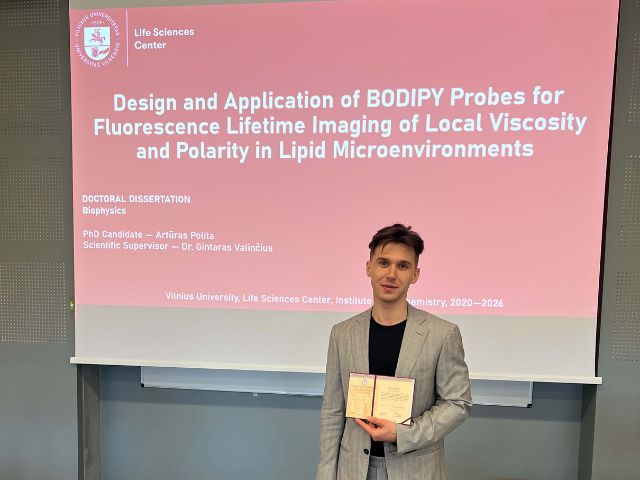
Artūras Polita has defended his thesis entitled "Design and Application of BODIP Probes for Fluorescence Lifetime Imaging of Local Viscosity and Polarity in Lipid Microenvironments" for the degree of Doctor of Science in Biophysics.
Scientific supervisor: Dr. Gintaras Valinčius (Vilnius University, Natural Sciences, Biophysics).
Composition of the Dissertation Defense Board: Chairperson - Prof. Dr. Saulius Bagdonas (Vilnius University, Natural Sciences, Biophysics); Dr. Lena Golubewa (Vilnius University, Natural Sciences, Chemistry), Prof. Dr. Gražvydas Lukinavičius (Max Planck Institute, Germany, Natural Sciences, Biochemistry), Prof. Dr. Daumantas Matulis (Vilnius University, Natural Sciences, Biophysics), Dr. Arūnas Stirkė (Center for Physical Sciences and Technology, Natural Sciences, Biophysics).
Quantitative imaging of the physical properties of cellular lipid structures remains challenging because conventional fluorescence microscopy provides limited information about membrane microenvironments, while many environment-sensitive probes exhibit low selectivity or cross-sensitivity. The aim of this dissertation was to develop fluorescence lifetime-based molecular sensors for quantitative measurements of microviscosity and polarity in cellular lipid structures and to apply them to the investigation of disease-related cellular processes.
A series of BODIPY-based molecular rotors and polarity-sensitive sensors was developed and photophysically characterised using time-correlated single-photon counting and fluorescence lifetime imaging microscopy in model lipid systems and living cells. The developed sensors enabled organelle-specific microviscosity measurements in plasma membranes, lipid droplets, and lysosomes.
Significant differences in membrane microviscosity were identified between lysosomes of cancer-derived and non-malignant cells, while treatment with chemotherapeutic drugs induced a redistribution of microviscosity within lipid droplets. The polarity-sensitive sensor showed that lipid droplet polarity increases during ferroptosis as a result of lipid peroxidation and decreases as resistance to ferroptosis develops. It was also demonstrated that the targeting of sensors to lipid droplets is determined not only by hydrophobicity but also by molecular geometry.