

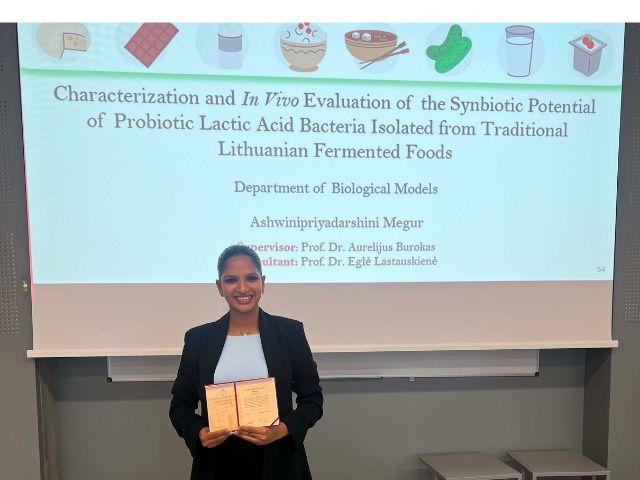
Ashwinipriyadarshini Megur defended her thesis entitled “Characterization and In Vivo Evaluation of the Synbiotic Potential of Probiotic Lactic Acid Bacteria Isolated from Traditional Lithuanian Fermented Foods” for the degree of Doctor of Science in Biochemistry.
Scientific supervisor: Prof. Dr. Aurelijus Burokas (Vilnius University, Natural Sciences, Biochemistry).
Scientific consultant: Prof. Dr. Eglė Lastauskienė (Vilnius University, Natural Sciences, Biology).
Composition of the Dissertation Defense Board: Chairperson – Prof. Dr. Julija Armalytė (Vilnius University, Natural Sciences, Biochemistry); Assoc. Prof. Dr. Audrius Gegeckas (Vilnius University, Natural Sciences, Biology), Assoc. Prof. Dr. Benjamin Anderschou Holbech Jensen (University of Copenhagen, Natural Sciences, Biochemistry), Dr. Cristina Torres Fuentes (University of Rovira i Virgili, Spain, Natural Sciences, Biochemistry), Prof. Dr. Gwénaël Jan (National Research Institute for Agriculture, Food and the Environment, France, Natural Sciences, Biology).
Traditional Lithuanian fermented foods harbour diverse microbial communities that may include lactic acid bacteria (LAB) with probiotic and synbiotic potential; however, this source remains poorly explored. The aim of this dissertation was to identify novel probiotic LAB strains and evaluate the most promising candidate in a mouse model of metabolic dysfunction.
A total of 150 LAB strains were isolated from fermented pear, tomatoes, cucumbers, cabbage, kombucha, and beans. Following in vitro screening based on survival, adhesion, and antimicrobial activity, ten candidates representing five genera were selected. Genome sequencing revealed genes associated with stress resistance, adhesion, and tryptophan biosynthesis, and five strains were identified as safe. Lacticaseibacillus paracasei 11W demonstrated high resistance and adhesion capacity, as well as the highest synbiotic production of L-tryptophan in combination with galactooligosaccharides (GOS). In a 25-week high-fat diet mouse model, supplementation with this strain and GOS alleviated metabolic disturbances, neuroinflammation, and anxiety- and depression-like behaviours, while increasing the abundance of Bifidobacterium, supporting its potential as a synbiotic candidate.