

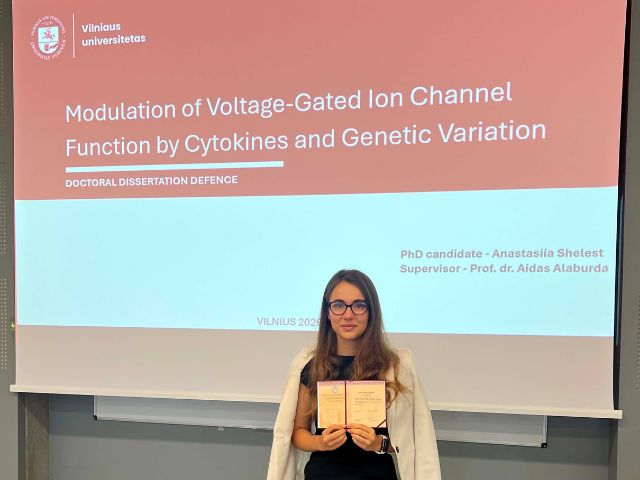
Anastasiia Shelest defended her thesis entitled “Functionality of Voltage-Gated Ion Channels: Influence of Cytokines and Genetic Variation” for the degree of Doctor of Science in Biophysics.
Scientific supervisor: Prof. Dr. Aidas Alaburda (Vilnius University, Natural Sciences, Biophysics).
Composition of the Dissertation Defense Board: Chairperson – Prof. Dr. Vilma Kisnierienė (Vilnius University, Natural Sciences, Biophysics); Assoc. Prof. Dr. Rokas Buišas (Vilnius University, Natural Sciences, Biophysics), Prof. Dr. Vitalijus Karabanovas (National Cancer Institute, Natural Sciences, Biophysics), Prof. Dr. Vitalii Kostenko (Poltava State Medical University, Ukraine, Medical and Health Sciences, Medicine), Prof. Dr. Saulius Šatkauskas (Vytautas Magnus University, Natural Sciences, Biophysics).
Voltage-gated ion channels regulate essential cellular processes in both excitable and non-excitable cells. Channel activity can be modulated by signalling molecules. In addition, mutations can alter the biophysical properties of ion channels and contribute to the development of pathological conditions. This dissertation comprises two studies investigating ion channel function.
The first study examined the effects of TGF-β3 and IL-1β on the activity of L-type voltage-gated calcium channels (L-VGCCs) and Ca²⁺ homeostasis in chondrocytes from patients with osteoarthritis and in human bone marrow-derived mesenchymal stem cells during chondrogenesis. The results showed that TGF-β3 differentially regulates L-VGCC function and intracellular Ca²⁺ homeostasis in different cell types, whereas IL-1β had no significant effect under the experimental conditions used.
The second study analysed the functional consequences of the c.1111G>C [p.(Ala371Pro)] mutation in the KCNQ1 potassium channel associated with long QT syndrome. Functional analysis showed that the p.Ala371Pro variant significantly reduced the IKs current by decreasing channel conductance without affecting voltage-dependent activation, thus confirming its pathogenic role in the development of long QT syndrome.