

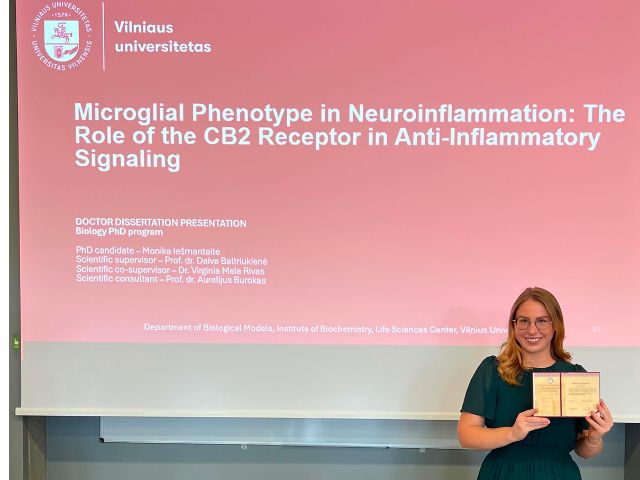
Monika Iešmantaitė defended her thesis entitled "Microglial Phenotype in Neuroinflammation: The Role of the CB2 Receptor in Anti-Inflammatory Signaling" for the degree of Doctor of Science in Biology.
Scientific supervisor: Prof. Dr. Daiva Baltriukienė (Vilnius University, Natural Sciences, Biology).
Scientific consultants: Dr. Virginia Mela (University of Málaga, Natural Sciences, Biology); Prof. Dr. Aurelijus Burokas (Vilnius University, Natural Sciences, Biology).
Composition of the Dissertation Defense Board: Chairperson - Assoc. Prof. Dr. Aušra Sasnauskienė (Vilnius University, Natural Sciences, Biology); Prof. Dr. Aidas Alaburda (Vilnius University, Natural Sciences, Biophysics), Dr. Veronika Viktorija Borutinskaitė (Vilnius University, Natural Sciences, Biology),
Dr. Indrė Kučinskaitė-Kodzė (Vilnius University, Natural Sciences, Biology), Dr. Cláudia Valente de Castro (University of Lisboa, Portugal, Natural Sciences, Biology).
Microglia are the main immune cells of the central nervous system, and their prolonged activation contributes to chronic neuroinflammation and the development of neurodegenerative diseases. The ketone body β-hydroxybutyrate (BHB) has anti-inflammatory properties; however, the receptor and signalling mechanisms underlying its effects on microglia remain incompletely understood.
The aim of this study was to determine the role of the CB2 receptor (CB2R) in mediating the effects of BHB on microglial phenotype and function under neuroinflammatory conditions. To comprehensively assess the effects of BHB, two complementary models were used: an in vivo mouse model of diet-induced obesity and an in vitro model of lipopolysaccharide (LPS)-activated primary mouse microglial cells.
In the brains of mice with diet-induced obesity, BHB reduced IL-1β and IL-6 levels, increased microglial branching, and altered the phagocytic profile. These changes were accompanied by altered expression of components of the endocannabinoid system. In LPS-activated primary mouse microglial cells, BHB enhanced phagocytosis, reduced the production of reactive oxygen species, decreased the expression of pro-inflammatory molecules, increased the expression of anti-inflammatory molecules, and inhibited NF-κB signalling.
Pharmacological blockade of CB2R attenuated or abolished some of these effects. Protein phosphorylation analysis revealed BHB-induced changes in signalling networks involved in inflammation, metabolism, cell survival, and cell death, some of which were sensitive to CB2R blockade.
The results indicate that BHB modulates the inflammatory phenotype of microglia and that CB2R signalling is one of the mechanisms underlying these effects.