

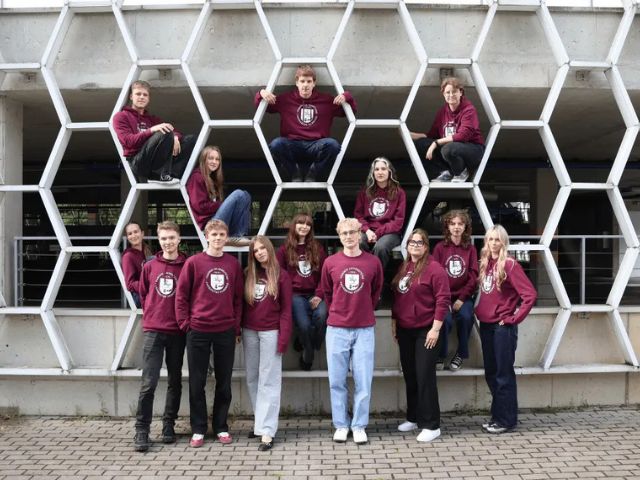
Bacteria hold far greater potential than might appear at first glance. Inside them are bacterial microcompartments (BMCs) – microscopic protein-based structures that could become valuable tools in future biotechnology. Before these natural systems can be applied beyond bacterial cells, however, scientists must first learn how to precisely control their assembly and tailor their properties for specific applications.
This is the challenge being addressed by this year's Vilnius-Lithuania iGEM team from Vilnius University through their project BMClick. The student researchers are developing a universal bioengineering platform that would enable bacterial microcompartments to be used with enzymes, biomolecules and functional surfaces. The team will present the platform this November at the international synthetic biology competition iGEM in Paris, which brings together more than 400 teams from around the world each year.
Microscopic protein compartments for enzyme protection and gene therapy
The platform is based on bacterial microcompartments (BMCs) – naturally occurring protein structures found in bacteria that function as specialised compartments within the cell, where specific chemical reactions take place. Rather than assembling these structures inside bacteria, the team aims to build them in vitro from individual components, creating a universal modular platform. Such a system could be easily adapted for different applications by modifying both its internal cargo and its surface properties.
One of the project's main focuses is enzyme encapsulation – enclosing enzymes within BMCs. Enzymes are widely used in scientific research as well as in the food, chemical and pharmaceutical industries, but they are highly sensitive to environmental conditions such as temperature changes, acidity and other adverse factors. In this context, BMCs could act as protective shells, shielding enzymes from degradation and enabling them to function in environments where they would normally lose their activity.
The team is also exploring ways to package not only enzymes but a broad range of other biomolecules, including DNA, inside BMCs. Short DNA molecules can regulate gene expression, yet they are inherently unstable within the body. The researchers hope that BMCs could serve as protective protein carriers, safeguarding these molecules and delivering them to their intended destination. If successful, the platform could eventually find applications not only in fundamental research but also in the development of gene therapy technologies.
A third direction of the project involves creating visible functional surfaces made from bacterial proteins. These surfaces can be functionalised with enzymes, antimicrobial proteins or even individual cells, giving them specific desired properties. In the future, such structures could contribute to more efficient industrial biocatalysts, highly sensitive biosensors for medicine and environmental monitoring, as well as antimicrobial coatings for medical devices and other surfaces that require protection against pathogens.
The platform under development could have applications across a wide range of fields, from medicine to industrial biotechnology. Its key strength lies in its versatility: the same biological system can be adapted for different purposes, making its potential far broader than that of a single end product.
"Our goal is not to create a tangible product. We aim to engineer the proteins that form bacterial microcompartments so that they can be easily adapted for a variety of applications. In other words, we are building a universal tool that other scientists will be able to use in the future," says Ema Ežerskytė, Laboratory Lead of the Vilnius-Lithuania iGEM team.
Science beyond the laboratory
The activities of the Vilnius-Lithuania iGEM team extend far beyond laboratory research. The students are committed to promoting synthetic biology through educational activities, public events and new ways of making complex scientific concepts accessible to diverse audiences. On 29 August, the team will participate in the BŪTENT Discussion Festival, where they will engage with members of the public in conversations about the relationship between science and everyday life.
This year's outreach activities are inspired by the concept of third place theory, which suggests that meaningful conversations and community connections are most likely to emerge not at home or at work, but in informal spaces such as cafés, libraries and parks. Drawing on this idea, the team seeks to bring conversations about synthetic biology beyond academia and into places where people naturally gather, exchange ideas and engage with one another.
"When talking to people about science, it is not enough to simply explain complex ideas in an accessible way. It is equally important to listen to what people think and understand the questions or concerns they have. These conversations help us better appreciate the purpose of our project and remind us that scientific progress truly matters only when innovations developed in laboratories address real societal needs," says Oskaras Belousovas, Team Lead of the Vilnius-Lithuania iGEM team.
Vilnius University students have represented Lithuania at the international iGEM competition since 2015. During this time, the team has consistently earned Gold Medals, while two of its projects – SynORI (2017) and FlavoFlow (2020) – received the competition's Grand Prize. In 2023, the Vilnius-Lithuania iGEM team also achieved an outstanding result by finishing in second place.
More information about the BMClick project and opportunities to support its development can be found on the Vilnius University Foundation website.