

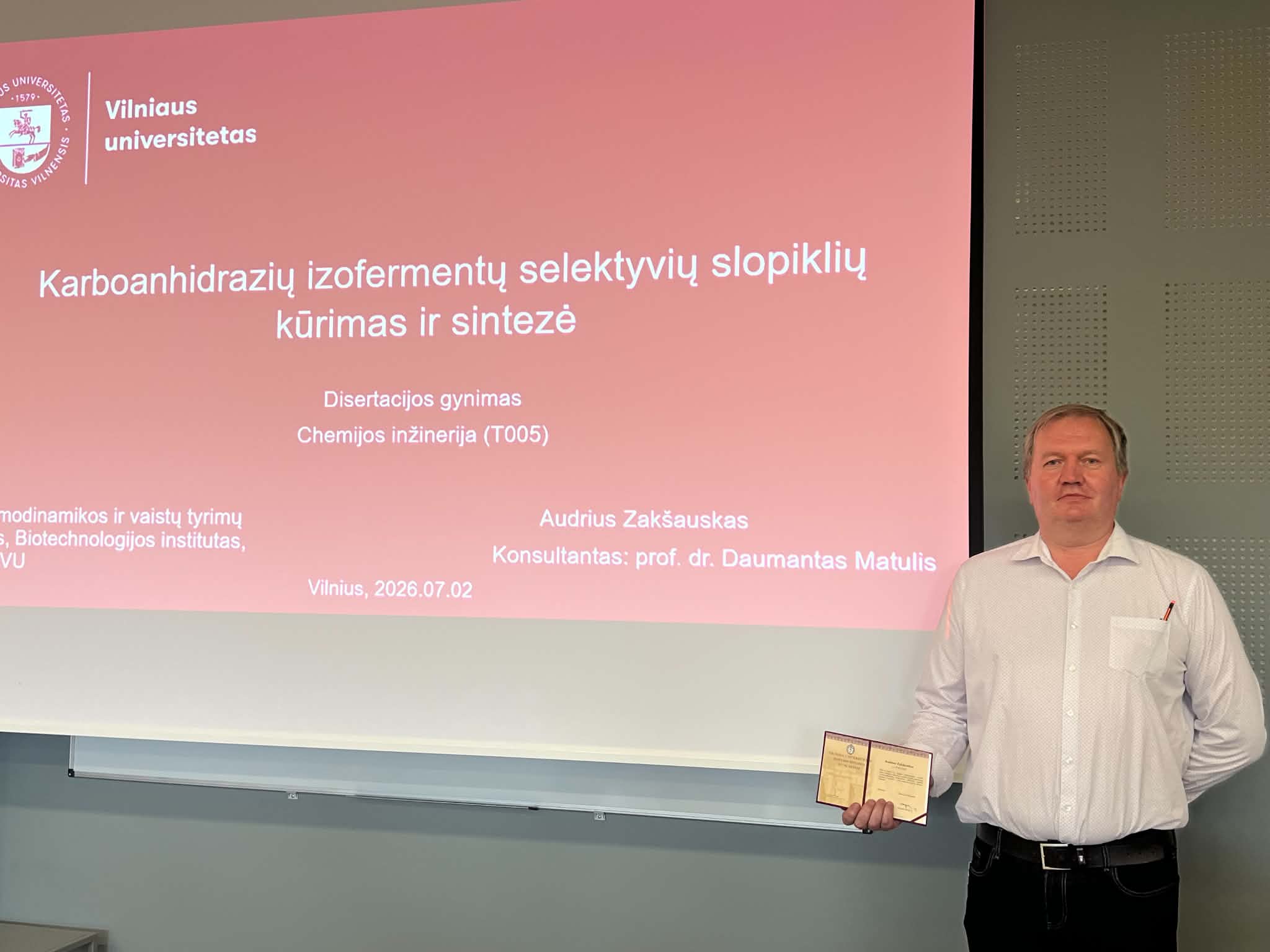
Audrius Zakšauskas has defended his thesis entitled "Design and Synthesis of Isozyme-Selective Carbonic Anhydrase Inhibitors" for the degree of Doctor of Science in Chemical Engineering.
Scientific consultant: Prof. Dr. Daumantas Matulis (Vilnius University, Technological Sciences, Chemical Engineering).
Composition of the Dissertation Defense Board: Chairperson - Prof. Dr. Rolandas Meškys (Vilnius University, Technological Sciences, Chemical Engineering); Prof. Dr. Eglė Arbačiauskienė (Kaunas University of Technology, Natural Sciences, Chemistry), Assoc. Prof. Dr. Rima Budvytytė (Vilnius University, Natural Sciences, Biochemistry), Dr. Jonas Šarlauskas (Vilnius University, Technological Sciences, Chemical engineering), Dr. Saulius Šumanas (University of South Florida, USA, Natural Sciences, Biochemistry).
The development of small-molecule chemical drugs is a long and costly process that has become increasingly complex in recent decades due to higher requirements for efficacy and safety. The first stage of this process involves the identification, organic synthesis, and optimization of a potential drug
candidate capable of being useful in the treatment of a specific disease or condition. Achievement of this stage requires an understanding of how drugs interact with target structures of biological systems (receptors, enzymes, transporters, etc.) and how desired drug properties can be obtained through
structural modification. In order to understand general principles of drug development, enzymes
are among the most attractive research targets. They usually exhibit selective activity, i.e., high substrate specificity, which makes it possible to develop drugs that affect only a specific biological process. In addition, many diseases are known to be associated with changes in enzyme expression and, consequently, in the functions they perform. Furthermore, the high catalytic activity of enzymes allows even small amounts of an inhibitor to significantly affect enzyme activity and produce a strong therapeutic effect. Moreover, such pronounced changes in activity often facilitate laboratory studies and
accelerate the research process itself. Therefore, in this dissertation, one such family of research targets – carbonic anhydrases – was selected