

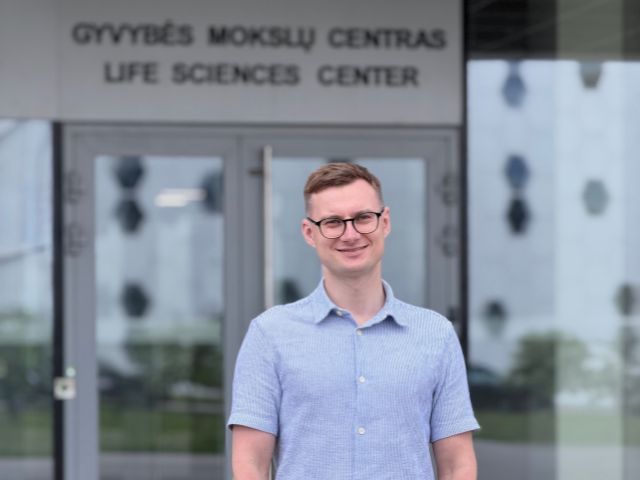
An article by Vilnius University Life Sciences Center researcher Dr. Dalius Ratautas and his team, published in the journal ACS Sensors, has been recognized as “ACS Editors’ Choice”. This is an initiative of the American Chemical Society (ACS), in which, based on editors’ recommendations, one article is selected each day from across the entire ACS publications portfolio for its broad public interest and significance. The ACS portfolio includes more than 70 scientific journals, making this recognition an important international acknowledgement not only of this particular work, but also of the bioanalysis and biosensor research direction at VU LSC.
This article is not a demonstration of a new biosensor. It is a critical review analysis of the field, assessing why, after more than three decades of intensive research, electrochemical DNA biosensors have still reached clinical practice only to a limited extent. Such works are important for science policy and for shaping the direction of the field: they help distinguish where a technology has real application potential and where progress mostly remains at the level of laboratory demonstrations.
Below, researcher Dr Dalius Ratautas answers questions about the publication, the research behind it, and the significance of this international recognition.
Why is this article important?
The article demonstrates the maturity of the VU LSC scientific community. The ability not only to develop new biosensors, but also to critically assess an entire field – its strengths, limitations, unresolved problems, and realistic application niches – is a scientific contribution that helps shape the direction of the field. The “ACS Editors’ Choice” recognition shows that this analysis was acknowledged as relevant and interesting to a broad international audience.
Why did you choose such a critical topic?
The article primarily emerged from our practical experience. When my team and I began working on electrochemical DNA biosensors in the Department of Bioanalysis at VU LSC, the application aspect and practical value were always, and still remain, part of our plans. We worked extensively on surface chemistry, DNA detection, and signal registration, but we also encountered certain limitations ourselves. These showed that there is often a large gap between laboratory results and real clinical application. The article discusses this gap, explains its causes, and, in our view, provides a “recipe” for what should be done.
What is the main message?
Electrochemical DNA biosensors are a highly interesting and valuable technology when expectations and visions are aligned with DNA biology, technological constrains, clinical and the market needs. An important part of the article is positive. We emphasize new horizons: DNA is a programmable molecule that can be applied very broadly not only as a target, but also as a functional tool in next-generation biosensors.
What does this work and the “ACS Editors’ Choice” recognition mean for the team?
It is an important symbolic and scientific recognition. Works like this emerge only in an environment where it is possible to ask uncomfortable questions, discuss, make mistakes, argue, and grow. I therefore sincerely thank the entire team, and especially the Head of the Department of Bioanalysis, Dr. Marius Dagys. The working culture of the department – strong academic freedom, trust in researchers, space for independent ideas, and openness – is what makes it possible to achieve results that are visible internationally.
Publication: Dalius Ratautas, Skomantas Serapinas, Deimantė Stakelytė, Simona Guobužaitė, Andrijana Danytė, Marius Dagys, “Quo vadis, electrochemical DNA biosensor? Lessons from three decades of SNP sensing,” ACS Sensors, 2026. https://doi.org/10.1021/acssensors.6c01221
Do you have questions or are you interested in collaboration? Contact Dr. Dalius Ratautas: