

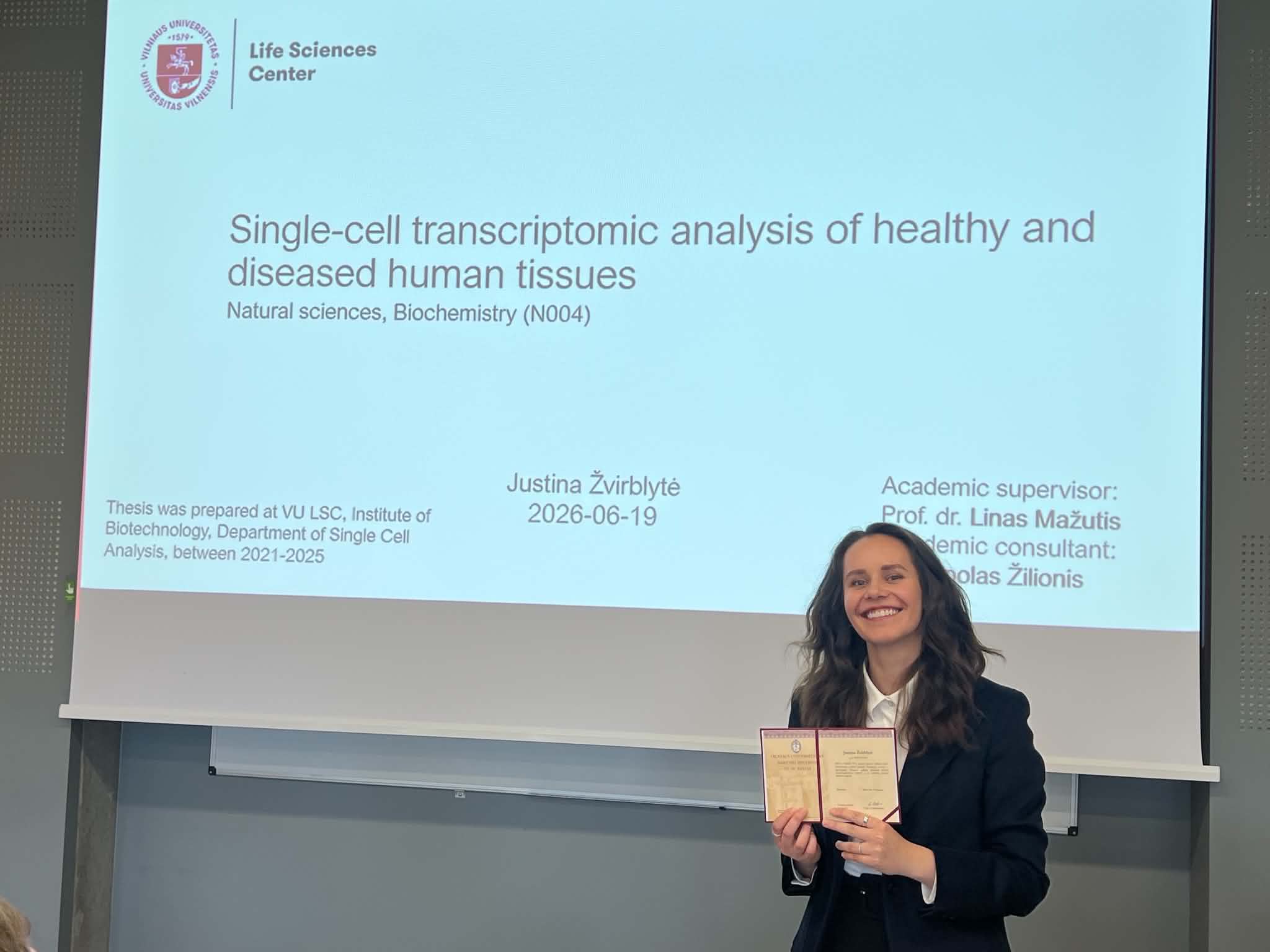
Justina Žvirblytė defended her thesis entitled "Single-Cell Transcriptomic Analysis of Healthy and Diseased Human Tissues" for the degree of Doctor of Science in Biochemistry.
Scientific supervisor: Prof. Dr. Linas Mažutis (Vilnius University, Natural Sciences, Biochemistry).
Scientific consultant: Dr. Rapolas Žilionis (Vilnius University, Natural Sciences, Biochemistry).
Composition of the Dissertation Defense Board: Chairperson - Dr. Daiva Dabkevičienė (Vilnius University, Natural Sciences, Biochemistry); Assoc. Prof. Dr. Johan Henriksson (Umeå University, Sweden, Natural Sciences, Biochemistry), Assoc. Prof. Dr. Monika Mozerė (Vilnius University, Natural Sciences, Biochemistry), Prof. Dr. Saulius Serva (Vilnius University, Natural Sciences, Biochemistry), Prof. Dr. Kęstutis Sužiedėlis (Vilnius University, Natural Sciences, Biochemistry).
Human tissues are extraordinarily complex and consist of diverse specialised cell types. Although most somatic cells share the same genome, their distinct identities arise from differential genome utilisation – a precisely regulated, context-dependent pattern of gene expression that determines a specific phenotype. In disease, this process becomes disrupted, leading to even greater cellular diversity. Revealing this diversity is essential for understanding tissue function and disease progression and holds significant diagnostic and therapeutic potential.
Traditional transcriptomics methods measure average gene expression across tissues, thereby masking the characteristics of individual cells. Advanced single-cell RNA sequencing (scRNA-seq) technology enables analysis of gene expression at the single-cell level and provides new insights into complex biological systems.
This dissertation focuses on the development and application of high-throughput scRNA-seq technology for the investigation of healthy and pathological human tissues. First, an improved microfluidics-based scRNA-seq platform, inDrops-2, is presented, and its performance is demonstrated through the analysis of lung carcinoma tissues. The method is then applied to investigate cellular heterogeneity in healthy and tumoural kidney tissues, revealing important features of the tumour microenvironment and identifying a novel subtype of tumour endothelial cells with an apical phenotype. Finally, the dissertation presents the world’s first comprehensive transcriptomic atlas of uncultured human amniotic fluid cells, enabling the non-invasive analysis of cells shed from various foetal tissues.