

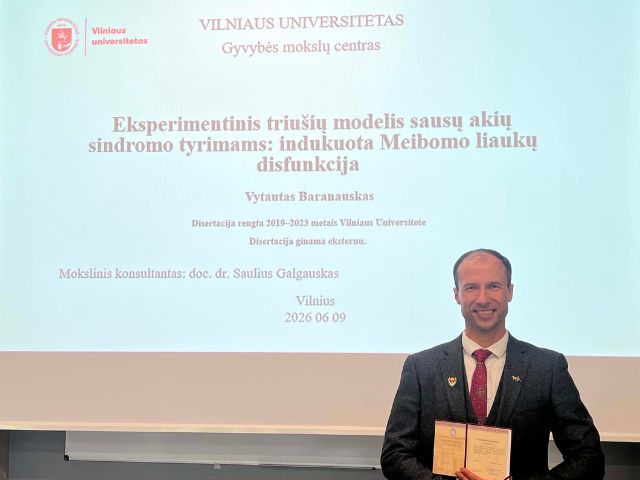
Vytautas Baranauskas has defended his thesis, "Experimental Rabbit Model for Dry Eye Syndrome Studies: Induced Meibomian Gland Dysfunction," for the degree of Doctor of Science in Biology.
Scientific consultant: Dr. Saulius Galgauskas (Vilnius University, Natural Sciences, Biology).
Composition of the Dissertation Defense Board: Chairperson - Prof. Dr. Daiva Baltriukienė (Vilnius University, Natural Sciences, Biology); Assoc. Prof. Dr. Mindaugas Mitkus (Vilnius University, Natural Sciences, Biology); Prof. Dr. Osvaldas Rukšėnas (Vilnius University, Natural Sciences, Biology); Prof. Dr. Vytautė Starkuvienė-Erfle (Heidelberg University, Natural Sciences, Biology); Prof. Dr. Reda Žemaitienė (Lithuanian University of Health Sciences, Medicine and Health Sciences, Medicine).
Dry Eye Syndrome (DES) and Meibomian Gland Dysfunction (MGD) are common and complex ocular surface diseases characterized by tear film instability, inflammation, and structural damage to the meibomian glands. This study aimed to develop an experimental rabbit model of DES based on MGD that accurately reproduces the key pathophysiological mechanisms of the disease and is suitable for preclinical evaluation of novel therapeutic agents.
Four different DES and MGD models were successfully established during the study: surgical removal of the lacrimal glands, benzalkonium chloride-induced chemical injury of the ocular surface, cauterisation of Meibomian gland orifices, and an inflammatory model induced using Complete Freund’s Adjuvant (CFA). These models enabled the reproduction of distinct etiological and pathogenic mechanisms underlying DES.
The results demonstrated that MGD exerts a multifaceted impact on the ocular surface, including corneal epithelial damage, reduced conjunctival goblet cell density, inflammatory cell infiltration, and a significant decrease in both tear film stability and tear production. These findings confirm the multifactorial nature of DES and highlight the close relationship between Meibomian gland function and ocular surface homeostasis.
Evaluation of the models revealed that the MGD model induced with Complete Freund’s Adjuvant (CFA) was the most suitable for assessing the efficacy of novel therapeutic agents. Biomimetic liposomal formulations (Lipo@Cur and Lipo@CycA) significantly reduced inflammatory processes and improved tear film stability, with the Lipo@CycA group showing the most pronounced therapeutic effect. Lipo@Cur also demonstrated beneficial effects, although to a lesser extent, while no significant improvement was observed in the control group. These results validate the suitability of the developed model and provide a reliable preclinical foundation for the further development of innovative ophthalmic therapies.