

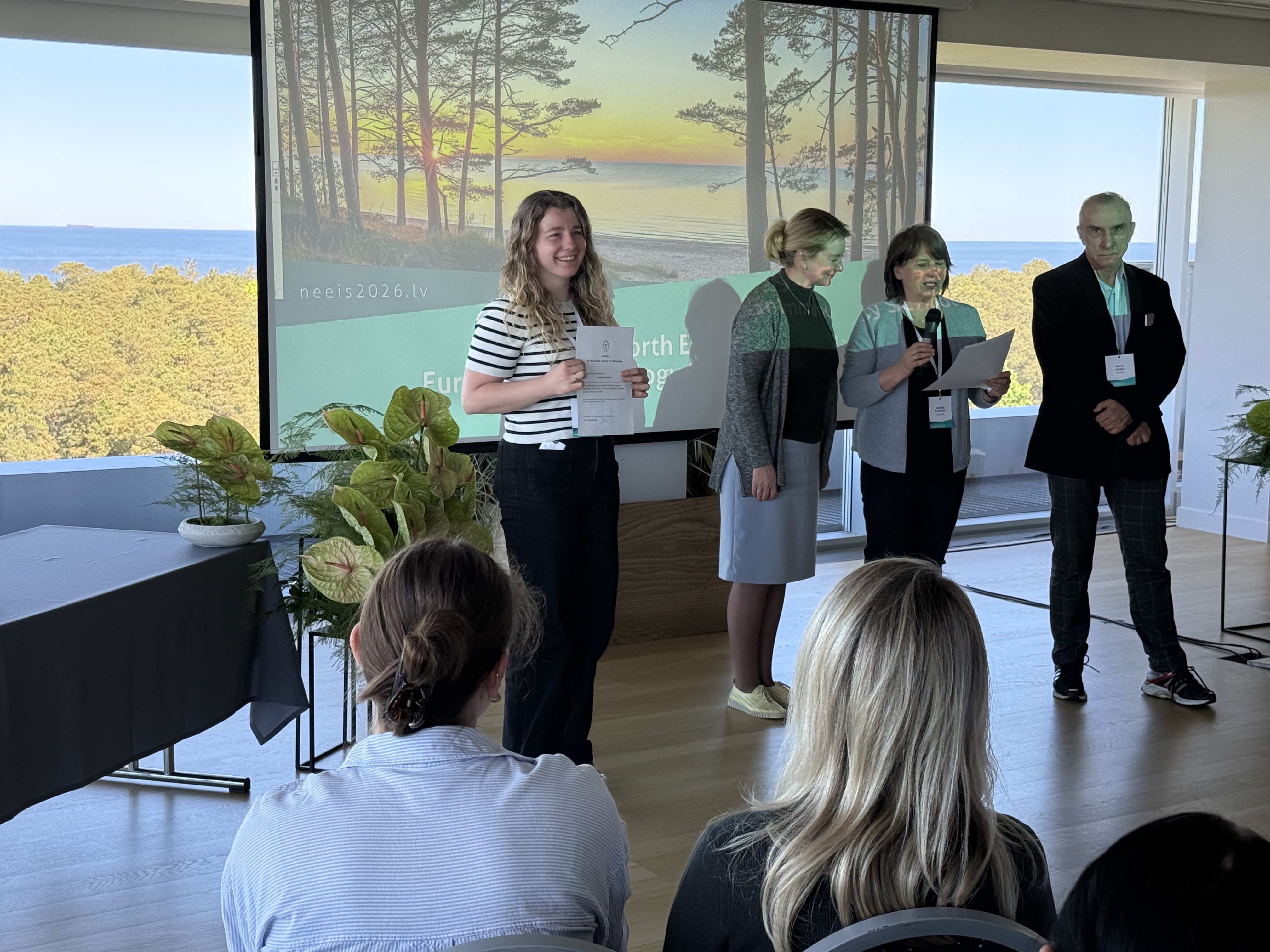
On 28–30 May 2026, the EFIS-EJI North Eastern European Immunology School (NEEIS 2026) took place in Jurmala, Latvia, bringing together students, PhD candidates, clinicians, and researchers from the Baltic countries, Poland, Ukraine, and Germany. The event aimed to strengthen regional collaboration in immunology, promote networking among early-career scientists, and provide opportunities to exchange the latest findings in both basic and clinical immunology.
Researchers and students from the Department of Immunology at the Life Sciences Center actively participated in the event. Prof. Aurelija Žvirblienė was invited to deliver the lecture “Inflammatory Response of Macrophages”, in which she presented recent research on the mechanisms underlying macrophage-mediated inflammatory responses. PhD student Kristina Mašalaitė presented her research during a short talk session. For the high scientific quality of her work and its excellent presentation, she was awarded the Latvian Society of Immunology Prize. Poster presentations were also delivered by members of the Department of Immunology, including Indrė Dalgėdienė, Dr. Karolina Bielskė, Dr. Dovilė Stravinskienė, and PhD student Povilas Žukauskas.
Support from the Study Department of Life Sciences Center enabled four students to participate in the conference: Nitika Mahajan (1st-year MSc student in Molecular Biotechnology), Arnas Treimakas (1st-year MSc student in Molecular Biology), Guoda Turauskaitė (1st-year BSc student in Genetics), and Kamilė Vestfal (2nd-year MSc student in Molecular Biotechnology). The students actively contributed to the scientific programme. Nitika Mahajan was selected to give a short oral presentation, while Arnas Treimakas presented his research during the poster session and in a flash talk.
Participation in NEEIS 2026 provided students and young researchers with an opportunity not only to learn about the latest advances in immunological research and present their own work to an international audience, but also to deepen their understanding of clinical immunology. The programme featured numerous clinical case presentations and discussions, helping participants better understand the role of immunological mechanisms in the diagnosis and treatment of immune-mediated diseases. The event also provided an excellent platform for establishing new professional connections and strengthening collaboration among researchers from the Baltic region and neighbouring countries.