

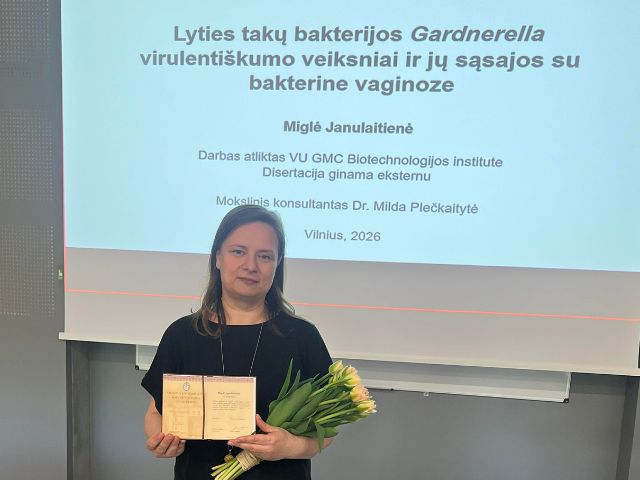
Miglė Janulaitienė has defended her thesis entitled "Virulence Factors of Vaginal Bacteria Gardnerella and their Association with Bacterial Vaginosis" for the degree of Doctor of Science in Chemical Engineering.
Scientific consultant: Dr. Milda Plečkaitytė (Vilnius University, Technological Sciences, Chemical Engineering).
Composition of the Dissertation Defense Board: Chairperson - Prof. Dr. Julija Armalytė (Vilnius University, Natural Sciences, Biochemistry); Dr. Laura Kalinienė (Vilnius University, Natural Sciences, Biochemistry), Dr. Saulius Kulakauskas (French National Institute for Agriculture, Food, and Environment, France, Natural Sciences, Biochemistry), Dr. Inga Matijošytė (Vilnius University, Technological Sciences, Chemical Engineering), Dr. Milda Norkienė (Vilnius University, Technological Sciences, Chemical Engineering).
Bacterial vaginosis (BV) is a highly prevalent form of vaginal microbiota imbalance among women of reproductive age worldwide, characterised by a reduction in lactobacilli and an overgrowth of various anaerobic bacteria. The bacterium Gardnerella is detected in the vagina of nearly all women with BV, although it is also present in lower amounts in some healthy women. Gardnerella exhibits distinctive virulence potential: it forms biofilms, produces the toxin vaginolysin, and secretes sialidases. It is believed that both commensal and pathogenic Gardnerella strains exist, belonging to different subtypes that differ in virulence and in their roles within the microbiota.
The aim of this study was to detect Gardnerella and determine its subtypes in healthy and BV-associated vaginal microbiota samples collected from women living in Lithuania (n=109), to isolate Gardnerella strains, and to characterise their virulence factors (biofilm formation, vaginolysin production, and sialidase secretion), as well as their distribution among Gardnerella subtypes/species.
Results and conclusions: Gardnerella was detected in all BV microbiota samples and in 87% of healthy microbiota samples. Subtypes 1 and 4 were most frequently identified. The presence of multiple Gardnerella subtypes was associated with BV microbiota, whereas strains belonging to a single subtype were characteristic of healthy microbiota. A total of 34 strains belonging to subtypes 1, 2, and 4 were isolated from vaginal samples; however, no strains of the rarely detected subtype 3 were successfully isolated. Subtype 4 strains lacked genes encoding sialidases and showed no sialidase activity; this may explain why this subtype is frequently detected in healthy vaginal microbiota. Gardnerella subtypes demonstrated differing virulence potential: subtype 4 was homogeneous and exhibited low expression of the investigated virulence factors, whereas subtypes 1 and 2 were heterogeneous and characterised by distinct phenotypic profiles.