

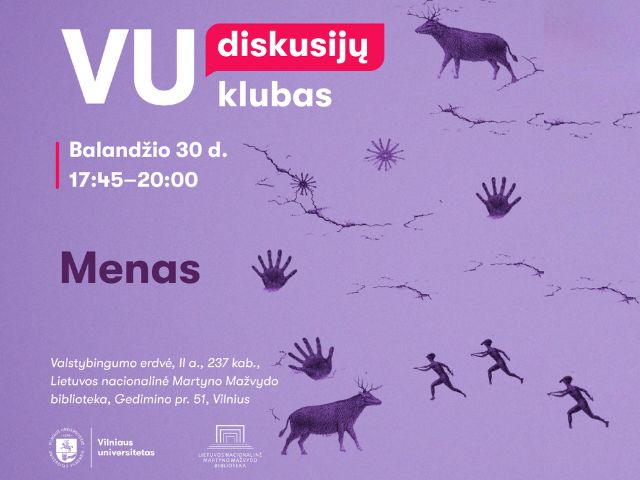
Art often seems like a self-evident part of human activity – it accompanies us in museums, cities, and on screens. Yet we rarely pause to ask: what is art, really, and why does it exist at all? On 30 April, the Vilnius University (VU) Discussion Club will host a conversation about art, approaching it as a cultural phenomenon, a form of thinking, and an experience that takes place in the brain.
One of the earliest traces of human creativity is cave paintings. They appeared before writing, before clearly defined language. Were they an attempt to convey information, to mark experience, or to connect with something beyond everyday life? Has art, from the very beginning, been a form of communication?
Over time, art has taken on many forms – from architecture to abstract ideas. Are the spaces we inhabit merely functional, or do they also speak to us? Does art reflect the world, or does it create it?
This discussion is an invitation to pause and reconsider something that feels familiar, yet remains ultimately undefined.
The discussion will feature architecture historian and professor at the VU Faculty of History Marija Drėmaitė; art critic, cultural commentator, and lecturer at the Lithuanian Academy of Music and Theatre Dr Karolina Rybačiauskaitė; neuroscientist and professor at the Vilnius University Life Sciences Center Inga Griškova-Bulanova; and interdisciplinary artist Robertas Narkus. The event will be moderated by Ieva Šiugždaitė.
The event will take place on 30 April at 17:45 in the Statehood Space (2nd floor, Room 237) at the Martynas Mažvydas National Library of Lithuania (Gedimino Ave. 51, Vilnius).
You can find the registration link here.