

A team of scientists from the Institute of Biochemistry, Bioanalysis Department, at the Vilnius University Life Sciences Center, led by Dr. Dalius Ratautas, has secured funding through one of the most competitive Lithuania–Japan bilateral research programmes [1]. Their project, Development of a Single Nucleotide Polymorphism Biosensor Based on DNA Nanotweezers, focuses on creating next-generation biosensors. The aim is to establish a fundamentally new principle for detecting genetic mutations, converting extremely small differences in DNA into a clearly measurable electrochemical signal.
“This achievement is particularly important to us. An already highly competitive programme attracted a record number of applications this year, so receiving funding confirms both the strength of the project idea and its scientific quality, as well as our team’s competence at the international level. It also demonstrates that the technologies we are developing could complement the currently dominant methods of genetic analysis,” says project leader Dr. Dalius Ratautas.
Small Sensors – Big Opportunities
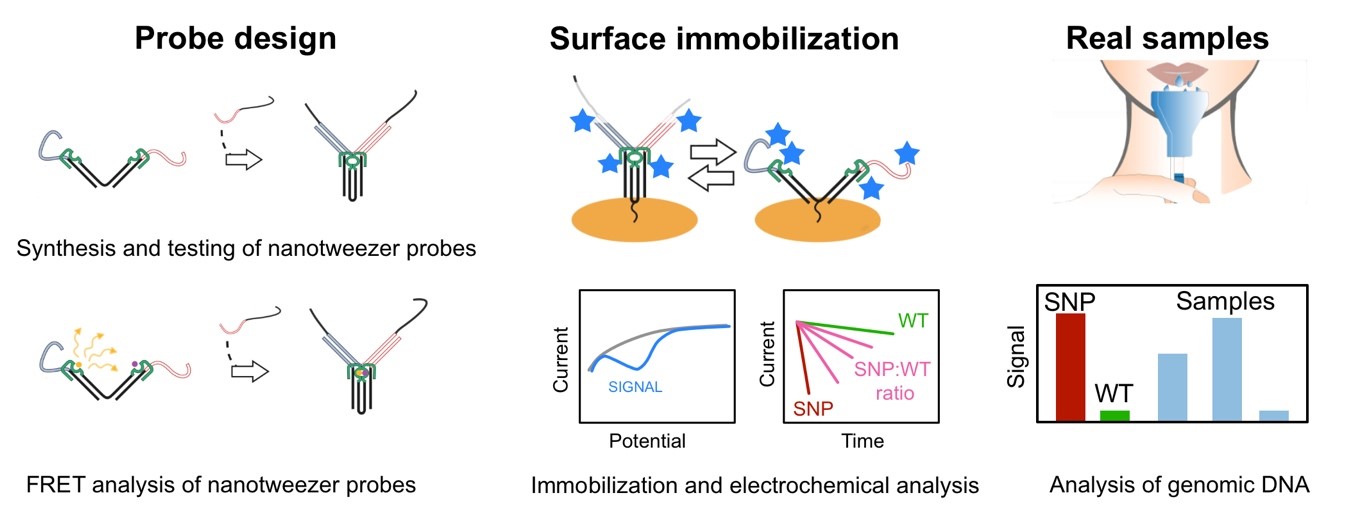
“The awarded project allows us not only to continue our ongoing work with electrochemical DNA sensors [2], but also to develop the concept itself further – to exploit not only DNA binding, but also its kinetics and stability differences, to convert even very small genetic mismatches into a clearly measurable electrochemical response,” explains PhD candidate Skomantas Serapinas.
 |
In the future, such sensors could enable the detection of genetic differences from extremely small samples, such as a drop of blood or saliva.
“We are talking about so-called single nucleotide polymorphisms – extremely subtle changes where just one DNA ‘letter’ differs. These are often the most difficult to detect reliably, especially when mutations are located very close to one another. However, their significance can be considerable – they may determine susceptibility to certain diseases or influence how the body responds to medication,” says PhD student Deimantė Stakelytė.
“As an example, we can mention clinically relevant mutations in the KRAS gene. These are frequently found in various types of cancer and are associated with tumour growth and resistance to treatment. Such mutations may differ by only a few nucleotides, making them difficult to distinguish even using advanced sequencing methods. Our method is based on the dynamics of DNA binding and dissociation, which would allow these mutations to be differentiated more precisely,” adds PhD candidate Simona Guobužaitė.
The researchers aim for this technology to enable faster, simpler, and more cost-effective detection of DNA changes in the future – without the need for complex optical equipment or thermocycling, relying instead on compact electrochemical measurement. This could pave the way for moving genetic testing beyond specialised laboratory settings.
International Collaboration
“In this project, we will combine our electrochemical sensor technologies with DNA nanostructures developed by our Japanese colleagues, known as DNA nanotweezers. In simple terms, these are structures that change their shape upon recognising a specific DNA sequence. This change acts as a molecular switch, enabling selective discrimination between perfectly matching and mismatched DNA sequences,” explains Dr. Marius Dagys, Head of the Bioanalysis Department.
This combination of technologies could significantly increase the system's sensitivity. “We aim for the system to detect even very small proportions of genetic changes – for example, when mutated DNA constitutes only about one-tenth of the entire sample. This is important for diagnosing certain conditions where genetic alterations are unevenly distributed, and mutations represent only a small fraction of the total genetic material,” says Dr. Dalius Ratautas.
The project’s partners in Japan are experts in DNA nanotechnology: Prof. Hisakage Funabashi from Hiroshima University, who has published in prestigious journals such as Nature Nanotechnology and Nature Materials, and Prof. Kuniaki Nagamine from Yamagata University.
In the near future, the Lithuanian public will have an opportunity to learn about their research firsthand – a public guest lecture is planned at the Vilnius University Life Sciences Center, where both scientists will present their work. To strengthen collaboration, a visit by Lithuanian researchers to Hiroshima University is also planned.