

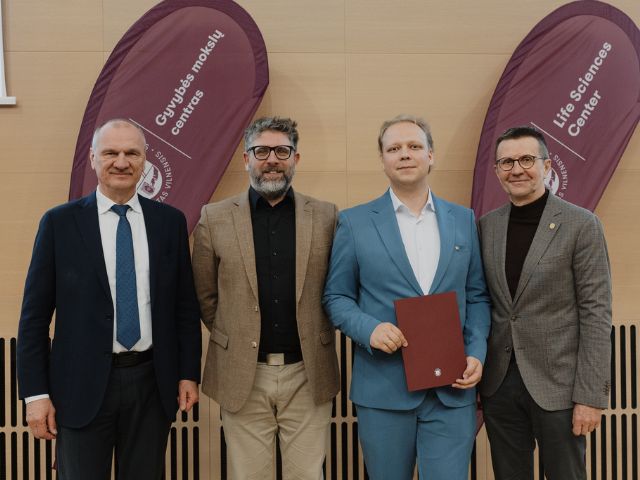
A PhD student at the Vilnius University Life Sciences Center (VU LSC), Džiugas Sabonis, has been awarded the Prof. Virginijus Šikšnys Scholarship in recognition of internationally acknowledged scientific achievements in the life sciences.
The €10,000 scholarship was established by Go Vilnius, the official business and tourism development agency of the City of Vilnius, to promote high-value-added life sciences research and strengthen the capital’s competitiveness within the international innovation ecosystem.
The award was presented to the laureate by Mangirdas Šapranauskas, Head of the Business Department at Go Vilnius. “Today, world-class life sciences ideas are born in Vilnius. The Prof. Šikšnys Scholarship helps nurture talent and contributes to shaping one of the fastest-growing high-tech sectors in Lithuania, which expands by more than 20% annually,” said M. Šapranauskas.
From Music to Molecular Biology
Sabonis’s path to science was neither straightforward nor planned. During his school years, it might have seemed that he would become a musician – he attended a music school in Alytus and took part in various competitions. After finishing the eighth grade, he moved to Vilnius to study at the National M. K. Čiurlionis School of Arts.
However, a decision made in his final year of school changed the course of his life. As he recalls, the turning point was not what he excelled at, but how he thought.
“Music came naturally to me, but I approached it not creatively, but constructively. That made me question whether I could truly express my strength – rational thinking – through music,” he reflects.
This doubt led him to search for a field where he could apply his analytical mindset. By speaking with professionals from different fields and trying to understand their choices, Sabonis ultimately chose to study biochemistry at Vilnius University. This discipline allows for a systematic exploration of life processes and provides a community of diligent, knowledge-driven peers.
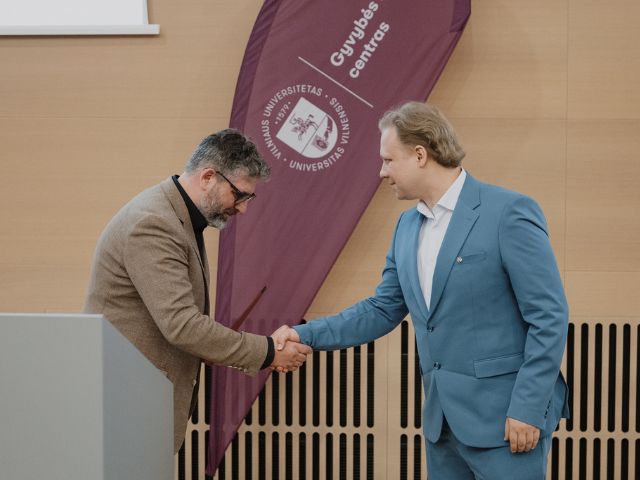 |
| Džiugas Sabonis, a PhD student at the VU LSC. Photo by Vilnius University. |
Research Revealing the Principles of Bacterial “Immune Systems”
Currently, Sabonis is investigating bacterial defence mechanisms against viruses – complex molecular systems that enable microorganisms to detect infection and halt it before the virus can spread.
One of his most significant studies focuses on a type of bacterial “immune system” named after the ancient Egyptian goddess Thoeris. In a paper published in the prestigious scientific journal Nature, Sabonis, together with researchers from the Vilnius University Life Sciences Center (VU LSC), revealed the operating principles of this system.
They found that a protein recognising viral infection produces a signalling molecule, which in turn activates another protein – an effector. Once assembled into a spiral structure, this effector begins degrading NAD+, a molecule essential for bacterial survival. This process triggers the infected cell's death and prevents the virus from spreading.
Another study published in Nature presents the discovery and characterisation of a new signalling molecule, His-ADPR, identified by Sabonis and a team of VU LSC researchers. This molecule acts as a “message,” transmitting information about viral infection and activating the bacterial defence response.
Importantly, Sabonis was a key contributor to this discovery – he played a central role in the structural and biochemical analyses that helped explain how these signals are recognised and how the protective mechanism is initiated.
These studies expand the fundamental understanding of bacterial antiviral systems. This rapidly advancing field has, in recent years, led to the development of gene-editing tools now being applied to treat severe genetic diseases.
Recognition as Motivation to Move Forward
Sabonis acknowledges that the scholarship is significant not only as recognition of his achievements but also as motivation to continue his research.
“It shows that I am moving in the right direction. Science is a long process, often involving uncertainty, so such recognition provides an additional push to keep going,” he says.
The young scientist emphasises that his studies at Vilnius University have allowed him to grow in an international environment – collaborating with researchers abroad, working in modern laboratories, and contributing to high-level research.
An Investment in the City’s Future
The Prof. Virginijus Šikšnys Scholarship was established to honour his contribution to the discovery of the CRISPR-Cas9 gene-editing technology and to strengthen Vilnius’s position as an international life sciences hub.
Initiatives like this not only recognise achievements already made but also create conditions for young scientists to develop further research conducted in Vilnius – research that has the potential to change the world.