

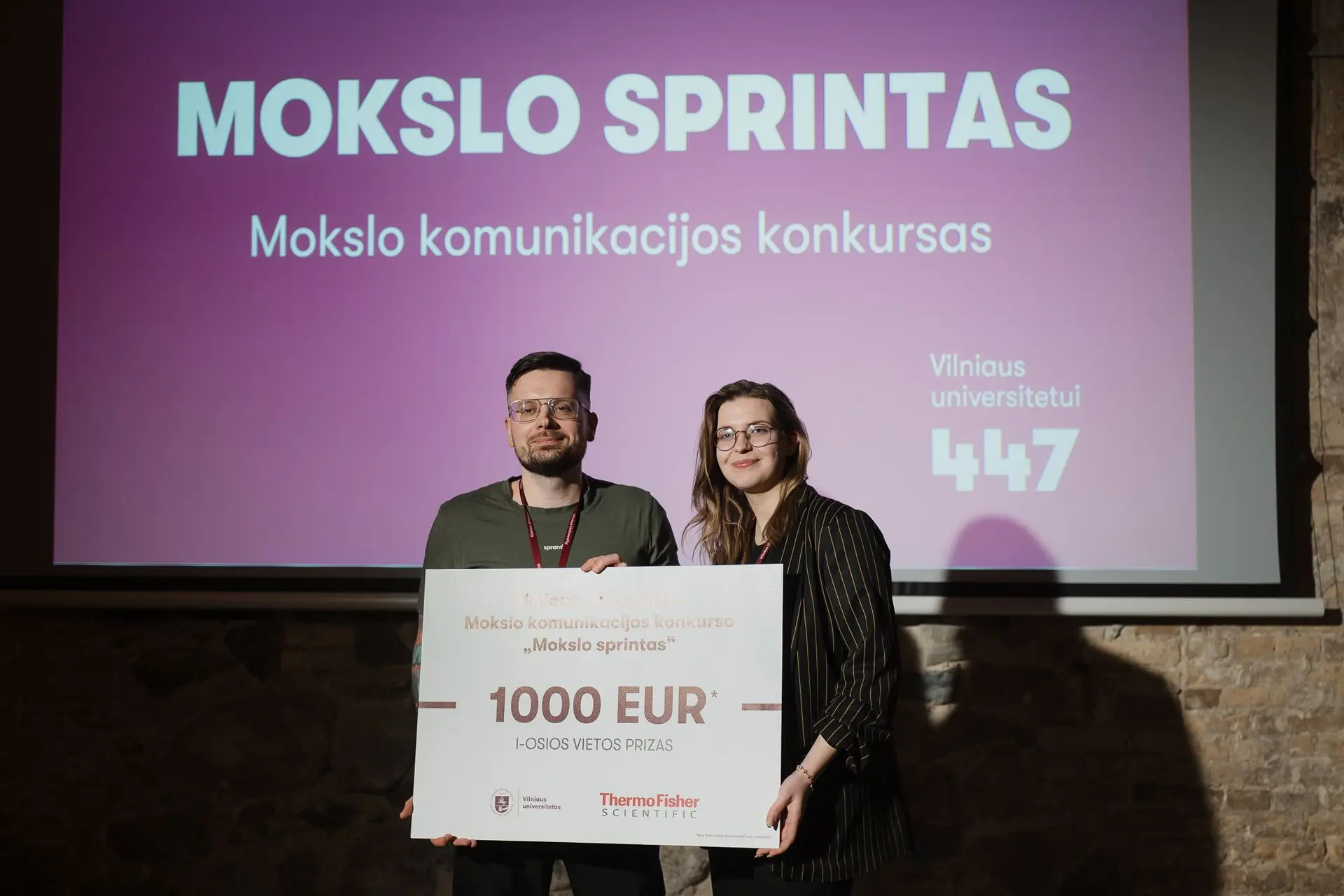
Marking the 447th anniversary of Vilnius University, the science communication competition Mokslo sprintas competition was held for the fifth time. First place was awarded to members of the Vilnius University Life Sciences Center team “Neuron Translators” – doctoral student Igoris Nagula and fourth-year undergraduate student Gabija Valentaitė – who presented their talk “What Does the Electrical Language of Neurons Reveal About the Development of Brain Networks?” in just three minutes. The winning team received a €1,000 prize from the competition partner, Thermo Fisher Scientific.
The winners were participating in “Mokslo sprintas” for the second time – last year, they placed second. “This year, we thought we needed first place – we had to go all the way,” says Nagula.
The team admits they did not expect to win, but notes that lessons learned from the previous year helped secure their victory. “When I was writing the text, I remembered the feedback we received last year and what we hadn’t done – we didn’t make good slides. This year, we did, we prepared more seriously, and in the end, it worked,” the doctoral student explains.
Both Nagula and Valentaitė say that the most difficult part of the competition was managing stress. “Before going on stage, I could feel my palms starting to sweat and my heart beating faster,” the student admits.
Second place went to the Faculty of Philology team “LengvAi,” consisting of Associate Professor Laura Vilkaitė-Lozdienė and Aušrinė Tverskytė, who presented “How to Write Texts for Those Who Find Reading More Difficult?” Third place was awarded to the Faculty of Philosophy team “Well-being Team,” whose members – Professor Jurgita Lazauskaitė-Zabielskė and doctoral student Rita Jakštienė – delivered the presentation “No One Wants to Burn Out.” The second-place winners received a €600 prize. In contrast, third place was awarded €400. These prizes were sponsored by the Sunrise Valley Science and Technology Park.
This year, eight selected teams – each consisting of a lecturer and a student – competed in the contest. Teams had three minutes to present their research or idea. The topics explored during the event ranged from the issue of drug use in Vilnius and reflections on whether cemeteries could become urban green spaces, to the development of a health-supporting product addressing deficiencies in vitamin D and antioxidants.
Participants were evaluated by a panel consisting of Laima Balčiūnė, Director of the Sunrise Valley Digital Innovation Centre; Eglė Stukaitė-Ruibienė, Teaching Assistant at the Faculty of Medicine of Vilnius University; Artiomas Akatovas, Production Manager at Thermo Fisher Scientific Baltics; Professor Antanas Kairys of the Institute of Psychology at the Faculty of Philosophy of Vilnius University; and Karolina Panto, a radio host at LRT. Participants were assessed based on the relevance of their topic, scientific accuracy, clarity, and their ability to communicate science engagingly and compellingly.