

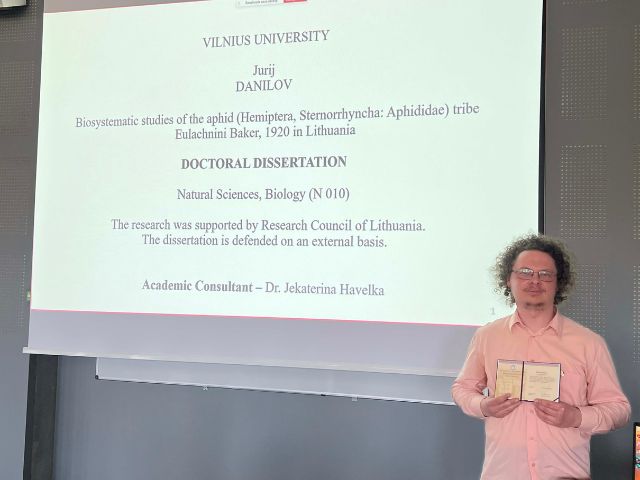
Jurij Danilov has defended his thesis entitled "Biosystematic studies of the aphid (Hemiptera, Sternorrhyncha: Aphididae) tribe Eulachnini Baker, 1920 in Lithuania" for the degree of Doctor of Science in Biology.
Scientific consultant: Dr. Jekaterina Havelka (Vilnius University, Natural Sciences, Biology).
Composition of the Dissertation Defense Board: Chairperson - Prof. Dr. Virginija Podėnienė (Vilnius University, Natural Sciences, Zoology); Dr. Rasa Bernotienė (State Scientific Research Institute Nature Research Centre, Natural Sciences, Zoology); Prof. Habil. Dr. Mariusz Kanturski (University of Silesia in Katowice, Poland, Natural Sciences, Zoology); Assoc. Prof. Dr. Virginijus Sruoga (Vilnius University, Natural Sciences, Biology); Assoc. Prof. Dr. Jurga Turčinavičienė (Vilnius University, Natural Sciences, Biology).
Aphids of the Eulachnini tribe spend their entire life cycle exclusively on gymnosperm plants. They are not only pests of forest and ornamental plants but also beneficial insects for beekeepers – the honeydew they excrete is collected to produce so-called “forest honey.” These aphids show a preference for specific parts of their host plants, and some species exhibit seasonal migration between aboveground and underground parts of their host plants. Faunistic information on Eulachnini aphids found in Lithuania is fragmentary and insufficient. Not all of their morphs are known. The literature also reports certain discrepancies between the classification and species boundaries of the Eulachnini tribe and the results of molecular phylogenetic studies.
This study presents research on the fauna, biology, phylogenetic relationships, and problematic species complexes of Eulachnini aphids occurring in Lithuania. Six species new to Lithuania were identified during the study. Periodic investigations of host specialization and life cycles revealed representatives of five previously unrecorded morphs belonging to three aphid species. Partial sequences of the COI gene from five aphid species and of the EF-1α gene from seven species were included in phylogenetic analysis for the first time. Taxonomic evaluations were carried out for three problematic species complexes: Cinara (Cinara) pilosa, C. (C.) pinea, and C. (C.) piniphila; Cinara (Cinara) piceicola, C. (C.) pilicornis, and C. (C.) pruinosa; and Cinara (Schizolachnus) obscura and C. (S.) pineti.