

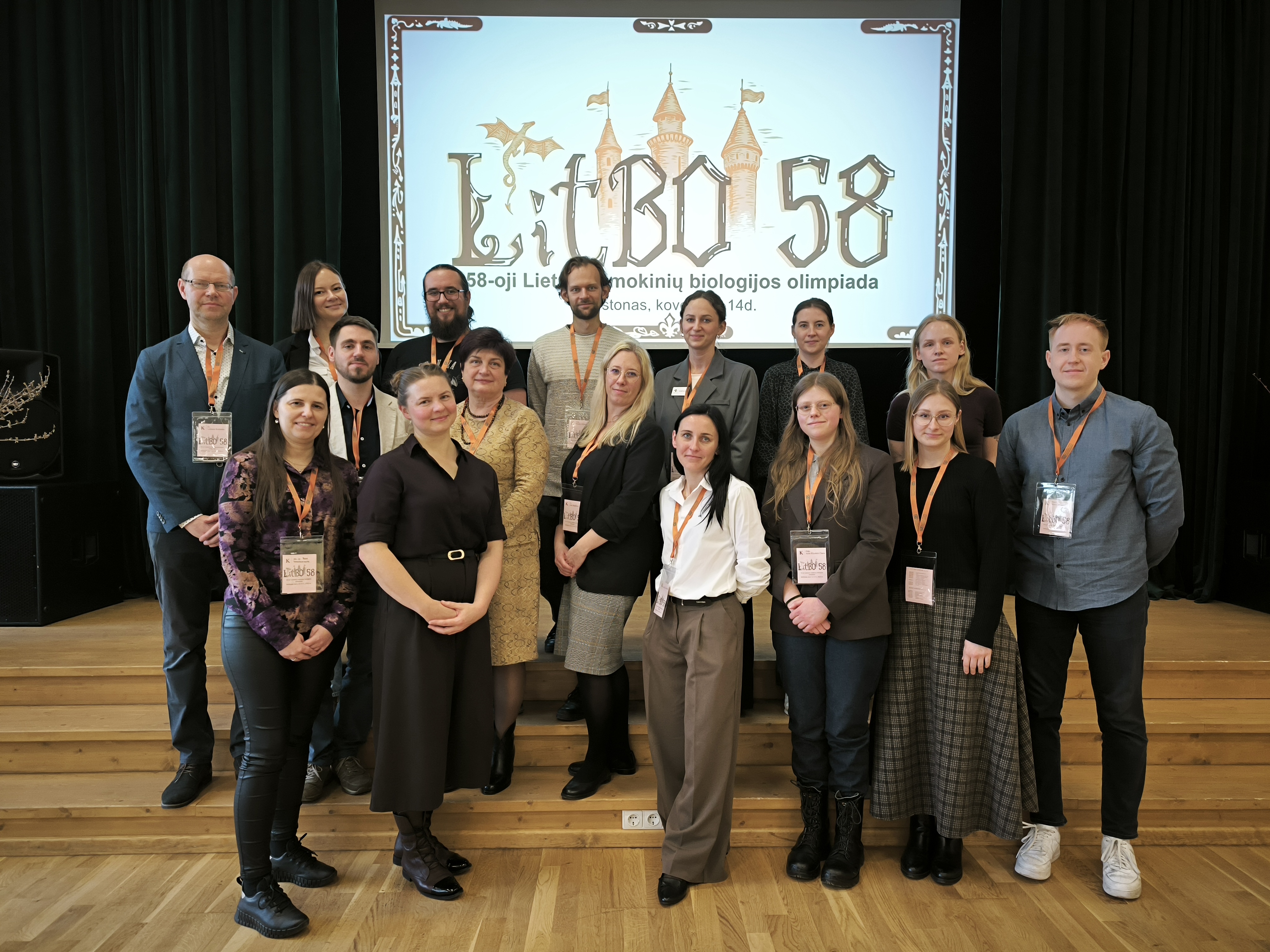
The Biology Olympiad in Lithuania has been held for the 58th time this year. As every year, it brought together the most talented students from forms 9–12 across the country. Nearly 2,500 students participated in the second municipal round, while 120 of the best advanced to the national stage.
Olympiads in Lithuania are organised by LINEŠA, and tasks are prepared and assessed in close cooperation with scientific and educational institutions. Scientists from the Vilnius University Life Sciences Center (VU LSC), the VU LSC Didactics Centre, the Vilnius University Methodological STEAM Education Centre, and the Kaunas University of Technology Gymnasium actively contribute to this process. Representatives of VU LSC serve annually on both municipal and national evaluation committees.
During the Olympiad, participants’ activities are coordinated by the Lithuanian Association of Natural Science Olympiads “Oranžiniai.” Young members of the organisation aim to increase young people’s interest in science by spreading what they call the “orange – 600 nanometres – light of science.” The association is currently led by VU LSC student Domantas Barkauskas.
According to the organisers, collaboration between different institutions ensures that the tasks reflect both the school curriculum and current scientific developments.
Assoc. Prof. Dr. Indrė Lapeikaitė, Head of the VU LSC Didactics Centre, notes that organising the Olympiad presents many challenges each year, but also provides an important space for students to grow. “Here they meet like-minded peers, build connections, and deepen their knowledge,” she says. According to her, the opportunity to be among the top four and represent Lithuania at the International Biology Olympiad is significant recognition and a strong motivation to pursue her field of interest further and strive for the highest achievements.
This year, the International Biology Olympiad will be held in Vilnius for the first time, bringing together students from more than 80 countries. As preparations continue, some national stage participants will be invited to training camps – around 15 selected students are expected to deepen their knowledge in the laboratories of VU LSC, where they will prepare for international challenges together with scientists.
According to Assoc. Prof. Dr. I. Lapeikaitė, Olympiads not only help nurture young talent but also strengthen ties between schools and higher education institutions, encouraging long-term interest in the life sciences.
Those wishing to contribute to the International Biology Olympiad are invited to volunteer in Vilnius from 12 to 19 July. More information