

Hormonal changes during the menstrual cycle can affect not only physical well-being but also emotions, behavior, and mental health. However, the boundary between natural cyclical fluctuations and disorders often remains unclear, and more severe conditions – such as premenstrual dysphoric disorder (PMDD) – are still underrecognized both in Lithuania and internationally.
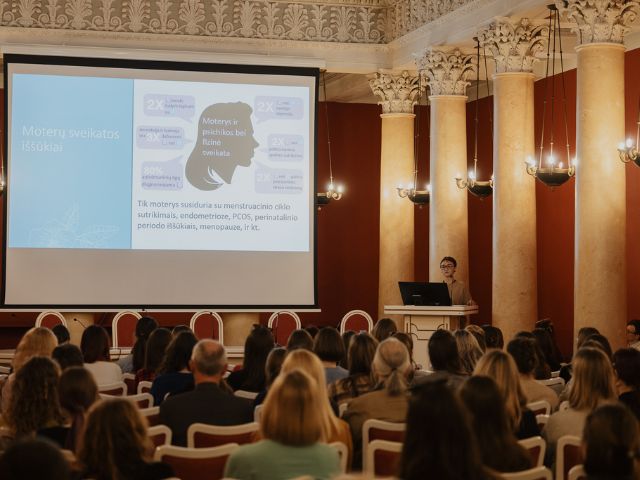
These issues were discussed at an open science and clinical practice event held at Vilnius University, Women’s Psychological (Emotional) Well-being and the Menstrual Cycle, where researchers and clinicians from different fields examined the links between hormones, brain function, and emotional well-being, and presented the results of a Lithuanian survey on women’s emotional health during the menstrual cycle.
Differences in women’s mental health
Prof. Ramunė Grikšienė, a neurobiologist at the Life Sciences Center of Vilnius University, pointed out that many mental health disorders are diagnosed more frequently in women than in men.
“Approximately twice as many women as men attempt suicide. Depression is diagnosed in women about twice as often as in men, and anxiety-related disorders are also more common among women. Eating disorders such as anorexia and bulimia are almost exclusively female conditions – women are affected about three times more often than men,” she said.
“Women are also twice as likely to experience post-traumatic stress disorder. Although PTSD is often associated with war experiences, women are less likely to encounter such events, yet the disorder is diagnosed in them more frequently,” Prof. Grikšienė added.
According to her, this is only part of the broader picture. “And here I’ve only talked about mental illnesses. There is also a whole range of physiological diseases that occur more often in women. For example, about 80% of autoimmune diseases – such as Sjögren’s syndrome or multiple sclerosis – are diagnosed in women. Do we know why this is?” she asked.
A long-standing “male model” in medicine
According to Prof. Grikšienė, one reason we still have less data about women’s bodies lies in the history of medical research itself.
“For a long time, medical and neuroscience research was conducted primarily on male organisms – both in animal models and clinical studies. The female body was often considered too complex due to hormonal fluctuations that could ‘distort’ results,” she explained.
This approach has had consequences: studies show that women experience adverse drug reactions more often, and in some areas of medicine, there is still a lack of scientific data about female physiology.
“However, the situation is gradually changing. In Canada, Europe, and Australia, there has been growing emphasis for more than a decade on systematically considering biological sex differences in medical research,” she said.
The brain changes during the cycle
The brain regulates hormone release, but once hormones enter the bloodstream, they also act back on the brain via receptors.
Prof. Grikšienė explained that estrogen receptors are found in many brain regions – the brainstem (which regulates alertness and sleep), areas responsible for emotions and memory, and the prefrontal cortex, which is involved in decision-making and impulse control.
“This means that hormones affect not only the reproductive system but also the brain. Therefore, it is natural that their fluctuations can influence emotions, behavior, and overall well-being,” she said. Sex hormones also affect neurotransmitters such as serotonin, dopamine, and oxytocin.
The menstrual cycle is a highly complex process involving constant interaction between the brain and the reproductive system. “Research shows that even brain structure can change during the cycle. For example, in the hippocampus – a region associated with memory and emotions – the number of neuronal connections may vary depending on estrogen levels,” she noted.
Modern MRI studies indicate that the volume of brain tissue in certain regions can also change throughout the cycle. “These are not just abstract hormonal fluctuations – they can have very real neurobiological effects,” she emphasized.
According to her, different hormones may affect brain activity in different ways. Estrogen is more often associated with increased brain activity, energy, and sociability, while progesterone is linked to states of calmness, sleepiness, or increased caution.
For some women, these hormonal changes manifest as premenstrual syndrome (PMS) or its more severe form – PMDD.
When cycle-related changes become a disorder
Dr. Jūratė Aleknavičiūtė, a clinical psychologist from Erasmus University in the Netherlands, presented a case illustrating how strongly the menstrual cycle can affect emotional well-being.
She described Laura, a 34-year-old woman with a family, a young child, and a skilled job. “At first glance, her life appeared stable, but in reality, she had long been seeking help for difficult-to-explain emotional states,” she said.
Initially, her difficulties were often linked to alcohol use within the mental health system. She attended addiction treatment groups but struggled to maintain abstinence and was removed from programs. However, she herself felt that alcohol was not the core issue – it was a way of coping with distressing thoughts.
These states occurred cyclically, about a week before menstruation. During that time, anxiety, sadness, and irritability intensified, conflicts with loved ones arose, and sometimes suicidal thoughts appeared. After menstruation, her well-being improved abruptly.
“Once menstruation began, she felt energetic, creative, and reconnected with her family. But after ovulation, sadness, anxiety, and irritability returned, reaching an emotional low point before menstruation,” Dr. Aleknavičiūtė explained.
Such cyclical emotional fluctuations are characteristic of PMDD, a severe form of PMS. “I sometimes say that the difference between PMS and PMDD is like the difference between a severe cold and pneumonia,” she added.
It is estimated that about 1 in 20 women may experience this condition. However, diagnosis is often delayed. “Research shows that it can take up to ten years from the onset of symptoms to diagnosis,” she noted.
Challenges in clinical practice
Gynecologist Akvilė Vilkaitienė emphasized that women often seek help for a wide range of symptoms – from irritability and fatigue to anxiety or physical discomfort.
“Sometimes a woman may think this is simply her personality or that she is just more sensitive. But in some cases, these may be the first signs of premenstrual disorders,” she said.
One of the biggest challenges is diagnosis. “Patients often request hormone tests, but in both PMS and PMDD, hormone levels are usually normal. The issue is not the amount of hormones, but increased sensitivity of the nervous system to hormonal changes,” she explained.
She also noted that in Lithuania, PMDD often does not have a distinct diagnostic code, making its true prevalence difficult to determine.
Survey in Lithuania: limited awareness of PMDD
At the event, PhD student Lauryna Filatovaitė-Vyčienė from the Life Sciences Center of Vilnius University presented results from a Lithuanian survey involving around 1,600 women.
The findings showed that while most women have heard of PMS, only a small proportion are aware of PMDD. Even those experiencing severe symptoms often do not know where to seek help.
According to the researchers, this highlights a significant lack of information and the need for more discussion about women’s mental health.
The need to reduce stigma
Speakers agreed that the menstrual cycle affects women’s well-being not only biologically but also through social context – societal expectations, stereotypes, and cultural attitudes.
Sociologist Prof. Aurelija Novelskaitė noted that menstruation has historically been interpreted through myths and medical theories – sometimes as a “cleansing” process, at other times as a cause of emotional instability. These interpretations have shaped taboos and stereotypes that still influence how women talk about their experiences and how others respond.
According to Dr. Aleknavičiūtė, women with PMDD often face dismissal or comments suggesting it is “part of being a woman.”
“It is very important for these women to be heard and understood. Women experiencing PMDD are not ‘others’ – they are our sisters, colleagues, and partners,” she said.
Experts emphasize that increasing public awareness about the impact of the menstrual cycle on emotional health could help better recognize conditions like PMDD and reduce stigma. Strengthening the healthcare system is also crucial – clearly identifying the disorder, introducing a specific diagnostic code, and ensuring that professionals are prepared to recognize and support patients.
A new study in Lithuania
To better understand the biological and psychological mechanisms behind these symptoms, researchers at the Life Sciences Center of Vilnius University are launching a new study.
The study will involve women of reproductive age experiencing premenstrual symptoms, as well as women in the perimenopausal period.
It will be a longitudinal study: participants will complete well-being questionnaires and will later be invited to the laboratory, where brain activity will be measured.
The project also plans to develop psychoeducational tools and a mobile application to help women better understand changes in their well-being throughout the menstrual cycle.
The study is supported by partners, including EPAM, Johnson Matthey, and the Lithuanian brand Gentle Day.