

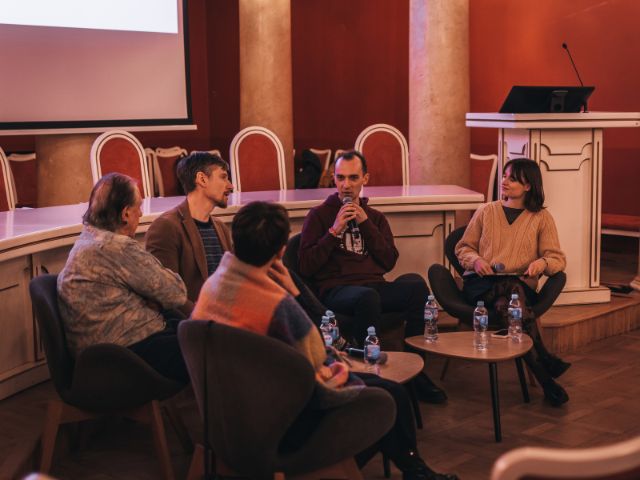
Is Love a Chemical Reaction in the Brain, a Social Construct, or a Dynamic System Describable by Mathematical Equations? This question was explored at Vilnius University (VU) Discussion Club by scholars from different fields – anthropologists, neuroscientists, and mathematicians. Although love is often seen as a mysterious and difficult-to-define feeling, it can be examined just as seriously as any other scientific phenomenon.
Love Between Bodily Needs and Self-Realization
Opening the discussion, cognitive psychology researcher Assoc. Prof. Vytautas Jurkuvėnas from the Institute of Psychology at the VU Faculty of Philosophy noted that psychology often understands love as a human need positioned between basic physiological needs and higher ones – such as self-realization, the search for meaning, and spiritual aspirations.
The psychologist referred to Maslow’s hierarchy of needs and to Erich Fromm’s idea that love is not about “finding the right person,” but rather about developing the ability to create and sustain a relationship. Attachment theory was also discussed.
According to Jurkuvėnas, attachment theory suggests that a person’s first bond with caregivers becomes a kind of “template” that later repeats in relationships with partners. Early experiences can influence whether someone feels secure in relationships or tends toward anxiety or avoidance.
“Many of our decisions – including partner choice – happen unconsciously. We believe we are choosing rationally, but a large part of these processes takes place in the subconscious,” said Assoc. Prof. V. Jurkuvėnas.
The discussion also raised the idea that love may be understood as a type of relationship in which a new identity emerges. It is not simply the sum of two individuals, but a kind of “third space” where the boundaries of the self shift. When the relationship ends, part of this shared identity seems to disappear. Psychologically, this resembles a loss – requiring a process of separation and grieving before a person can build a new bond.
Love Begins in the Brain
Prof. Ramunė Grikšienė, a neuroscientist at the Life Sciences Center of Vilnius University (VU LSC), explained that the biological foundations of love are far older than humanity itself.
According to her, neurotransmitters such as dopamine, oxytocin, vasopressin, and others play key roles in forming attachment, feelings of safety, and interpersonal bonds.
“When we are with someone important to us and experience pleasure, the brain’s reward system is activated – dopamine is released. This encourages us to seek that connection again,” the professor explained.
Oxytocin plays a particularly important role. This hormone is released during childbirth and breastfeeding, strengthening the bond between mother and infant. However, it is also important in romantic relationships, helping to create closeness, trust, and a sense of safety.
In the early stages of falling in love, the body also experiences stress – cortisol levels increase while serotonin levels decrease. As a result, people may behave more impulsively and experience an obsessive focus on another person. Over time, however, higher brain regions – such as the prefrontal cortex, responsible for decision-making and emotional regulation – become involved in the process.
“Biology writes a certain script, but we can adjust it. Over time, a close partner becomes part of our regulatory system – helping maintain emotional balance,” said Prof. R. Grikšienė.
Love Shaped by Culture and Social Norms
Prof. Victor Celestine de Munck, a sociocultural anthropologist at the VU Faculty of Philosophy, approached love from an anthropological perspective. He noted that love became a popular subject of scientific research only in the late 20th century, when it was recognized as a culturally universal phenomenon found in all societies.
However, love is not limited to romantic relationships. It can also refer to family bonds, attachment to ideas, or even national identity.
The professor also emphasized that the relationship between two people is a universal social structure:
“Although different cultures have various forms of partnership – such as polygyny, polyamory, or other models – the core unit in most societies remains the couple. The bond between two people forms the foundation for family, child-rearing, and social stability.”
The discussion also highlighted that modern society increasingly views love as an individual choice rather than a relationship regulated by the community. Relationships become conditional – dependent on personal satisfaction and the subjective decision to stay or leave.
At the same time, the concept of “ontological rootedness” was introduced – the desire to find a relationship in which a person feels existentially grounded, secure, and “rooted.”
Can Emotions Be Calculated?
Dr. Vytenis Šumskas from the VU Faculty of Mathematics and Informatics presented a mathematical model of love sometimes called the “Romeo and Juliet” system.
In this model, the feelings of two individuals are described by differential equations that account for their reactions to each other and their individual “emotional cooling” rates. One partner’s love may strengthen the other’s feelings – or, conversely, trigger withdrawal.
“Models are always simplifications – they cannot capture the full scope of human experience. But they show that relationships are dynamic systems. They can stabilize, oscillate, or ‘explode’ when tension becomes too great,” the mathematician explained.
According to him, love does not have a single final solution – it is a constantly changing process in which the sensitivity and responses of both partners matter.
Between Biology and Unconscious Decisions
The discussion highlighted a shared conclusion: although love has a biological basis, it cannot be reduced to hormones alone. Early relationship patterns, cultural expectations, and even structural changes in society also play a role.
The scholars agreed that love is neither merely an emotion nor an instinct – it is a multilayered phenomenon in which biology, psychology, and culture intersect. Perhaps it is precisely this complexity that makes love one of the most powerful human experiences – difficult to explain fully, yet endlessly explored.
The VU Discussion Club invites the public once a month to an open interdisciplinary space where ideas and different ways of thinking meet beyond academic disciplines. The focus is not on finding a final answer, but on the process of thinking itself – the ability to question, doubt, and listen to others.
The next meeting of the VU Discussion Club is scheduled for the 26th of March at the Martynas Mažvydas National Library of Lithuania. A recording of the discussion on love is available on the VU YouTube channel.