

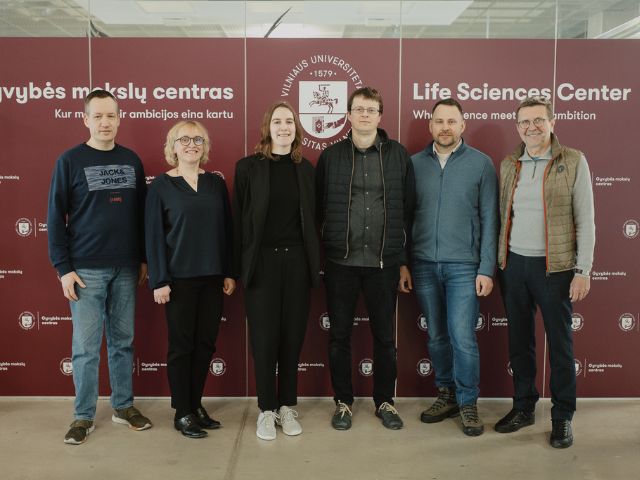
Scientists at the Life Sciences Center of Vilnius University (VU LSC), Dr. Ugnė Gaižauskaitė, Dr. Giedrė Tamulaitienė, Dr. Arūnas Šilanskas, Dr. Giedrius Gasiūnas, Prof. Virginijus Šikšnys, and Dr. Giedrius Sasnauskas have investigated how the bacterial protein Cas9, better known as the CRISPR-Cas “genetic scissors,” helps bacteria integrate fragments of viral DNA from infecting viruses – bacteriophages – into their genome, thereby acquiring resistance to viral infections.
The study describing this work, entitled “Structural insights into Cas9-mediated prespacer selection in CRISPR-Cas adaptation,” was published in the prestigious, high-impact journal Molecular Cell.
The Mechanism of Bacterial Immune Memory
According to Dr. Giedrius Sasnauskas, CRISPR-Cas systems are among the best-studied defense mechanisms bacteria use against viruses – bacteriophages. Their activity is typically divided into three stages: adaptation, guide RNA synthesis, and interference.
“Most often, attention is focused on the final stage – when the Cas protein recognizes and cleaves viral DNA. However, the first step, adaptation, is no less important, as it is when the bacterium acquires information about the invader,” says Dr. G. Sasnauskas.
“During adaptation, an approximately 30 base pair fragment of viral DNA, known as a spacer, is inserted into a specific region of the bacterial genome – the CRISPR locus. In this way, the bacterium effectively stores a genetic record of the invader. Later, CRISPR RNA (crRNA) is transcribed from this region and, together with Cas proteins, forms a protective complex. Upon reinfection by the same virus, this complex recognizes the matching nucleic acid sequence and cleaves it. This is a form of bacterial immune memory that enables rapid and precise recognition of a previously encountered virus,” the researcher explains.
Cas9 Protein – More Than Genetic Scissors
“Until now, Cas9 has primarily been associated with DNA cleavage. Our findings show that this protein also actively participates in an early stage of the bacterial immune response – the selection and integration of new genetic memory elements,” says Dr. Ugnė Gaižauskaitė.
“The study revealed that Cas9 forms a so-called “supercomplex” together with the Cas1– Cas2 integrase and the auxiliary protein Csn2. This protein–nucleic acid complex selects an appropriate viral DNA fragment – the future spacer – and facilitates its integration into the CRISPR locus,” she explains.
According to her, the findings provide deeper insight into how Cas9 has been evolutionarily adapted for distinct functions: “We see that the same protein can serve different purposes – both protecting against viruses and contributing to the formation of immune memory,” says Dr. U. Gaižauskaitė.
Structural Studies Reveal Mechanistic Details
Most of the insights into this process were obtained through cryogenic electron microscopy (cryo-EM) using the Cryo-TEM “Glacios” microscope operating at VU LSC – one of the most advanced research instruments currently available in Lithuania, valued at €2.5 million.
Using this microscope, the article describes as many as 11 distinct structures of CRISPR-Cas protein complexes, including three variants of the so-called “supercomplex,” each composed of more than 10 proteins and nucleic acid components.
Structural analysis enabled the researchers to propose a detailed mechanism of spacer selection and integration. They also uncovered a previously unknown function of the ring-shaped protein Csn2. “It turned out that it helps assemble all components of the supercomplex on the viral DNA fragment,” says Dr. Giedrius Sasnauskas.
“Structural data allowed us to observe this process at near-atomic resolution. This enabled us not only to describe individual components but also to understand how they function together as a coordinated system,” he emphasizes.
Fundamental Research as a Foundation for New Technologies
This work contributes to a deeper understanding of bacterial immune defense and reveals new aspects of CRISPR-Cas systems. Fundamental studies elucidating natural molecular mechanisms often lay the groundwork for innovative biotechnological applications.
Cas9 has already transformed the field of genome engineering. A better understanding of how this protein functions in its natural bacterial context may open new possibilities for developing even more precise and versatile genome-editing tools and pave the way for the development of information storage technologies based on CRISPR spacer integration.