

Could love be solved like a mathematical equation? And if so, what would that change in our relationship with it?
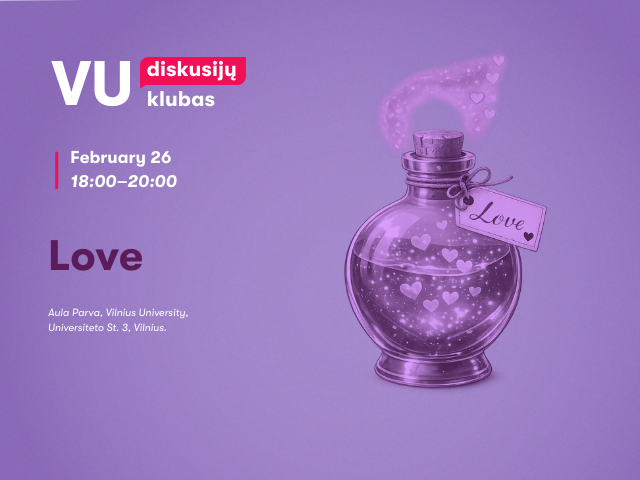
On 26 February at 6:00 PM, the third event of the VU Discussion Club will take place at Aula Parva Hall of Vilnius University (Universiteto g. 3, Vilnius). The event will invite participants to explore love not only as a feeling but also as a complex, multifaceted phenomenon.
Rather than asking “what is love?”, scholars from different fields will examine how it operates – at biological, psychological, cultural, and even mathematical levels.
The Concept of Love Across Different Academic Fields
Prof. Ramunė Grikšienė, a neuroscientist at the VU Life Sciences Center, will discuss the role of hormones in cognitive functions and how biochemical processes influence attachment, the sense of security, and interpersonal bonds. Research suggests that over time, a close person may become a part of our regulatory system – a factor that helps maintain emotional balance.
Prof. Victor Celestine de Munck of the VU Faculty of Philosophy (sociocultural anthropology) will invite participants to view love as a social construct. In different historical periods and communities, what is considered fidelity, passion, or duty takes on different meanings. In this context, love emerges as a culturally shaped relationship influenced by both personal experiences and social norms.
Dr. Vytenis Šumskas from the VU Faculty of Mathematics and Informatics will present a mathematical model of love. Although emotions are often regarded as indefinite and unpredictable, mathematical systems allow us to describe dynamic relationships and their variables. From this perspective, love may be understood as an ever-changing system without a single or final solution.
Assoc. Prof. Vytautas Jurkuvėnas, a researcher in cognitive psychology at the VU Institute of Psychology, will speak about the boundaries of the self and their transformation in relation to another person. The discussion will raise the idea that love can be seen as a form of relationship in which a new identity is born – something that neither of the two individuals possesses separately.
Important Information for Participants
The event is open to everyone; however, advance registration is required by 25 February. The organizers encourage live dialogue; therefore, remote participants will not be able to ask questions. The livestream link will be sent only to registered participants.
Please note that the event will be held in English.
The VU Discussion Club – A Space for Interdisciplinary Encounters
Once a month, the VU Discussion Club invites participants to explore the complex world of science from multiple perspectives. It is a space where representatives of natural sciences, social sciences, and the humanities examine specific phenomena together – seeking not quick answers, but meaningful dialogue. Here, it is not disciplines that meet, but ideas and different ways of thinking – so that through discussion, deeper understanding, growth, and new insights may emerge.
The VU Discussion Club aims to create an open, interdisciplinary space for vibrant academic and public dialogue. What matters most here is not the final answer, but the process of thinking itself: the ability to question, to doubt, and to listen to different perspectives.