

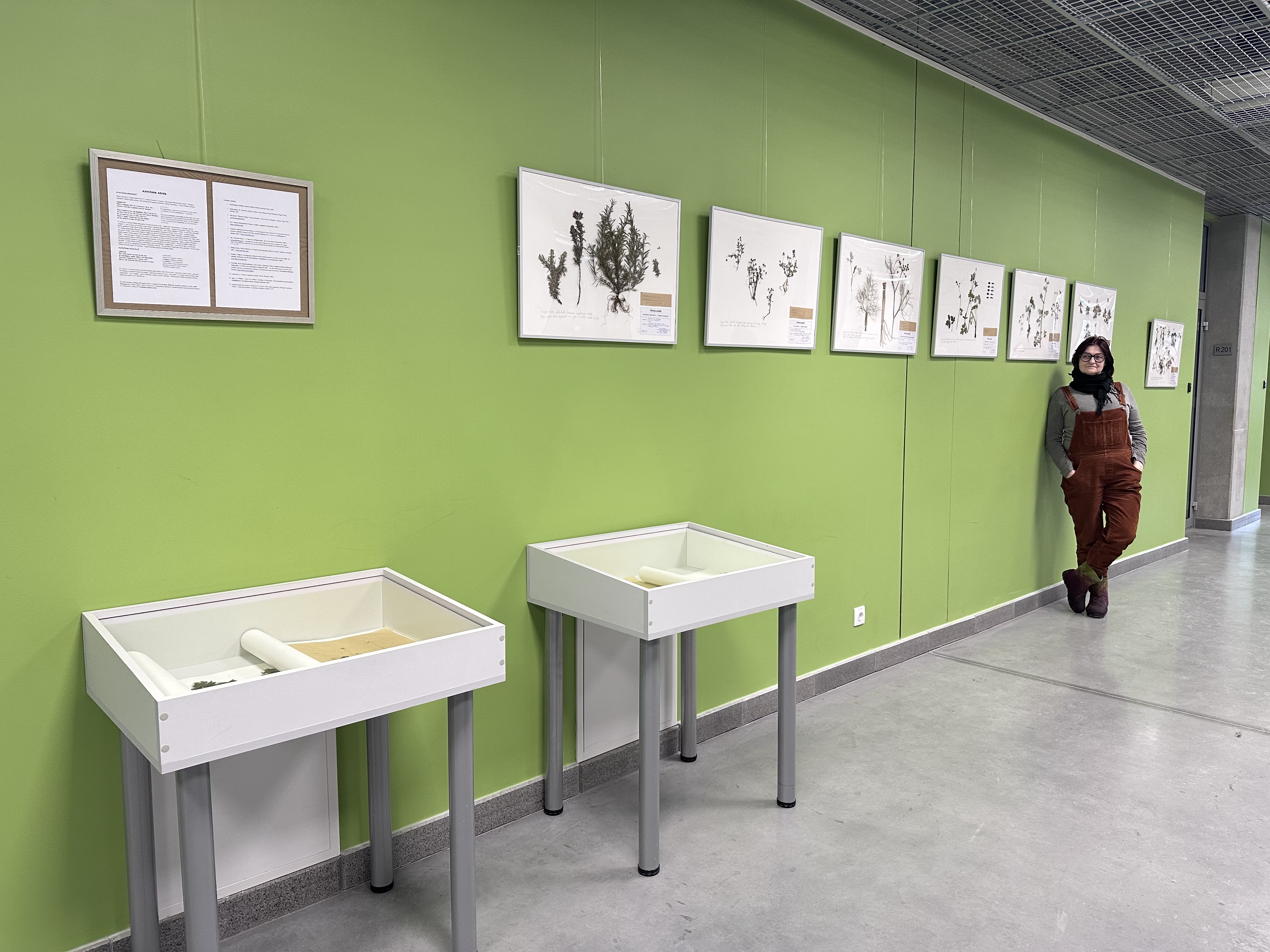
The exhibition Ophelia’s Flowers is on display at the Vilnius University Life Sciences Center, inviting visitors to explore the symbolic meanings of Ophelia’s flowers.
The idea for this seven-plant herbarium arose from the work of television translator Aida Martinaitytė, who has repeatedly encountered Ophelia’s flower scenes from William Shakespeare’s Hamlet while translating dialogue for feature films. Practical difficulties in translating plant names revealed that solutions chosen in different Lithuanian translations do not always correspond to the botanical and symbolic meanings of the original text. This herbarium is based on Alfonsas Nyka-Niliūnas’s Lithuanian translation of Hamlet.
Shakespeare scholars note that the playwright relied on a particular “language of flowers” characteristic of his time: each plant or flower carried a precise symbolic meaning, expressing a specific state, quality, or emotion. This visual language made it possible—without words and with less risk of censorship or punishment—to convey complex feelings and messages: to confess, reject, propose, part, honour, scorn, or even mortally insult someone using only a bouquet of flowers.
For this reason, Ophelia, as she distributes flowers, is not mad. She speaks rationally and with precision—reminding, reproaching, condemning, offending, and lamenting. Each flower she offers constitutes a specific statement, readily understood by Shakespeare’s contemporary audience. Although this scene is often interpreted as an expression of madness, it is not. Ophelia is rational, as is her bouquet.
The collection was prepared, and most of the plants were collected and identified, by Rima Briškaitė, a biologist at the VU Life Sciences Center, who supported Aida Martinaitytė’s idea for the Ophelia’s Flowers herbarium. Sincere thanks are extended to Dr. Mindaugas Rasimavičius, Head of the VU Herbarium, for his support, advice, and assistance in preparing the exhibition.
The exhibition can be viewed on the second floor of the R building at the VU LSC.