

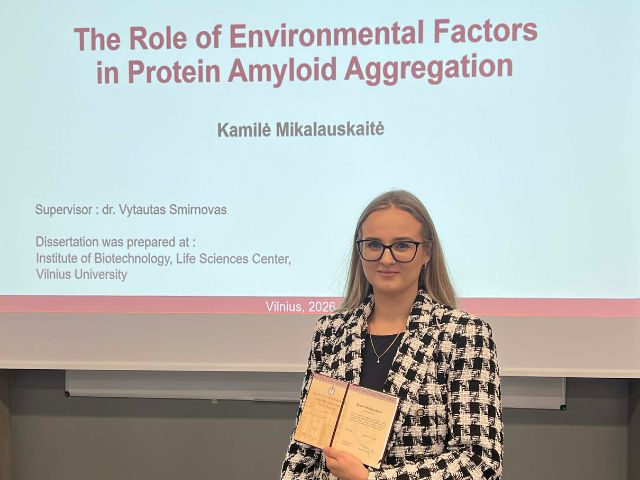
Kamilė Mikalauskaitė defended her thesis entitled "The Role of Environmental Factors in Protein Amyloid Aggregation" for the degree of Doctor of Science in Chemical Engineering.
Scientific supervisor: Dr. Vytautas Smirnovas (Vilnius University, Technological Sciences, Chemical Engineering).
Composition of the Dissertation Defense Board: Chairperson - Prof. Dr. Rolandas Meškys (Vilnius University, Technological Sciences, Chemical Engineering); Dr. Lina Baranauskienė (Vilniaus University, Technological Sciences, Chemical Engineering), Dr. Rima Budvytytė (Vilniaus University, Natural Sciences, Biochemistry), Prof. Dr. Per Hammarström (Linköping University, Sweden, Technological Sciences, Chemical Engineering), Dr. Rebecca Sternke-Hoffmann (Institute of Paul Scherrer, Switzerland, Natural Sciences, Biochemistry,).
Amyloid protein aggregation into fibrillar forms is associated with various neurodegenerative disorders, such as Alzheimer’s disease, Parkinson’s disease, and prion diseases. Despite many years of research in this field, numerous questions regarding the specifics of fibril formation remain unanswered.
This work investigated how environmental factors – such as temperature, pH, ionic strength, and protein–protein interactions – affect the amyloid aggregation of several key proteins, including lysozyme, insulin, alpha-synuclein, and the prion protein. The study analysed the phenomenon of fibril polymorphism, whereby the same protein can form structurally and morphologically distinct aggregates under different or even identical conditions.
A primary focus of this work was the relationship between the initial protein folding state and the structure of the resulting fibrils. Using lysozyme, it was shown that protein unfolding induced by temperature and pH significantly promotes structural variability and the formation of different fibril types. Another part of the study examined the sensitivity of insulin aggregation to small changes in the chemical environment, revealing that its secondary structure and morphology are highly dependent on specific solution components. Finally, the research highlighted the complexity of amyloid protein interactions, demonstrating that interactions with proteins such as SOD1 and S100A9 can inhibit prion protein nucleation and stabilize specific aggregate types.