

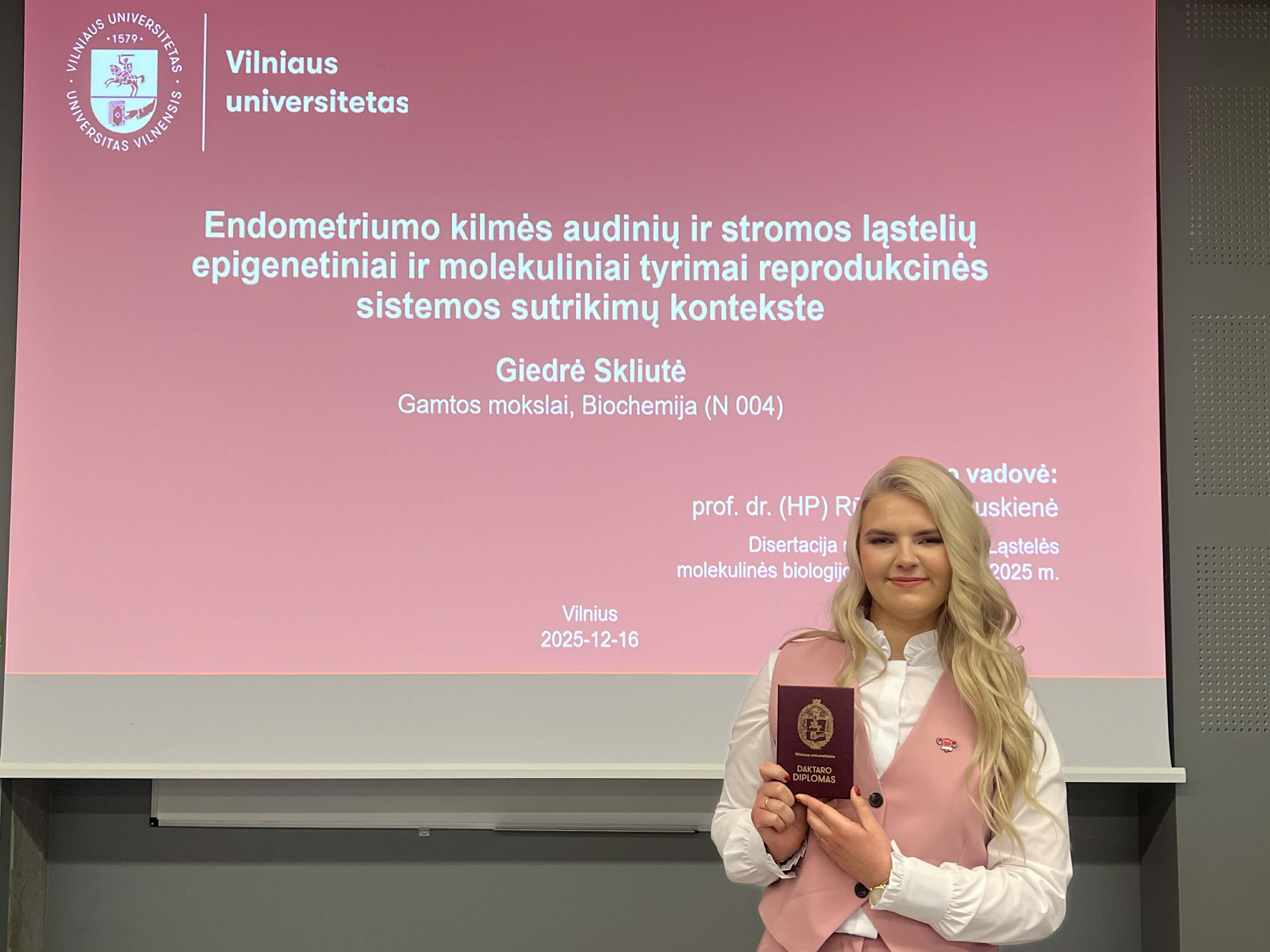
Giedrė Skliutė defended her thesis entitled "Epigenetic and Molecular Studies of Endometrial-Derived Tissues and Stromal Cells in the Context of Reproductive System Disorders" for the degree of Doctor of Science in Biochemistry.
Scientific supervisor: Prof. Dr. Rūta Navakauskienė (Vilnius University, Technological Sciences, Biochemistry).
Composition of the Dissertation Defense Board: Chairperson - Prof. Habil. Dr. Juozas Rimantas Lazutka (Vilnius University, Natural Sciences, Biology); Assoc. Prof. Dr. Violeta Jonušienė (Vilnius University, Natural Sciences, Biochemistry); Dr. Augustas Pivoriūnas (Innovative Medicine Centre, Natural Sciences, Biochemistry); Prof. Dr. Vytautė Starkuvienė-Erfle (Heidelberg University, Germany, Natural Sciences, Biochemistry); Dr. Egidijus Šimoliūnas (Vilnius University, Natural Sciences, Biochemistry).
Fertility disorders affect up to 12% of reproductive-age couples worldwide; however, diagnostic and treatment methods for infertility remain insufficiently studied. Endometrial tissue, as one of the key elements ensuring successful embryo implantation, represents a potential model for investigating the mechanisms of infertility. Endometriosis is diagnosed in one-third of infertile women. Although the disease is common, 60% of patients who experience symptoms characteristic of endometriosis remain undiagnosed, and the time from symptom onset to a definitive diagnosis can be as long as 11 years.
The aim of this dissertation was to investigate molecular and epigenetic differences in tissues of the female reproductive system and in stromal cells associated with reproductive disorders. The conducted studies revealed differences in the expression of molecules essential for receptivity in endometrial tissues of healthy women and women with pathologies, as well as in stromal cells and extracellular vesicles isolated from these tissues. We demonstrated that in the endometrium of women with reproductive disorders, the expression of miR-34a-3p, miR-125b-5p, and miR-223-5p is significantly reduced. In contrast, the expression of genes encoding pro-inflammatory factors (CSF2 and RELA), the pro-angiogenic gene PDGFA, and genes necessary for implantation and decidualization (MUC1 and HAND2) is increased. Specific differentially expressed miRNAs and proteins were identified in extracellular vesicles from endometriosis lesions and ovarian endometrioma tissues, which could serve as potential biomarkers of endometriosis, pending validation of their reliability.